Finding the perfect balance between plush comfort and reliable support often feels impossible. Buyers frequently assume a thicker cushion guarantees a better sitting experience. However, sheer volume rarely tells the whole story.
Selecting an incorrectly sized cushion creates immediate physical drawbacks. A pad too thick can leave your feet dangling, cutting off blood circulation to your lower legs. Conversely, a pad lacking proper density will quickly bottom out, forcing you to sit directly on a hard surface. This rapid degradation ruins your posture and causes ongoing discomfort.
This guide provides a strictly evidence-based framework for evaluating cushions. You will learn how to match dimensions to specific furniture applications effortlessly. We will explore foam science and physical requirements so you can accurately determine the exact support profile you need.
Key Takeaways
- Thickness is irrelevant without sufficient material density and firmness (ILD rating).
- Ideal thickness varies strictly by furniture type: 2–3 inches for dining/office chairs, 3–4 inches for benches, and 4–6+ inches for couches and deep patio seating.
- Higher body weight requires increased firmness rather than just added thickness to prevent sinking and spinal misalignment.
- Construction details, such as Dacron wrapping, add loft (visual thickness) but do not contribute to core structural support.
1. The "Thickness Illusion": Evaluating Density and Firmness (ILD)
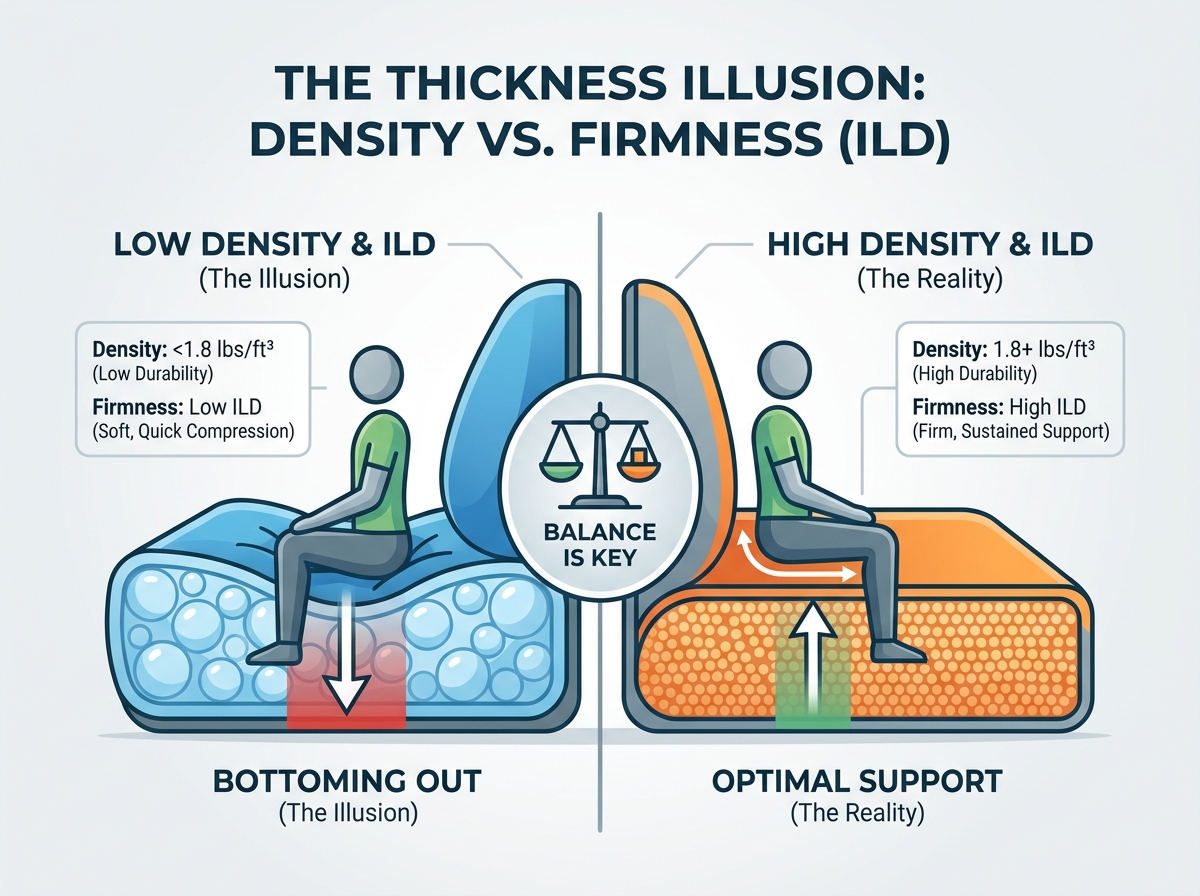
Consumers consistently make a critical error when shopping for seating accessories. Buyers often correlate thickness directly with comfort. They assume a massive five-inch block of foam will feel better than a modest three-inch alternative. This assumption completely ignores the internal physics of the material. A five-inch low-density pad will compress much faster than a thinner, high-density counterpart. It will ultimately offer far less support over time.
Evaluation Criteria: Density vs. Firmness
To avoid the thickness illusion, you must understand two distinct metrics used in the upholstery and foam industries. These metrics dictate how a product performs under human weight.
- Density (Durability): Manufacturers measure density in pounds per cubic foot. This metric dictates how long the Seat Cushion Pad will last before it loses its original shape. It reveals the actual amount of material packed into the foam block. A higher density means less empty air inside the cellular structure. For standard daily use, you should look for a minimum benchmark of 1.8 pounds per cubic foot. Anything lower will break down rapidly.
- Indentation Load Deflection (ILD/Firmness): This metric measures the exact force required to compress the foam by 25 percent. ILD determines the actual "sit feel" and structural support. A high ILD means the cushion feels firm and resists your body weight. A low ILD means it feels soft and yields quickly. You can have high-density foam with a low ILD, or low-density foam with a high ILD. They operate independently.
Adoption Risk: The Bottoming Out Effect
Purchasing a very thick pad possessing a low ILD leads directly to the "bottoming out" effect. When you sit down, the soft foam compresses entirely. Within just a few weeks of purchase, the cellular structure collapses. The user ends up feeling the hard wooden or metal surface beneath the pad. You paid for five inches of thickness, but you only experience half an inch of actual support.
Applying a Skeptical Lens
Always maintain strict skepticism when reviewing product descriptions. Avoid manufacturers who heavily highlight extreme thickness but refuse to publish standard density or ILD specifications. If a brand only advertises "extra thick" or "ultra plush" terminology, they usually hide inferior materials. Reputable brands gladly share their core metrics because they know educated buyers demand them.
2. Shortlisting Logic: Ideal Thickness by Furniture Type
The optimal thickness of a Seat Cushion Pad depends entirely on existing furniture dimensions. You cannot buy a universal size and expect it to work everywhere. The existing seat height and depth strictly dictate your solution categories.
Dining and Office Chairs (2 to 3 Inches)
Most standard dining and office chairs sit roughly 17 to 18 inches off the floor. Adding a massive cushion alters this critical ergonomic geometry.
- Success Criteria: The pad must provide essential tailbone relief without raising your thighs too high. If you choose a thick pad, your feet will lose flat contact with the floor. Additionally, your legs might hit the underside of your desk or dining table. A strict two to three-inch profile prevents these posture disasters while delivering necessary comfort.
Window Seats and Benches (3 to 4 Inches)
Built-in window seats and wooden entryway benches require a slightly different approach. These surfaces usually lack any built-in give or suspension.
- Success Criteria: Your choice here must balance visual proportionality with sustained comfort for medium-duration sitting. A two-inch pad often looks too thin and insubstantial on a large wooden bench. A three to four-inch profile accommodates standard wood or concrete bases perfectly. It looks visually substantial while providing enough material to absorb shock.
Couches and Deep Patio Seating (4 to 6+ Inches)
Outdoor lounging furniture and deep indoor sofas feature significantly lower base frames. Manufacturers design them specifically to accommodate massive amounts of upholstery.
- Success Criteria: Extended lounging requires deep compression support. You need four to six inches of high-quality foam to absorb your body weight over several hours. Manufacturers often pair the core foam alongside a Dacron wrap. This specialized wrap provides a crowned, plush look. It fills out the fabric cover beautifully while protecting the core foam from friction.
| Furniture Category | Recommended Thickness | Primary Application Profile | Ergonomic Goal |
| Dining & Office Chairs | 2 - 3 Inches | Standard height frames, task seating. | Keep feet flat on the floor; clear table underside. |
| Window Seats & Benches | 3 - 4 Inches | Hard wood or concrete bases. | Balance visual weight; provide medium-term relief. |
| Couches & Deep Patio Seating | 4 - 6+ Inches | Low-slung frames built for lounging. | Deep compression support; prolonged pressure relief. |
![Ideal thickness for a seat cushion pad based on furniture type]()
3. Ergonomic and Health Considerations for Your Seat Cushion Pad
Evaluating physical health outcomes remains just as critical as assessing foam metrics. You must link specific product features directly to the physical outcomes they produce. Choosing the wrong dimensions causes hidden strains across your musculoskeletal system.
Evaluation Dimensions (Features-to-Outcomes)
Consider how cushioning interacts with human anatomy. Two major areas require strict attention during your evaluation process.
Sciatica & Tailbone Pressure
Your pelvic bone handles immense pressure during seated activities. A cushion strictly failing to distribute weight causes immediate tailbone pain. If the pad is too thin, localized pressure spikes occur at the ischial tuberosities (your sit bones). Conversely, a cushion appearing too thick and soft causes your pelvis to tilt backward. This unnatural tilt flattens your lower back curve, worsening lumbar strain and aggravating sciatic nerves.
Circulation and Blood Flow
The front edge of your seat plays a massive role in vascular health. The seat edge must never compress the back of your thighs. Adding an oversized four-inch pad to a standard office chair frequently creates this specific risk. It raises your legs just enough to let gravity pull them down against the foam edge. This pinches major blood vessels, leading to numbness, tingling, and deep vein thrombosis risks.
Weight as a Variable
Body weight drastically alters how foam performs in real-world scenarios. Standard sizing charts often assume an average weight of 150 to 170 pounds.
Heavy-duty support requires shifting the entire evaluation away from "thicker" toward "firmer." If you weigh over 200 pounds, a standard medium-firm pad will bottom out regardless of its thickness. Users in this category should seek high-resilience (HR) foams possessing a higher ILD rating. You will achieve better spinal alignment using a firm three to four-inch pad rather than jumping blindly to six inches of standard, unsupportive memory foam.
4. Material Impact on Thickness Requirements
The interior material you select directly dictates how much thickness you actually need. Different chemical compositions behave differently under body heat and sustained pressure. Understanding these material realities helps you avoid buying unnecessary bulk.
Solution Approaches & Material Realities
- Standard Memory Foam: This material reacts heavily to body heat. It softens and compresses significantly as you sit on it. Because it yields so much, you require more initial thickness to maintain ergonomic support. Alternatively, it requires a high-density base layer underneath it. Without sufficient volume, standard memory foam provides zero structural resistance.
- High-Density Polyurethane (HD Foam): Traditional polyurethane offers rigid, reliable support. It pushes back against your body weight immediately. Because it does not melt under body heat, it achieves proper pressure relief at much lower thicknesses. A high-quality HD foam performs beautifully at just two to three inches.
- Gel and Silicone Grids: Modern grid technologies utilize specialized buckling columns. Engineers design them to collapse only under specific pressure points, like the tailbone, while remaining firm everywhere else. They rely strictly on geometric structure rather than mass. Therefore, they prove highly effective at very thin profiles, usually ranging from 1.5 to 2.5 inches.
Implementation Reality: Dual-Layer Constructions
When searching for a high-performance Seat Cushion Pad, be acutely aware of dual-layer constructions. Smart manufacturers combine materials to maximize efficiency. They often glue a very firm HD foam base beneath a soft memory foam topper. This dual-layer strategy delivers the initial plushness of memory foam while relying on the rigid base to prevent bottoming out. It maximizes the ergonomic efficiency of a three-inch profile without forcing you to deal with the cumbersome bulk of a five-inch block.
5. Pre-Purchase Implementation: Measuring and Sizing Accurately
You cannot estimate dimensions by eye. Accurate measurement prevents the costly mistake of buying a poorly fitted product. Implementing a strict measuring protocol ensures your final purchase aligns perfectly with your furniture.
Implementation Considerations & Actions
Measuring the Base Properly
You must capture the exact geometry of your chair. First, measure the edge-to-edge width across the front of the seat. Next, measure the front-to-back depth. Many chairs feature tapered designs. For curved or tapered backs, you must measure both the widest point at the front and the narrowest point near the rear uprights. Record these numbers precisely.
Calculating Final Seat Height
You must factor in the total seated height to ensure proper ergonomics. Standard dining seat height hovers around 18 inches from the floor. First, measure the distance from the floor to the bare chair base. Next, add the *compressed* thickness of your chosen pad. Do not add the uncompressed number. A standard foam pad compresses by about an inch under weight. Add this compressed value to your floor-to-base measurement. Ensure the final number stays near the 18 to 19-inch ergonomic sweet spot.
Cover Allowances and Tension
Fabric choices alter the final physical dimensions. You must account for seam styles like piping or welting. Tight fabric tension naturally compresses the foam edges. Heavy canvas or outdoor acrylic covers can squeeze the perimeter foam by up to 0.25 inches. If you want a perfectly flush fit, you might need to order the internal foam slightly larger than the cover to ensure it fills out the corners completely.
Conclusion
Choosing the ideal seat pad thickness requires a systematic approach rather than guesswork. You must match the physical thickness directly to the specific furniture application you intend to use. Prioritize verifying the internal foam density and firmness over simply buying the thickest option available. Finally, always calculate your total seated height to guarantee your feet remain flat and your posture stays healthy.
Before you browse another product page, grab a tape measure. Check your current chair base height and evaluate your floor clearance. Armed with accurate measurements and an understanding of foam mechanics, you can confidently finalize your selection and permanently upgrade your daily comfort.
FAQ
Q: Is a thicker seat cushion pad always better for back pain?
A: No. Excessive thickness can elevate the hips too high, misaligning the lumbar spine and causing your feet to dangle. Firmness and proper pressure distribution are far more critical than sheer thickness for resolving back pain.
Q: How much does a foam cushion compress when sitting on it?
A: Depending on the specific ILD rating, a standard medium-firm cushion will compress by roughly 20 to 30 percent of its total thickness under average adult body weight.
Q: Should outdoor patio cushions be thicker than indoor cushions?
A: Generally, yes. Outdoor deep-seating furniture frames are built lower to the ground. Manufacturers design them specifically to accommodate four to six-inch thick cushions required for prolonged lounging.