Picture yourself swaying gently in the afternoon breeze, completely relaxed. A hanging chair offers undeniable aesthetic appeal for any patio, balcony, or backyard retreat. However, buyers often face a massive gap between visual charm and actual outdoor longevity. Many budget options mimic a tropical aesthetic but fail quickly under UV exposure, humidity, or regular structural stress. You might purchase a beautiful seat only to watch the cords rot or fade within a single summer season.
Defining a successful purchase means balancing ergonomic support, verifiable load-bearing safety, and climate-appropriate materials. To avoid common traps, you need to understand what makes these products truly durable. We will explore how to evaluate fabrics, assess space requirements, and ensure a secure installation for long-lasting comfort. You will learn how to bypass weak anchor points and select the optimal design for your unique outdoor space.
Key Takeaways
- Material selection dictates lifespan: Spun polyester outperforms cotton in uncovered outdoor environments.
- Safe installation requires verifiable load-bearing hardware and precise overhead clearance.
- Spreader bar designs offer different ergonomic outcomes and spatial requirements compared to traditional sling styles.
- Evaluating weight capacity claims requires looking at the weakest link: the hardware, the weave, or the mounting point.
Evaluating Caribbean Hammock Chair Materials for Outdoor Durability
The fabric you select ultimately dictates how long your purchase will survive outdoor elements. Buyers frequently make the mistake of prioritizing color patterns over fiber composition. You must weigh ergonomic comfort against long-term weather exposure.
When comparing cotton and spun polyester, the differences become stark. Cotton offers superior breathability and immediate comfort. It feels incredibly soft against bare skin on a hot day. However, cotton is highly susceptible to mold and rot. Frequent rain ruins untreated cotton fibers very quickly. Organic materials hold moisture, creating a perfect breeding ground for mildew. You should reserve cotton models exclusively for covered porches, sunrooms, or indoor spaces. If a cotton model gets wet, you must dry it immediately to prevent degradation.
Conversely, spun polyester serves as the gold standard for true outdoor exposure. Manufacturers engineer this synthetic material for maximum UV and mildew resistance. High-quality spun polyester effectively mimics the soft feel of cotton without absorbing excessive moisture. It repels water and dries rapidly after a rainstorm, resisting photodegradation from intense sunlight. If you plan to leave your furniture outside permanently, spun polyester is strictly mandatory for longevity.
Beyond the raw material, pay close attention to weave density and cord thickness. How a seat distributes your body weight depends heavily on its construction. A tighter micro-weave distributes body weight more evenly across hundreds of individual cords. This dense construction prevents painful pressure points from forming on your back or legs. Dense weaves also extend overall fabric life by drastically reducing the strain on any single cord. Loose weaves, while cheaper to manufacture, tend to stretch out of shape and fray faster under daily use.
Finally, examine spreader bar integrity. A quality Caribbean hammock chair relies on strong, rigid wood to maintain its shape. Choose dense hardwoods like oak or finished bamboo. Avoid cheap, untreated softwoods that splinter easily under tension. Assess the wood for marine-grade varnish applications, such as spar urethane. Marine varnish expands and contracts alongside temperature changes. It provides essential waterproofing and prevents the wood from warping over time.
Assessing Space Requirements and Load-Bearing Capacity
Before finalizing any purchase, evaluate your physical space meticulously. Hanging furniture requires a specific dimensional footprint to function safely. A common mistake involves squeezing a large seat into a cramped corner, rendering it unusable.
Start by calculating your necessary overhead clearance. Industry safety standards suggest a minimum height of seven feet from the floor to the ceiling mounting point. Anything lower will force your feet uncomfortably against the ground, ruining the floating sensation. You also need to calculate your 360-degree swing radius. Allow at least three feet of empty clearance radiating outward from the center anchor. This buffer zone prevents dangerous wall or railing collisions while swinging. It also protects nearby windows from accidental impacts.
Manufacturers often advertise exceptionally high weight limits on their packaging. However, decoding these claims requires healthy skepticism. A 300+ lb capacity rating on the woven fabric is entirely irrelevant if your mounting hardware pulls out of the ceiling at 150 lbs. Always evaluate the weakest link in your setup. The ceiling anchor point, the suspension hardware, and the fabric weave must all meet your maximum load requirement. A single weak carabiner compromises the entire system.
Mounting Method Comparison
| Mounting Type | Pros | Cons | Best Application |
| Freestanding C-Stand | High flexibility, easily movable, requires zero drilling | Consumes a much larger ground footprint, can be bulky | Renters, open patios, individuals who move frequently |
| Ceiling or Beam Mount | Saves valuable ground space, provides a cleaner aesthetic | Requires strict structural validation, permanent placement | Covered porches, pergolas, permanent home installations |
You must decide between using a standalone base and pursuing structural mounting. A freestanding C-stand offers unmatched flexibility. You can chase the sun across your patio or move it indoors during storms without leaving holes in your ceiling. The trade-off is the large steel base taking up valuable floor space. Ceiling mounting saves space and looks highly integrated but requires you to locate a structurally sound beam and commit to a permanent location.
![Caribbean hammock chair setup on a sunny patio]()
Comfort Ergonomics: Spreader Bars vs. Traditional Slings
Design deeply shapes your daily lounging experience. The two primary styles offer entirely different ergonomic outcomes and spatial requirements. Understanding how you intend to use the seat will guide your decision.
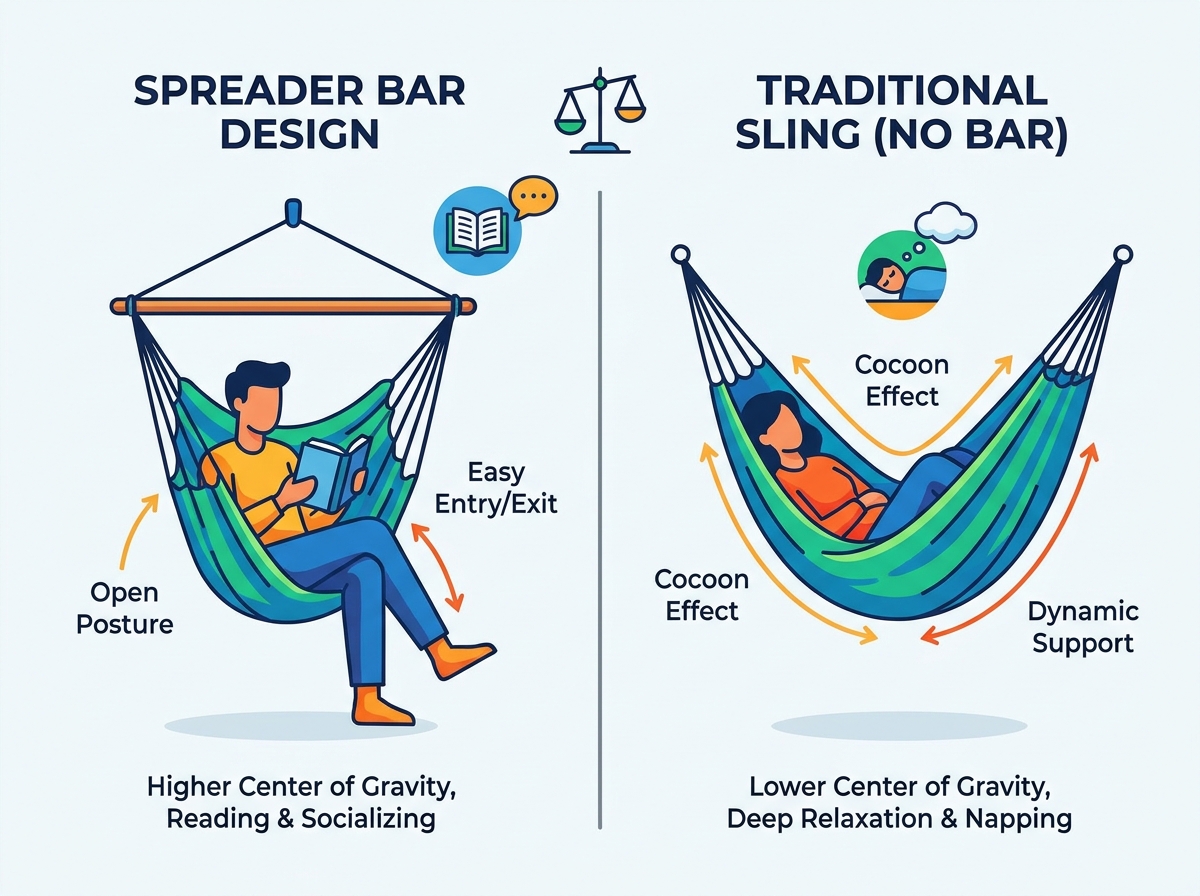
The spreader bar design utilizes a wooden beam to keep the fabric open at all times. This rigid structure allows effortless entry and exit. It provides a wider, flatter seating posture. Because the fabric does not collapse inward against your shoulders, you enjoy a broad field of view. Many users find this open posture ideal for reading, working on a laptop, drinking coffee, or socializing with guests.
A notable risk exists with this design. The rigid spreader bar inherently creates a higher center of gravity. It is noticeably more prone to tipping if you shift your weight abruptly or lean too far forward. Users must sit down smoothly to maintain balance.
In contrast, the traditional sling operates completely without a wooden bar. When you sit down, the fabric cocoons you entirely. The woven cords adapt dynamically to your unique spine curvature, providing targeted lumbar support without rigid boundaries. It feels highly supportive and isolating, making it ideal for deep relaxation or afternoon napping.
The primary risk here is spatial restriction. The enveloping cocoon effect can feel overly restrictive to some users. Larger individuals, or those struggling with limited mobility, might find it physically difficult to stand up and exit the sling because the fabric wraps tightly around their body weight.
Installation Realities and Structural Safety
Proper installation guarantees your physical safety. Never rush the mounting process or guess about structural integrity. A falling accident causes severe injuries and property damage.
Anchor point verification remains your absolute top priority. You must anchor mounting hardware directly into solid wood joists. Industry professionals require joists measuring a minimum of 2x6 inches to safely support dynamic human weight. Load-bearing structural beams also provide an excellent foundation. Use a high-quality magnetic stud finder to locate the exact center of the joist.
There are strict warnings you must heed. Never mount suspension hardware to drywall. Drywall possesses zero structural pull-out strength; it will immediately fail. Do not hang hardware from drop ceilings, decorative pergolas, or compromised tree branches. Always inspect a tree branch for rot, disease, or insect damage before trusting it with human weight.
Hardware compliance dictates the long-term safety of your setup. Mandate the use of heavy-duty, rust-resistant components. Stainless steel or zinc-plated hardware performs best outdoors, resisting oxidation from rain and humidity.
Here are the critical components for a safe ceiling installation:
- A heavy-duty lag eye screw (minimum 3/8 inch diameter) driven fully into the joist center. Always drill a pilot hole slightly smaller than the threads to prevent the wood from splitting.
- A marine-grade S-hook to connect the eye screw to the suspension system.
- A heavy-duty spring carabiner featuring a screw-lock mechanism to prevent accidental detachment during swinging.
- A strong extension chain if your ceiling exceeds eight feet in height, allowing you to lower the seat to an ergonomic height.
Do not overlook the shock absorption factor. Integrating a heavy-duty extension spring between the mounting point and the seat is critical for safety. Every time you sit down, you generate dynamic force. A steel spring absorbs this sudden kinetic motion. It significantly reduces sheer stress on the ceiling joist and prevents fabric cords from snapping. A spring transforms a harsh, rigid hang into a gentle, floating experience.
Maintenance, Storage, and Long-Term Value
Routine care actively protects your outdoor investment. Even the most rugged materials require occasional maintenance to look their best and function safely.
Establish a strict routine care protocol. Spot-clean the framework and fabric weaves as soon as dirt, bird droppings, or pollen appear. Use lukewarm water mixed with mild soap for both polyester and cotton weaves. Scrub gently using a soft-bristle brush. You must avoid harsh detergents completely. Abrasive chemicals actively strip protective UV coatings from polyester fibers. Bleach destroys cotton instantly, compromising its tensile strength. Strong cleaners also degrade the marine varnish protecting the wooden spreader bars.
Winterization and proper storage define long-term product longevity. The impact of off-season storage cannot be overstated. Even products labeled "all-weather" should be brought indoors during freezing conditions. If rain permeates the cords and freezes overnight, ice crystals expand inside the threads. This microscopic expansion causes severe fiber brittleness. Over a few winters, this freezing cycle destroys the tensile strength of the weave, causing unexpected snapping. Store your seat and metal hardware in a dry garage or closet to prevent rust and fiber degradation.
Analyze the cost versus lifespan metric when shopping. Spending $100 or more on weather-graded spun polyester and marine-varnished hardwood yields a multi-year lifespan. Conversely, replacing a $40 inferior model annually wastes money, time, and environmental resources. Investing in premium, climate-appropriate materials ensures structural safety and visual appeal year after year. A slightly higher upfront cost guarantees a reliable, durable product.
Conclusion
Selecting the ideal hanging furniture requires smart shortlisting logic. First, match your material to your local climate conditions. Reserve delicate cotton weaves for covered, dry areas where moisture is not an issue. Choose durable spun polyester for uncovered, high-sun spaces to resist mildew and UV damage. Next, align the physical design to your primary use-case. Choose a spreader bar design for active, upright lounging, reading, and socializing. Select a traditional sling if you prefer enveloping cocoon comfort for napping.
Before finalizing a purchase, execute a few concrete next-step actions. Verify your structural mounting points first. Use a stud finder to confirm you have access to solid 2x6 joists. Measure your available overhead clearance to ensure a safe swing radius, leaving three feet of empty space surrounding the intended anchor. If you cannot safely drill into a solid joist, immediately pivot your strategy and budget for an accompanying C-stand. Taking these precautions ensures your outdoor space remains comfortable, beautiful, and safe.
FAQ
Q: Can a Caribbean hammock chair be left outside in the rain?
A: It depends entirely on the fabric. Spun polyester survives rain well and dries quickly, though continuous exposure will eventually degrade it. Cotton models absorb water rapidly and will quickly develop mold or structural rot. You must bring cotton chairs inside during inclement weather to prevent permanent damage.
Q: What is the minimum ceiling height required for installation?
A: Industry standards dictate a minimum ceiling height of 7 to 7.5 feet. This measurement accounts for mounting hardware, an extension spring, the chair's overall length, and fabric stretch once loaded. Insufficient height forces your legs uncomfortably against the floor, ruining the floating experience.
Q: How do I safely wash the woven fabric?
A: Hand wash the fabric in a bathtub using lukewarm water and a mild, non-detergent soap. Gently agitate the cords to remove embedded dirt. Rinse thoroughly with clean water. Hang it outside to air dry completely. Never use a washing machine or tumble dryer, as extreme agitation destroys woven cords.