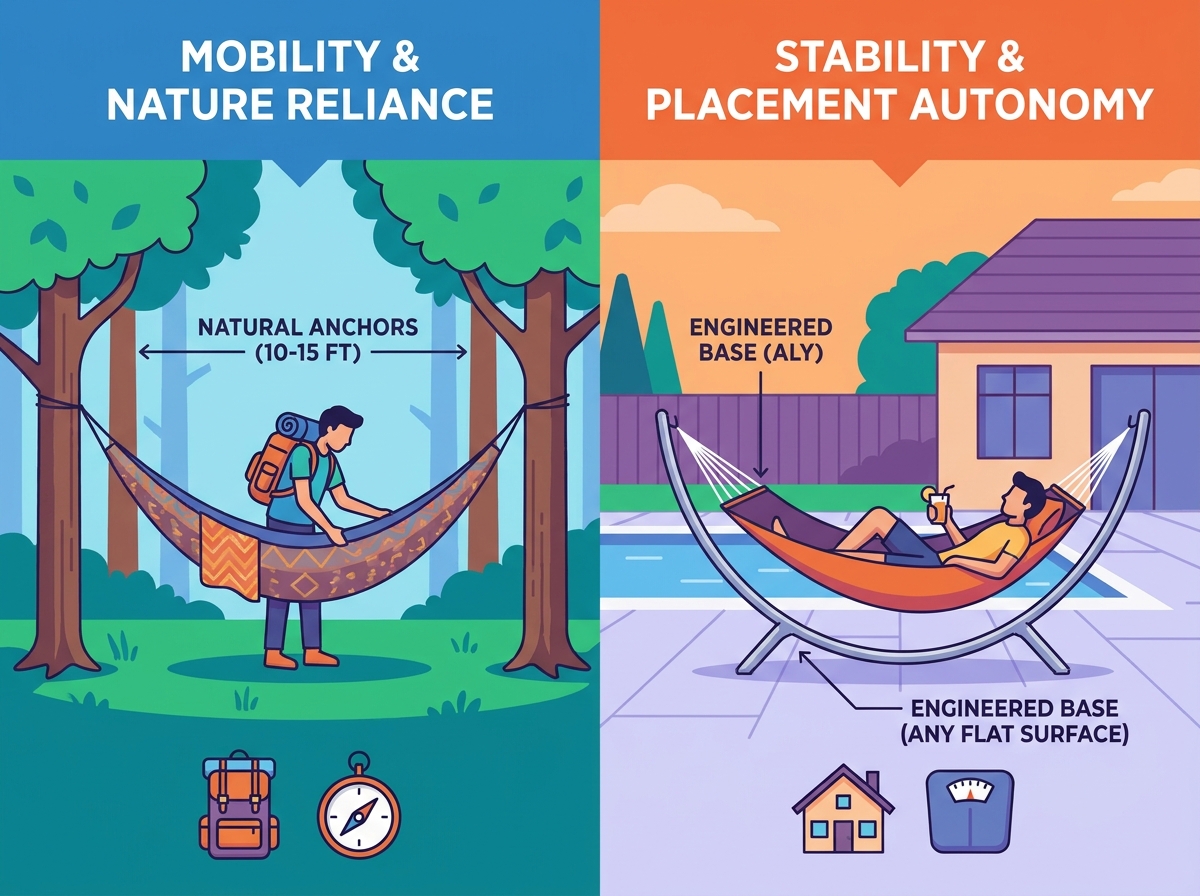
You are ready to invest in outdoor relaxation. However, a major structural question stands in your way. Do you rely on nature to support your setup, or do you bring your own framework? Making this choice defines your entire lounging experience. Many buyers stall at this stage. They misunderstand how their physical environment dictates product performance. Purchasing the wrong suspension method often leads to damaged property. It can also cause unused gear or unsafe hanging angles. These issues matter immensely. Safety and convenience are paramount when suspending your body weight above the ground. This guide provides an objective evaluation of both suspension methods. We will examine structural reliability, environmental constraints, and ongoing maintenance requirements. You will learn exactly how to match the right support system to your specific outdoor lifestyle.
Mobility vs. Stability: Traditional suspension hammocks win on portability (often under 2 lbs), while stands offer predictable static load capacity at the expense of mobility (often 25–50+ lbs).
Hidden costs: No-stand hammocks frequently require aftermarket suspension upgrades (tree-safe straps), whereas stands require winterization or protective covers to mitigate rust and material fatigue.
Defining Your Use Case: Environmental Constraints and Success Criteria
Before selecting an Outdoor hammock, you must thoroughly evaluate your physical space. A successful lounging experience depends entirely on matching the hardware to the surrounding environment. Consider these three foundational criteria before making any purchasing decisions.
The Baseline Requirement: Identify your primary usage zone. Are you dealing with an HOA-regulated patio, dense woodland camping, or an open sandy beach? Each zone imposes distinct rules. HOA guidelines might restrict permanent fixtures on balconies. Woodland areas require durable materials to withstand sap and moisture. Open beaches lack natural vertical structures completely. You must clearly define where the equipment will live most of the time.
Anchor Point Availability: Evaluate your intended space for natural, structurally sound anchors. Mature trees need a minimum six-inch diameter to hold human weight safely. If you plan to use architectural posts, they require careful inspection. Pergolas and standard deck beams handle vertical compression well. However, they often fail under dynamic horizontal loads. Lateral stress can easily snap standard four-by-four wooden posts. Ensure your architectural anchors are reinforced for side-pulling forces.
Permanent vs. Transient Setup: Decide whether your setup will remain deployed all season or be packed away daily. Permanent setups require weather-resistant materials to survive UV exposure and rain. Transient setups demand quick, hassle-free deployment mechanisms. If you hate tying knots or unhooking heavy chains, a transient setup needs highly efficient hardware. You need to be honest about your willingness to perform daily setup routines.
Traditional Suspension (No Stand): Agility and Environment Reliance
This traditional method strips away excess bulk. It relies primarily on webbing straps, carabiners, and the structural integrity of natural anchors. When executed correctly, it offers immense freedom. However, it demands a solid understanding of basic physics and environmental stewardship.
Primary Advantages
High portability: These systems boast a minimal storage footprint. You can easily stuff them into a small backpack or beach tote.
Lower initial cost: Without a massive metal or wooden base, the upfront purchase price drops significantly. You pay strictly for the fabric and basic suspension hardware.
Customizable hang angles: You can achieve the standard 30-degree suspension angle effortlessly. This specific angle provides optimal weight distribution. It flattens the sleeping surface, making lounging far more comfortable.
Implementation Realities & Risks
Leave No Trace compliance: Responsible outdoor recreation requires 1-inch to 1.5-inch wide tree straps. These wide straps prevent bark damage. Thin ropes are a massive liability. They cut directly into the tree, destroying the cambium layer and eventually killing it.
Setup friction: You face the challenge of finding trees spaced exactly 10 to 15 feet apart. You must also scan the canopy above. Avoiding dead or compromised branches, often called widow-makers, is vital for your physical safety.
Dynamic stress: Anchors must handle sheer forces much higher than your static weight. The suspension geometry multiplies the load applied to the anchor points. A tightly strung setup pulled nearly horizontal creates extreme tension. A 200-pound person can easily exert over 1,000 pounds of force on the anchor if the hang angle is too shallow.
Freestanding Architecture (With Stand): Predictability and Placement
Engineered bases remove the unpredictability of nature. They utilize tubular steel, powder-coated aluminum, or treated wood to provide self-contained suspension points. This architecture transforms any flat surface into a viable relaxation zone. It brings structure and predictability to your outdoor living space.
Primary Advantages
Zero reliance on the environment: You can deploy them on concrete patios, artificial grass, or composite decking. You never need to hunt for perfectly spaced trees again.
Predictable weight capacities: Manufacturers rigorously test these frames. Most units safely hold 400 to 450+ lbs. You know exactly what the structure can handle before sitting down.
Eliminates the learning curve: You skip the hassle of tying complex knots. You also avoid manually calculating suspension sag. Most frames feature simple hook-and-chain adjustments for instant use.
Implementation Realities & Risks
Material degradation: Steel frames are highly prone to rust at joint connections if left in the rain. Powder coating eventually scratches, inviting moisture inward. Wooden frames demand significant upkeep. They require annual sealing or varnishing to prevent dry rot and splintering.
Footprint consumption: Most frames require 9 to 15 feet of linear clearance. They dominate small patios easily. A massive wooden arc can overwhelm a modest deck, leaving little room for other furniture or foot traffic.
Portability limits: Disassembly is often a cumbersome process involving bolts and heavy segments. This drastically limits use to a single property. You will rarely pack a steel frame for a weekend camping trip due to its sheer bulk.
Head-to-Head Evaluation Dimensions
To make an informed decision, you must compare these systems across three critical dimensions. Aesthetics alone should never drive this purchase. You must weigh the financial implications, safety factors, and space constraints carefully.
Table 1: Comparative Analysis of Suspension Methods
Evaluation Dimension
Traditional Suspension (No Stand)
Freestanding Architecture (With Stand)
Cost Requirements
Low initial cost. May require accessory purchases like bug nets, specialized straps, or rain flies.
Higher upfront cost. Potential ongoing maintenance costs for protective covers or rust treatments.
Safety & Load Ratings
Risk relies on tree or post failure. Setup geometry dictates actual tension forces on anchors.
Risk relies on joint failure under dynamic swinging. Some frames may tip if you swing too aggressively.
Space Scalability
Easily accommodates multi-person loads if trees are robust. Does not clutter ground space.
Strictly limited by the engineered weight rating. Bulky footprint dominates tight spaces.
Cost Factors
You face a trade-off between upfront investment and long-term accessories. Traditional setups feature very low entry prices. However, you might spend extra on wide tree-saver straps or insect netting. Stand setups require a much higher initial investment. Furthermore, you must purchase protective weather covers to prevent rust or wood rot. Maintenance supplies add up over the years.
Safety and Load Ratings
Evaluate the unique risks associated with each method. A tree-anchored setup risks catastrophic failure if you choose a weak branch or rotted post. You must inspect anchors diligently. Conversely, an engineered base mitigates anchor failure but introduces tipping hazards. If you generate too much lateral momentum while swinging, a lightweight metal frame can tip over. You must respect the static load limits provided by the manufacturer.
Space Scalability
Consider how easily the setup accommodates double configurations or multi-person loads. Solid oak trees handle massive weight without compromising structural integrity. You can easily upgrade to a larger fabric bed. Engineered bases often max out at their factory-rated limits. If you try to squeeze two adults into a frame designed for one, you risk bending the tubular steel. Frames also consume physical floor space, which restricts how you use your patio.
Shortlisting Logic: Making Your Final Selection
By now, your specific lifestyle needs should point toward a clear winner. If you remain undecided, apply this straightforward shortlisting logic to finalize your choice. The best Outdoor hammock seamlessly integrates into your daily routines.
Choose a No-Stand Setup if: You prioritize hiking and camping adventures. You possess mature trees spaced 10–15 feet apart on your property. You want to store your gear in a small, compact bag when not in active use. This option suits minimalist outdoorsmen perfectly.
Choose a Stand Setup if: You lack mature trees entirely. You intend to use the gear on a concrete pool deck or open lawn. You prefer a permanent seasonal fixture for daily lounging. You also have adequate indoor storage space in a garage or shed to winterize the bulky frame.
Hybrid consideration: You might consider utilizing a portable, collapsible base for car camping or RV use. This approach bridges the gap between both methods. It provides structural independence while retaining some mobility. However, you must acknowledge the significant weight tradeoffs. Collapsible metal bases still weigh significantly more than nylon straps.
Conclusion
Your lounging experience is only as reliable as your chosen anchor system. Ensure you trust the structure holding you.
Match the product design directly to the realities of your physical space rather than just aesthetic preferences. Function must precede form.
Measure your intended patio space carefully before ordering a large metal frame to avoid overcrowding your deck.
Inspect your backyard trees for disease or insufficient diameter before committing to a traditional suspension setup. Keep safety as your top priority.
FAQ
Q: Can I use an outdoor hammock without a stand indoors or on a balcony?
A: Yes, but it requires extreme caution. You must anchor directly into structural, load-bearing studs using heavy-duty lag bolts. Never attach suspension hardware to standard drywall, decorative pillars, or hollow balcony railings. These architectural elements cannot withstand the severe lateral forces generated by human weight. Failure to find a true structural anchor will result in serious property damage and personal injury.
Q: How do I prevent a steel hammock stand from rusting outdoors?
A: You must maintain the powder-coating layer diligently. Touch up any scratches immediately with rust-resistant outdoor paint. Apply a thin layer of waterproof grease to all connecting joints and bolts. Use a high-quality, weather-resistant cover during heavy rain. Most importantly, disassemble the frame and store it indoors during harsh winter months to prevent prolonged moisture exposure.
Q: Are hammock tree straps actually safe for trees?
A: Yes, provided you use the correct type. You must use webbing straps that are at least one to 1.5 inches wide. Wide straps distribute your body weight across a larger surface area on the trunk. This prevents the fabric from biting into the delicate cambium layer beneath the bark. Never use thin ropes or paracord, as they will girdle and kill the tree.
Q: What is the ideal distance between trees for a no-stand hammock?
A: The ideal spacing is generally between 10 and 15 feet. This distance allows you to achieve the optimal 30-degree suspension angle. If trees are closer than 10 feet, the fabric sags too deeply. If trees are further than 15 feet apart, you will need extra-long straps. Stretching the setup too tightly across a long distance dangerously increases the tension forces on the trees.