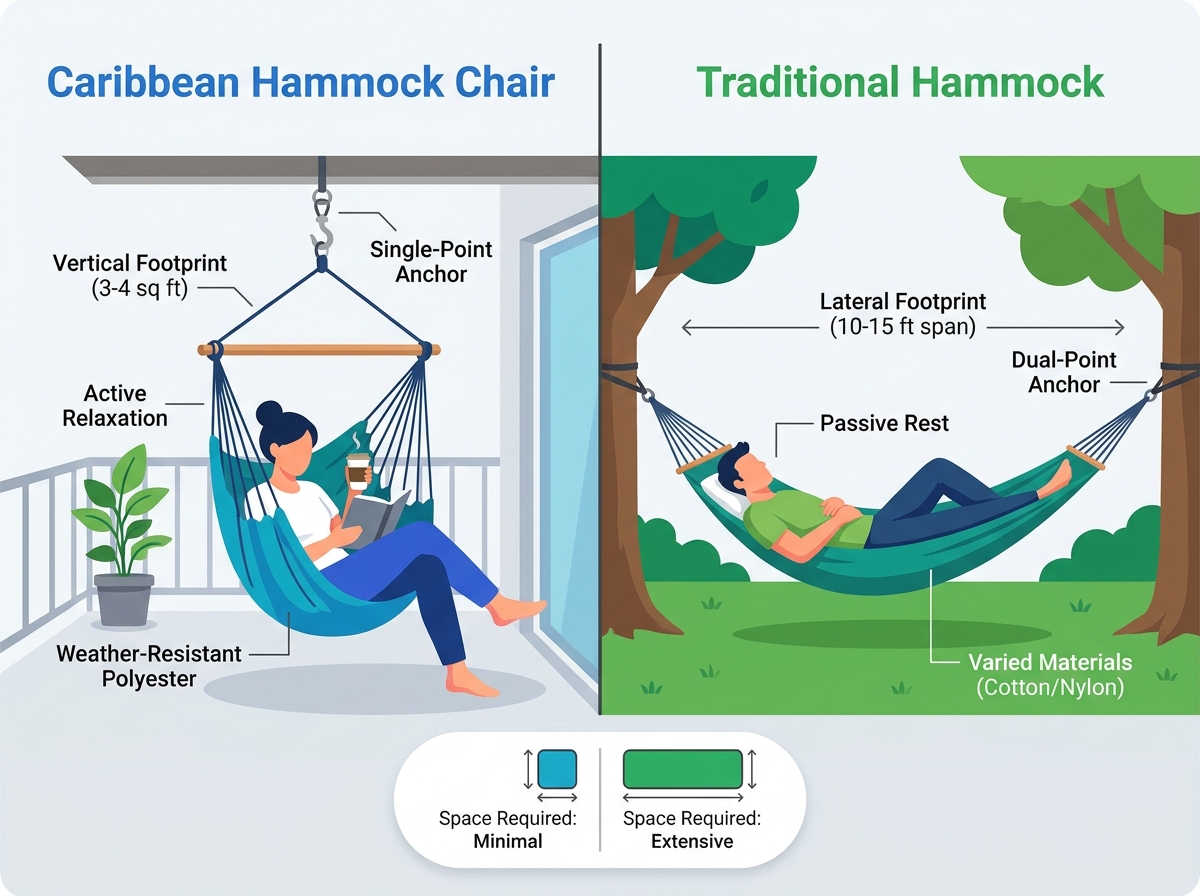
Choosing outdoor seating often comes down to balancing comfort against the physical constraints of your space. You likely want a peaceful spot to unwind. However, limited patios or awkwardly shaped decks can quickly frustrate those plans. While both options offer suspended relaxation, they serve fundamentally different use cases—upright, active engagement versus horizontal, passive rest. You must decide which posture fits your daily routine best. This guide breaks down the spatial requirements, ergonomic differences, installation realities, and material durability of the Caribbean hammock chair and traditional hammocks to help you make a definitive purchase decision. We will explore exactly how each option interacts with your environment.
Key Takeaways
- Spatial footprint is the primary filter: Caribbean hammock chairs require a single overhead point and minimal square footage; traditional hammocks require 10–15 feet of lateral clearance.
- Function dictates form: Choose the chair style for reading, socializing, and working; choose the traditional style for sleeping or extended lounging.
- Installation complexity varies: Single-point overhead suspension demands strict attention to load-bearing joists, whereas traditional hammocks often rely on standalone frames or tree straps.
- Material matters for longevity: Authentic Caribbean hammock chairs utilize tightly woven, soft-spun polyester for weather resistance, differing from the typical cotton or nylon used in traditional designs.
1. Framing the Decision: Intended Use and Ergonomics
Your daily habits should dictate your seating choice. The way you engage with your environment changes drastically depending on your body mechanics. We categorize these two seating styles into active relaxation and passive rest.
The Caribbean Hammock Chair (Active Relaxation)
This design supports a seated, semi-reclined posture. It keeps your torso upright and your head elevated. This position actively maintains your line-of-sight for conversations. You can comfortably interact with friends across the patio.
The ergonomic structure makes it highly suitable for specific activities. You can read a book, use a laptop, or hold a beverage without spilling. Many premium models include a built-in footrest. This allows leg elevation without requiring a full horizontal layout. Your lower back receives consistent support from the woven cradle.
The Traditional Hammock (Passive Rest)
Traditional designs force a fully supine or deeply reclined position. They engulf your body and shift your center of gravity horizontally. This makes them ideal for napping, sleeping, or stargazing.
They also offer a social benefit for couples. A double-sized traditional hammock can comfortably accommodate two adults. In contrast, suspended chairs are strictly single-occupancy. You must choose between shared lounging or solitary focus.
Ergonomic Best Practices
- Position your monitor or book at eye level when using a suspended chair.
- Lie diagonally in a traditional hammock to flatten the curve and protect your spine.
- Use a small lumbar pillow in either option if you experience lower back fatigue.
2. Spatial Requirements and Footprint Analysis
Available space often serves as the ultimate dealbreaker. You must carefully measure your intended relaxation zone before purchasing any hardware.
Vertical vs. Horizontal Dependency
A Caribbean hammock chair primarily relies on vertical space. It requires roughly 3 to 4 square feet of floor space. You will also need at least 7 feet of vertical clearance. This compact footprint makes it ideal for apartment balconies, small patios, or indoor corners.
Traditional options depend heavily on horizontal spans. They demand 10 to 15 feet of lateral distance between two anchor points. You might use mature trees, structural posts, or a bulky standalone stand. Standalone metal or wood frames consume massive amounts of deck space.
Swing Radius Considerations
You must evaluate the necessary movement clearance. A suspended chair needs a 360-degree rotational clearance. Plan for about 2 to 3 feet of empty space around the center axis. This prevents frustrating wall collisions when turning.
Traditional designs have a linear sway path. They move back and forth like a pendulum. However, they require clear space on both sides for safe entry and exit. You cannot push them flush against a wall.
Spatial and Footprint Comparison
| Feature | Caribbean Hammock Chair | Traditional Hammock |
| Primary Orientation | Vertical | Horizontal |
| Floor Space Needed | 3–4 sq. ft. | 30–45 sq. ft. |
| Anchor Points | Single (Overhead) | Dual (Lateral) |
| Clearance Type | 360-degree rotational | Linear sway + side access |
![Caribbean hammock chair]()
3. Installation, Hardware, and Safety Realities
Mounting your seat correctly ensures long-term safety. A failed anchor point can lead to severe injuries or structural property damage.
Single-Point vs. Dual-Point Anchoring
Chair installation requires locating a sturdy ceiling joist or exposed overhead beam. If you cannot modify your ceiling, you must use a heavy-duty C-stand. The hardware necessity here is critical. You must use an industrial-grade swivel hook for your Caribbean hammock chair. This hardware prevents the suspension cords from twisting and fraying under tension when you rotate.
Traditional installation relies entirely on lateral tension. If using trees, straps can easily damage the bark. You must use properly widened tree hugger straps. Indoor installation requires heavy-duty lag screws driven directly into the center of wall studs. Drywall anchors will fail instantly under human weight.
Risk Mitigation
Structural failure points differ between the two designs. In chair models, failures often occur at the wooden spreader bar or the single overhead anchor. Traditional models usually fail at the suspension ropes or the tree straps.
Weight limits must be strictly adhered to for safety. Standard capacities typically range from 250 to 300 lbs. Dynamic loads present the highest risk. Dropping heavily into the seat multiplies the force exerted on the anchor.
Common Installation Mistakes
- Skipping the swivel hook on single-point setups, leading to snapped cords.
- Mounting hardware into drywall or false ceilings instead of solid wood joists.
- Using thin ropes instead of flat webbing on trees, which girdles and kills the tree.
- Ignoring dynamic load forces by allowing children to use the seat as a playground swing.
4. Material Construction and Weather Resistance
Outdoor furniture faces constant elemental abuse. Sun, rain, and humidity quickly degrade inferior materials. Understanding fabric construction saves you money and maintenance time.
Cordage and Weave
Authentic Caribbean hammock chairs feature tightly woven, soft-spun polyester cord. This synthetic material offers a massive advantage. It mimics the soft feel of natural cotton but strongly resists UV degradation. It also prevents mold and mildew growth in humid climates. You can leave it exposed to moderate weather without immediate ruin.
Traditional hammocks vary widely in their material composition. Mayan models use thin cotton string. They are highly comfortable and breathable but exceptionally fragile. Brazilian models feature thick cotton fabric. They provide excellent warmth but remain highly prone to rot if left in the rain. Camping models utilize ripstop nylon. They are incredibly durable and lightweight but far less breathable during hot summer afternoons.
The Spreader Bar Variable
Caribbean hammock chairs almost always utilize a single wooden spreader bar. Manufacturers usually craft these from varnished hardwood. This component requires seasonal maintenance. You should lightly sand and re-varnish the wood annually. This simple routine prevents wood rot, warping, and dangerous splitting.
Traditional designs can be found both with and without spreader bars. The presence of a bar dictates the bed's shape. Models lacking a bar will cocoon the user deeply. Models using spreader bars stay flat and open, though they tip over much easier if you lose your balance.
5. Shortlisting Logic: Which Fits Your Needs?
Making your final choice requires matching features to your specific lifestyle. Review these scenarios to identify your ideal setup.
Opt for the Caribbean Hammock Chair if:
- You are outfitting a small porch, an apartment balcony, or a tight specific corner of an indoor room.
- Your primary outdoor goal involves reading, socializing, or enjoying your morning coffee upright.
- You have accessible, structurally sound overhead beams ready for mounting.
- You prefer an aesthetic piece that blends well into modern patio decor.
Opt for the Traditional Hammock if:
- You have a large backyard featuring mature trees or enough deck space for a 12-foot metal stand.
- Your primary goal is deep relaxation, afternoon sleeping, or stargazing.
- You want a portable solution for weekend camping trips or travel.
- You plan to share the lounging experience simultaneously alongside a partner.
Conclusion
Neither seating option is universally superior. The final verdict hinges entirely on your available dimensions, structural setup, and personal relaxation habits. If you value upright engagement and space efficiency, the chair style wins easily. If you crave horizontal naps in a large yard, traditional designs remain unmatched.
Your actionable next step is immediate measurement. Before purchasing anything, measure your intended space. If leaning toward the chair, locate your ceiling joists using a reliable stud finder to confirm structural viability. If choosing a traditional setup, measure the exact span between your anchor points to ensure adequate tension.
FAQ
Q: Can you sleep in a Caribbean hammock chair?
A: While you can take short naps, they do not support a flat, horizontal posture. This flat posture is necessary for overnight sleeping or deep REM rest. Attempting to sleep long-term in a seated position will likely cause neck or back strain.
Q: Do I need a special stand for a hammock chair?
A: No, they can be hung securely from structural beams or ceiling joists. However, freestanding C-stands are readily available. You should use a stand if overhead structural mounting is impossible, unsafe, or prohibited by your landlord in a rental property.
Q: Can a Caribbean hammock chair be left outside in the rain?
A: If made from spun polyester, the cords will successfully withstand rain. However, the wooden spreader bar remains vulnerable. It will eventually weather, fade, or rot if continuously exposed to harsh elements without periodic re-sealing.
Q: What is the weight limit for most Caribbean hammock chairs?
A: Standard models safely support up to 250–300 lbs. This rating assumes you install the equipment properly. The anchoring hardware and the structural beam itself must also be rated for that exact same weight capacity to ensure safety.