Most office chairs force your body into unnatural alignments over time. Prolonged sitting causes pelvic pressure, poor posture, and persistent lower back fatigue. A standard chair often lacks the necessary ergonomic support you need for long workdays. Consequently, buyers face a highly saturated market dominated by two primary materials: gel and memory foam. Choosing the wrong material can easily exacerbate heat retention, disrupt your seated posture, or lead to the cushion bottoming out prematurely. You need a reliable solution to stay comfortable and productive.
This guide provides an objective, use-case-driven framework to help you evaluate these options. We will help you select the correct Seat Cushion Pad based on your sitting duration, physical environment, and specific ergonomic pain points. You will learn exactly how viscoelastic foams and hyper-elastic polymers interact under human body weight. Armed with this knowledge, you can optimize your daily workspace for maximum physical relief.
Key Takeaways
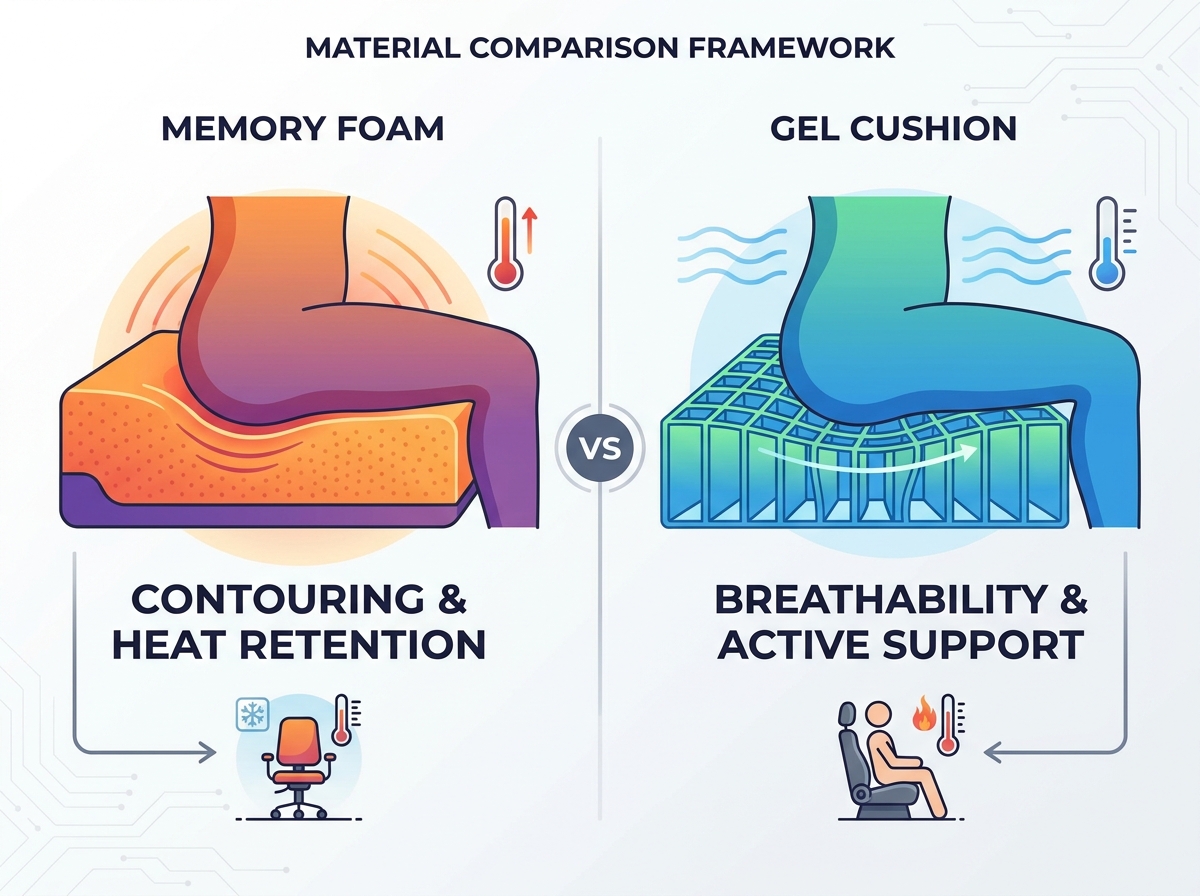
- Memory Foam excels at custom contouring and pressure-point relief but is prone to heat retention and temperature-dependent firmness.
- Gel Cushions (particularly honeycomb grids) prioritize breathability, active support, and consistent firmness regardless of room temperature.
- Use Case Dictates Choice: Memory foam is best for static, temperature-controlled office environments; gel is optimal for hot environments, long commutes, or users who shift weight frequently.
- Hybrid Models (gel-infused memory foam) offer a middle-ground solution but require careful evaluation of the foam density to ensure longevity.
The Role of a Seat Cushion Pad: Setting Evaluation Criteria
Before comparing materials, you must understand what functional ergonomics actually require. A well-designed product does much more than simply add softness to a hard chair. It actively alters your biomechanics. Proper support must achieve three specific outcomes. First, it should correct your pelvic tilt. A slight forward tilt encourages the natural inward curve of your lower spine. Second, it must provide coccyx pressure suspension. Suspending the tailbone prevents the chair from compressing your lower spinal discs. Third, it needs to optimize weight distribution. Spreading your body weight across the entire seat pan minimizes focal pressure on your thighs and buttocks.
You also need to accept the "one size does not fit all" reality. Material choice remains highly subjective. Ergonomic success depends heavily on your unique body weight. It also depends on your specific chair type and the ambient room temperature. A dense material might perfectly support a heavier individual. However, that same material could feel like solid concrete to a lighter person. Selecting the right Seat Cushion Pad requires matching the physics of the material to your personal physiology.
Finally, we must address a common industry misconception. You must avoid the "medical cure" trap. These products serve as excellent ergonomic aids. They are not medical treatments for chronic spinal conditions like herniated discs or severe scoliosis. Industry ergonomics guidelines emphasize proactive postural support. They do not endorse accessories as standalone medical interventions. If you experience severe, radiating pain, consult a medical professional. Use these products to improve daily comfort, not to bypass proper medical care.
Memory Foam: Deep Contouring and Pressure Relief
Viscoelastic foam, commonly known as memory foam, revolutionized the seating industry. It utilizes a fascinating scientific principle to provide comfort. The material reacts directly to your body heat and physical weight. As it warms up, the cellular structure softens. It then slowly molds around the unique curves of your hips and thighs. Once you stand up, it gradually returns to its original flat state.
This unique yielding property offers several notable benefits for daily users. Consider the following key advantages:
- Maximum surface area contact: By contouring perfectly to your body, the foam ensures completely even weight distribution. This drastically reduces numbness in the legs.
- Superior shock absorption: The dense cellular structure absorbs kinetic energy exceptionally well. This minimizes micro-movements and vibrations, which proves invaluable during bumpy vehicle rides.
- Targeted postural anchoring: The custom mold helps lock your pelvis into a stable position. This prevents the gradual forward slouching common during long computer sessions.
Despite these benefits, you must consider the implementation risks and skeptical realities. The temperature variable remains a significant hurdle. Foam density directly correlates to ambient temperature. A frequent complaint among users is cold-weather stiffness. If your office runs cold, the foam becomes uncomfortably rigid. It often takes several minutes of sitting before your body heat softens the material enough to provide relief. You might feel like you are sitting on a brick until it warms up.
Heat trapping presents another substantial challenge. High-density foam inherently restricts airflow. The same cellular density providing superior support also acts as a thermal insulator. It traps your body heat against your skin. During extended eight-hour sessions, this often causes uncomfortable sweating. Manufacturers sometimes punch ventilation holes into the foam, but the core issue of thermal retention usually persists.
![Comparing different ergonomic seat cushion pad designs for office and commute usage]()
Gel Cushion Technology: Active Support and Cooling
Gel technology approaches ergonomic support from a completely different engineering angle. These products do not rely on thermal reactivity. Instead, manufacturers construct them from hyper-elastic polymers. They mold these durable polymers into a distinctive grid or honeycomb pattern. This structural design relies on column buckling. The grid walls stay firm under light pressure. However, they intelligently buckle and fold under specific high-pressure thresholds, such as beneath your hip bones.
This dynamic buckling mechanism delivers unique benefits for different use cases. The key advantages include:
- Exceptional breathability: The open honeycomb design consists mostly of empty air pockets. This enables passive cooling and constant airflow beneath your body.
- Immediate shape recovery: Hyper-elastic polymers snap back into place instantly. The material does not require your body heat to conform or reset.
- Consistent firmness: Unlike foam, polymer grids ignore ambient room temperature. They feel exactly the same in a freezing car cabin as they do in a heated office.
However, gel structures introduce their own set of implementation risks. Weight and portability create the largest practical drawback. Hyper-elastic polymer is a dense, heavy material. A high-quality gel grid can weigh significantly more than a comparable foam model. This heft makes them cumbersome for frequent travel. If you constantly move between different offices, you might find carrying it exhausting.
Additionally, you must account for the "bounce" factor. Elastic polymers provide active, springy feedback. Some users find this sensation distracting. It feels entirely different from the slow, sinking sensation of viscoelastic foam. If you shift your weight frequently, the grid pushes back against you. This dynamic feedback promotes active sitting. Yet, some users prefer the locked-in stability of traditional contoured foam.
Head-to-Head Decision Framework (By Environment)
Selecting the ideal material requires matching its properties to your primary environment. We can break down the optimal choices into three distinct real-world scenarios.
For the Office Worker (8+ Hours)
The clear winner for stationary office work is memory foam or a high-quality hybrid. When you sit at a desk for eight or more hours, static postural support becomes critical. Memory foam anchors your pelvis perfectly. It keeps you aligned with your monitors and keyboard. Since most corporate offices maintain climate-controlled temperatures, the foam rarely becomes too cold or too hot.
There is one crucial caveat. You must ensure the product carries a high-density rating. Low-density foams easily fatigue under continuous body weight. They often flatten entirely by 3 PM, leaving you sitting on the hard plastic of your chair pan.
For the Commuter and Truck Driver
Gel cushions win decisively for vehicle applications. Commuters and truck drivers face unique environmental challenges. Car upholstery rarely breathes well. Adding dense foam on top of leather or vinyl creates a massive heat trap. The open grid of a gel design maintains essential airflow.
Furthermore, gel performs flawlessly in extreme temperatures. It will not freeze solid in a winter cabin. Implementation note: Watch your thickness carefully. Excessive product height can drastically alter your driving sightline. It can also negatively impact your ability to reach the gas and brake pedals safely. Thin gel profiles work best here.
For Sciatica and Tailbone (Coccyx) Pain
If you suffer from specific lower spine pain, U-shaped memory foam provides the best results. Sciatica and tailbone pain require specific physical offloading. You need a structural gap at the back of the seat to suspend the coccyx in mid-air.
The structured, dense molding of foam better maintains this crucial physical gap. Yielding gel grids tend to stretch and compress inward across the gap when loaded with weight. Foam walls remain rigid enough to protect the sensitive tailbone from any underlying pressure.
| Primary Use Case | Recommended Material | Key Environmental Factor | Crucial Warning |
| Static Office Work | Memory Foam | Climate-controlled rooms | Requires high density to avoid 3 PM flattening. |
| Long Vehicle Commutes | Honeycomb Gel | Variable cabin temperatures | Excessive height alters driving sightlines. |
| Tailbone Pain Relief | U-Shaped Memory Foam | Need for targeted physical offloading | U-shape cutout must align perfectly with coccyx. |
Hybrid Seat Cushion Pads: Are They Worth the Premium?
Manufacturers eventually recognized the polarizing nature of this market. They responded by developing hybrid models. The construction usually features a sturdy memory foam base. Manufacturers then top this base with a cooling gel layer or infuse it directly with gel beads. The theory suggests you get the deep contouring of foam combined with the active cooling of gel. Naturally, these hybrid models command a higher retail price.
However, you need a realistic understanding of thermal dynamics. A reality check is necessary here. Solid gel layers only provide temporary cooling. The gel possesses a specific thermal mass. It absorbs your body heat efficiently for about twenty to thirty minutes. After this initial window, the gel reaches your body temperature. It can no longer draw heat away. At that point, it behaves similarly to standard dense foam.
The final verdict on hybrids is nuanced. They represent a solid middle-ground solution. They are exceptionally good for users who desperately want the contouring support of foam but need a slight buffer against initial heat buildup. Just temper your expectations. Do not expect active refrigeration throughout a full workday. Carefully evaluate the density of the underlying foam to ensure the product guarantees structural longevity.
Shortlisting Logic: How to Make Your Final Choice
You now understand the science behind the materials. The final step involves a practical elimination process. Follow this shortlisting logic to secure the perfect ergonomic accessory for your daily routine.
- Assess your climate and body temperature. This acts as the ultimate tiebreaker. If you naturally run hot or work in a stuffy environment, default to gel. If you run cold or work in aggressively air-conditioned rooms, select foam.
- Check your seating surface. Match the material to the existing chair. A hard wooden dining chair requires the thick impact absorption of high-density foam. Conversely, a plush, padded car seat pairs much better with a thin, flexible gel grid.
- Measure your chair. Grab a tape measure before purchasing. Ensure the dimensions closely align with your chair's actual seat pan. If the pad overhangs the edges, it will cause edge-sagging. This completely ruins the intended ergonomic posture.
- Look for non-negotiable features. Never compromise on hygiene and safety. Ensure the product includes a removable, machine-washable cover. Verify it utilizes a non-slip rubberized bottom to prevent dangerous sliding. Finally, check for appropriate thickness, which usually ranges between two and three inches for optimal desk height alignment.
Applying these four steps removes the guesswork. It transforms an overwhelming online catalog into a simple, personalized shopping list. Incorporating a well-chosen Seat Cushion Pad into your daily routine will drastically improve your seated endurance.
Conclusion
Selecting the right ergonomic support fundamentally changes your daily comfort. Memory foam clearly wins for targeted pressure relief and static posture correction. It anchors your body perfectly during long desk shifts. Gel decisively wins for breathability, temperature neutrality, and dynamic support. It keeps you cool and comfortable regardless of the environment.
Take action right now. Grab a tape measure and document your current chair's dimensions. Identify your primary physical pain point, whether it involves trapped heat or sharp tailbone pressure. Finally, prioritize brands offering a risk-free trial period. Testing the material in your real-world environment provides the only true proof of comfort. Protect your spine and upgrade your workspace today.
FAQ
Q: Do memory foam seat cushions go flat over time?
A: Yes, viscoelastic foam inevitably experiences density degradation over time. Continuous exposure to body weight and heat breaks down the cellular structure. A high-quality model typically lasts between one to three years before flattening occurs. You should replace it once it no longer rebounds to its original shape.
Q: Can I leave a gel seat cushion pad in a freezing car?
A: Absolutely. Hyper-elastic polymers maintain remarkable resilience across extreme temperature ranges. Unlike foam, which hardens into a rigid block in cold weather, a gel grid retains its flexible, buckling properties. You can leave it in your vehicle overnight without compromising morning comfort.
Q: How do I clean my seat cushion pad?
A: You should never put memory foam in a washing machine, as water destroys its structural integrity. Instead, remove the outer cover and machine wash it separately. For gel honeycomb grids, you can often rinse the polymer structure directly in the shower with mild soap and let it air dry.
Q: Does a seat cushion pad fix poor posture?
A: It serves as a helpful tool, not a magical cure. Ergonomic cutouts naturally encourage a healthier forward pelvic tilt. However, you must still actively engage your core muscles to maintain alignment. You also need to adjust your monitor height and desk positioning to achieve truly correct posture.