Transitioning from casual browsing to evaluating technical specifications requires sharp focus. You want a reliable setup to relax outdoors. Finding gear to support two adults safely is no simple task. Let us dive into the actual metrics you need. Marketing labels often mislead buyers into purchasing standard gear. Many brands simply add extra fabric width. If you ignore the structural reality, you risk broken suspensions. You might also endure uncomfortable shoulder squeezing and unsafe drops. We will break down the essential specifications you must evaluate. You will discover how weight ratings and dimensions truly impact comfort. We will look at structural designs and fabric strength. Let us build a reliable baseline to help you choose wisely. You will learn to prioritize safety, evaluate dimensions, and match gear to your specific environment.
Key Takeaways
- **True Capacity vs. Marketing Labels:** A "double hammock" often indicates extra width for a single user's diagonal lay; a true two-person hammock requires specific structural reinforcement and dimensions.
- **Minimum Safe Load Ratings:** Reliable dual-occupancy requires a minimum static weight capacity of 400 to 500 lbs, supported by high-denier fabrics.
- **Design Dictates Comfort:** Gathered-end designs inevitably push occupants to the center, whereas spreader-bar or multi-point tension systems offer compartmentalized sleeping areas.
- **Suspension is the Weak Link:** Upgrading to non-stretch, high-capacity polyester webbing straps is mandatory for supporting dynamic dual-occupant weight loads safely.
Clarifying the Category: "Double" vs. True "Two-Person" Hammocks
Many standard models advertise themselves as doubles. Manufacturers usually just add extra fabric width to their single designs. They intend for one adult to lay diagonally across the fabric. A diagonal lay flattens the sleeping surface beautifully for solo users. It does not mean two adults can sleep overnight comfortably. This fundamental misunderstanding ruins many camping trips. You must look beyond the generic labeling. You need gear engineered for simultaneous human occupancy.
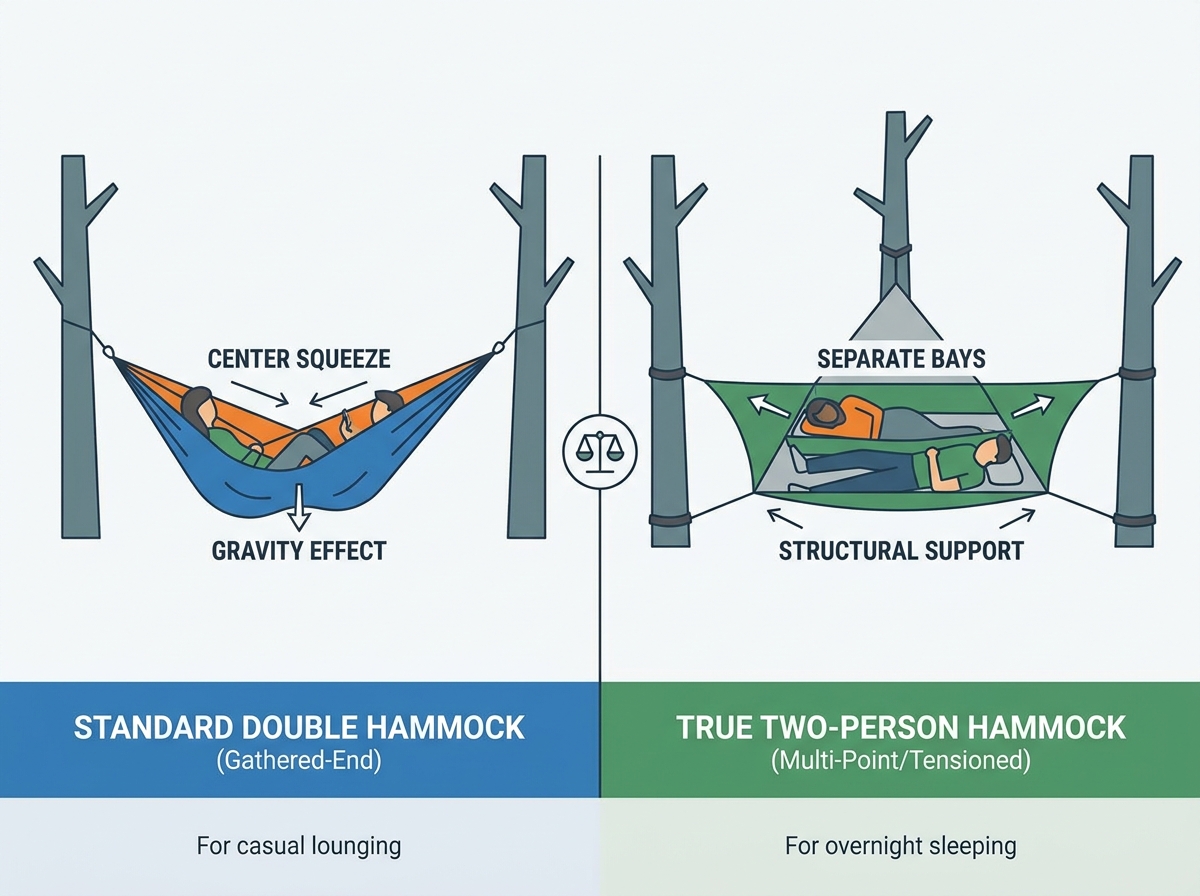
Gravity creates a massive issue in traditional gathered-end designs. It forces two occupants down into the absolute center trough. You might survive short-term lounging in the backyard. However, overnight camping turns into a compressed, painful experience. You end up crushing your partner. Shoulders fold inward. Knees bump constantly. The fabric wraps around you like a tight cocoon. This phenomenon is universally known as the center squeeze. It happens because standard designs lack structural boundaries.
A genuine dual-occupant model supports separate weight distribution. You must look for specialized baffles. Spreader bars help create firm boundaries between users. Multi-point anchor systems provide the best compartmentalization. These systems suspend the floor tightly. They prevent bodies from rolling together. When evaluating these setups, you must test the tension. A flat, segmented surface indicates proper dual-occupancy design. Anything less will eventually force you into the middle.
![Two-Person Hammock]()
Critical Weight Capacity and Load Ratings
Laboratories measure static load using still weights. Real life involves intense dynamic load. Two adults constantly shift, bounce, and climb in or out. These sudden actions multiply the force applied to the fabric. You must account for dynamic stress. A static rating of 350 lbs might sound sufficient. In reality, a sudden drop from one occupant creates force spikes. These spikes easily exceed weak static limits. You need a massive safety buffer.
Do not settle for less than a 400-lb static capacity. We highly recommend a 500-lb rating for long-term durability. This generous buffer ensures you stay safe during sudden movements. Heavy-duty construction handles the stress of daily use. It prevents catastrophic fabric tears. When two adults sleep suspended above the ground, peace of mind matters. Always verify the manufacturer's testing protocols. Reputable outdoor brands publish their failure thresholds openly.
The overall system is only as strong as its weakest link. Fabric might comfortably hold 600 lbs. If your carabiners snap at 200 lbs, you fall. You must inspect every hardware component carefully. Demand climbing-grade carabiners rated at 12kN or higher. Check the continuous loops threaded through the end channels. They should use ultra-high-molecular-weight polyethylene. Standard parachute cord loops will snap under dual-occupant dynamic stress.
| Load Type | Definition | Impact on Gear | Required Rating Buffer |
| Static Load | Still, motionless weight applied evenly. | Tests baseline fabric and seam strength. | Combined body weight + 20% |
| Dynamic Load | Force from moving, swinging, or dropping. | Stresses carabiners, tree straps, and loops. | Combined body weight + 100% |
Dimensional Requirements for Simultaneous Use
You need a width between 70 and 85 inches. Anything under 70 inches guarantees severe shoulder squeeze. You cannot escape the fabric walls wrapping around you. Broad dimensions give both occupants breathing room. It allows each person to find a comfortable sleeping angle. Extra width also provides extra fabric to pull over yourselves. This acts as a makeshift blanket during chilly breezes.
A minimum length of 10 to 11 feet is equally critical. Shorter beds create steep wall angles at the head and foot. These steep angles force your bodies tightly together. Extra length flattens the curve of the fabric. It reduces the banana-shape effect significantly. You will experience less knee hyper-extension. Longer models also accommodate taller campers easily. Do not compromise on length to save a few ounces of pack weight.
Material stretch changes functional dimensions overnight. Standard nylon stretches significantly under dual-occupant loads. You might start out flat, but you will sag by morning. Ripstop nylon resists stretching much better. You want a fabric retaining its shape consistently. Heavy sleepers will notice the difference immediately. A non-stretch fabric maintains the structural integrity of your sleeping space.
Follow these steps to verify functional dimensions:
- Lay the fabric completely flat on the ground.
- Measure the widest point across the center panels.
- Measure the full length from gathered end to gathered end.
- Check the fabric weave for ripstop grid patterns.
- Subtract five inches from the width to account for edge curling.
Structural Design: Evaluating Gathered-End, Spreader Bar, and Multi-Point Systems
Gathered-End Hammocks
These models bunch all fabric at two focal points. They remain the most common style available today. Many backpackers prefer them for their simplicity.
- Pros: Highly portable. Extremely lightweight. They contain no hard components to break or pack. You can stuff them into tiny sacks.
- Cons/Risks: They produce maximum shoulder squeeze. It remains virtually impossible for two adults to sleep comfortably overnight. They work best for casual lounging only.
Spreader Bar Hammocks
These designs utilize wooden or metal bars at each end. The bars force the fabric to stay open and flat. You frequently see them in suburban backyards.
- Pros: The design keeps fabric taut at all times. It separates occupants slightly more effectively than gathered-end models. You get a flatter lounging surface.
- Cons/Risks: They feature a notoriously high center of gravity. They flip easily when two people attempt to enter or exit. They weigh too much for backpacking. You should strictly reserve them for backyard or car camping.
Multi-Point/Tensioned Systems
These advanced shelters look like floating triangles. They rely on heavy ratchets and heavy-duty webbing. They represent the pinnacle of suspended outdoor sleeping.
- Pros: The system utilizes a 3-point anchor framework. Under-floor tension straps create separate, flat sleeping bays. This entirely eliminates the dreaded center-roll effect.
- Cons/Risks: You must locate specific tree configurations to set them up. They carry a significantly heavier pack weight. You will face a much steeper learning curve for proper setup.
Material Strength and Suspension System Requirements
When investing in a quality Two-Person Hammock, you must scrutinize fabric denier. Denier measures the thickness of the individual threads. We recommend fabrics utilizing a minimum of 70D nylon. Heavy-duty canvas also works perfectly for stationary setups. Avoid 40D ultralight materials entirely. They degrade rapidly under heavy point-loads. A rogue zipper or sharp toenail can easily tear ultralight fabric. Dual occupancy demands robust, abrasion-resistant materials.
You must upgrade your suspension system immediately. Stop using standard rope or basic string. Paracord stretches rapidly over time. Worse, thin ropes dig into tree bark, causing permanent damage. We recommend 1-inch to 1.5-inch non-stretch polyester webbing straps. Polyester repels water and prevents sagging. Ensure the straps boast a minimum breaking strength of 1,000+ lbs. This guarantees they will never fail under dynamic stress.
Stitching quality directly dictates product lifespan. Look closely at the seams connecting the main panels. Require triple-stitched seams along all weight-bearing sections. The continuous loop channels need exceptional reinforcement. If you see single-stitched hems, walk away. Poor stitching unravels quickly when two bodies shift around. High-quality outdoor gear always features bar-tack stitching at critical stress points.
| Fabric Denier | Ideal Use Case | Durability Level |
| 20D - 40D | Solo ultralight backpacking | Low (Prone to tearing under dual weight) |
| 70D Nylon | Car camping, robust backpacking | High (Excellent balance of weight and strength) |
| Canvas / Cotton Blend | Backyard, permanent patio setup | Maximum (Heavy, but virtually tear-proof) |
Decision Framework: Shortlisting Your Ideal Two-Person Hammock
For backyard use and casual day-lounging, prioritize comfort over weight. Choose thick cotton or heavy canvas blends. Spreader bar designs work perfectly in these controlled environments. They look beautiful on wooden patio stands. Width and aesthetic take precedence here. You do not need to worry about packing it into a tiny backpack. Focus purely on the tactile feel of the fabric and the visual appeal.
For car camping and short weekend trips, opt for heavy-duty 70D nylon. You can use gathered-end "double" models here safely. Since you are near your vehicle, extra weight matters little. Verify your tree straps are included. Ensure the manufacturer rates them for 500+ lbs. You can lounge together during the day. If sleeping gets too cramped, you always have your car tent as a backup.
For true overnight backcountry sleeping, avoid gathered-end designs completely. Shortlist 3-point multi-anchor systems. Specialized dual-baffle systems also serve this purpose well. Factor in the added weight of your total sleep system. You will need compatible two-person underquilts. Standard single underquilts leave massive cold spots. You also need a wide hex tarp to cover the expanded footprint. Plan your gear list carefully to ensure total coverage.
Conclusion
Purchasing reliable suspended gear requires looking past the clever "double" marketing tags. You must verify hard specifications before trusting your safety to a piece of fabric. Always demand a 500-lb static capacity and a minimum 70-inch width. Ensure your suspension hardware utilizes climbing-grade components and non-stretch polyester straps.
Align your purchase strictly with your primary use case. If you plan to sleep overnight, multi-point tension systems remain the only way to avoid the center squeeze. If you just want to read a book together, a sturdy spreader bar model works wonders. Make your choice based on function, not just aesthetics.
Take a moment to review your shortlisted options right now. Check the fabric denier ratings. Verify the breaking strength of the included tree straps. Do not finalize your checkout until you confirm these critical safety metrics match your intended outdoor adventures.
FAQ
Q: Can two people actually sleep comfortably in a double hammock?
A: Rarely, unless it is a specialized 3-point system or features an internal divider. Standard gathered-end double models inevitably cause occupants to crush together overnight. You might fall asleep fine, but gravity will force you into the center trough by morning. This results in compressed shoulders, lost body heat, and poor sleep quality.
Q: What is the difference between static and dynamic weight capacity in hammocks?
A: Static capacity measures still weight in a controlled lab setting. Dynamic capacity includes the sudden force generated by getting in, moving, or swinging. Two moving adults create massive force spikes. Always buy gear with a static rating far exceeding your combined body weight to safely account for these unpredictable dynamic forces.
Q: Do I need a special suspension system for a two-person hammock?
A: Yes. Standard single-user straps frequently fail or stretch under 400+ lbs. You must upgrade to heavy-duty, non-stretch polyester straps. We recommend widths of at least 1.5 inches to protect tree bark. Pair these straps with 12kN high-tensile climbing carabiners to ensure your suspension system handles dynamic shifts.
Q: How do we stay warm in a two-person hammock?
A: Standard single underquilts will not fit over two people. They leave massive gaps where cold air rushes in. You must invest in an oversized double underquilt designed specifically for your gear. Alternatively, use a multi-point system that accommodates separate, insulated sleeping pads for each individual occupant.