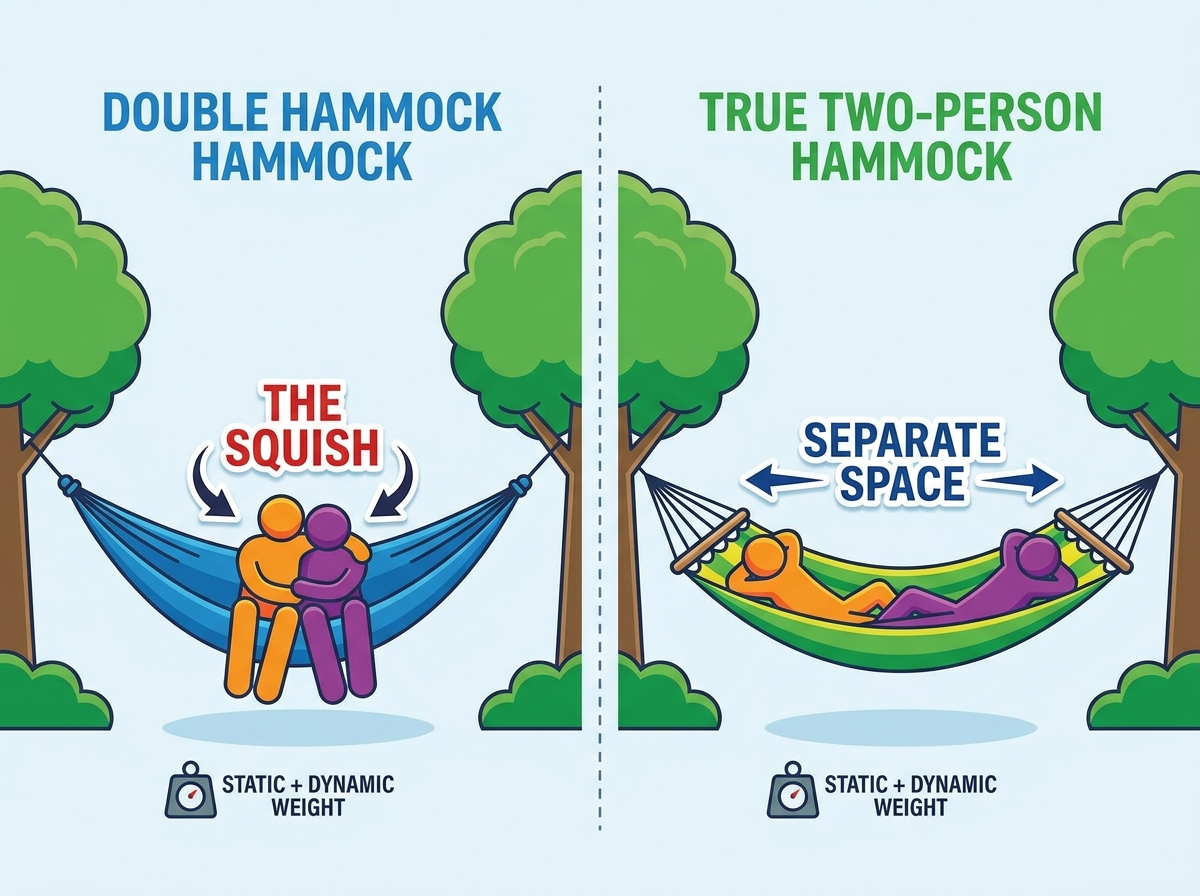
Many buyers dream of relaxing together under the trees, only to face a harsh reality. You buy a Two-Person Hammock, climb in, and immediately slide into an uncomfortable heap in the middle. We call this frustrating phenomenon "the squish." A truly successful shared hammock experience requires much more than simply adding extra fabric. It demands proper weight distribution, adequate tension, appropriate sizing, and fail-proof suspension. When you get these structural elements right, lounging or sleeping together becomes genuinely comfortable.
This guide serves as a practical, hype-free framework to help you evaluate technical specifications. We will help you separate clever marketing claims from actual structural realities. By the end, you will know exactly how to shortlist the right product for your specific outdoor adventures or backyard use cases.
Key Takeaways
- Most "Double Hammocks" are actually designed as spacious single hammocks; true two-person sleeping requires specific structural designs (like spreader bars or multi-point tension).
- Combined weight capacity must account for dynamic weight (movement), not just static resting weight.
- Suspension systems require heavy-duty, tree-safe straps rated for at least 500 lbs to safely accommodate two adults.
- Your primary use case (backyard lounging vs. overnight camping) dictates whether you need a gathered-end, spreader-bar, or tensioned flat-bed hammock.
The Industry Ambiguity: "Double" vs. "True Two-Person" Hammocks
The outdoor gear market suffers from a major naming problem. Brands frequently label wide, single-occupancy gear as "double" models. You must understand this distinction to avoid buyer's remorse.
The "Double Hammock" Reality
Standard gathered-end double hammocks usually measure between 6 and 6.5 feet wide. Manufacturers create them by simply sewing extra fabric panels onto a single hammock body. They provide excellent comfort for one person lying diagonally, creating a flat, ergonomic sleeping surface. They also work fine for two people lounging briefly while reading a book or enjoying a view.
However, physics takes over when you attempt to sleep overnight in this setup. The gathered ends force the fabric into a U-shape under a heavy load. Gravity pulls both occupants to the lowest point in the center. You will experience "the squish," leading to compressed shoulders, overheating, and a terrible night of sleep.
The "Two-Person" Architecture
True shared sleeping requires specialized structural designs. Multi-point tensioned hammocks use a triangular anchor system to create a taut, flat bed. Dual-bay hammocks feature an internal divider or separate fabric channels to give each person their own distinct sleeping space. Spreader bar hammocks use wooden or metal beams at both ends to force the fabric to stay open.
These architectural choices actively fight the gravity-fed center drop. They provide independent support zones for two adults.
The Decision Filter
You must honestly evaluate your primary goal. If you plan to camp overnight together, you must invest in a true two-person design. Standard doubles will fail you in this scenario. Alternatively, many experienced campers prefer hanging two single hammocks from the same trees. You can achieve this using bunking techniques or specialized spreader poles to hang side-by-side. Do not force a standard double to do a job it was never engineered to perform.
![Two-person hammock setup in a forested camping environment]()
Core Evaluation Dimensions for Shared Hammocks
Once you understand the structural differences, you must evaluate the technical specifications. High-quality materials and appropriate dimensions separate reliable gear from cheap imitations.
Static vs. Dynamic Weight Limits
Weight capacity serves as your most critical safety metric. You should always look for a minimum weight capacity of 400 to 500 lbs when evaluating shared models. However, you must differentiate between static and dynamic loads.
Brands typically advertise maximum static limits. This number represents the absolute maximum weight the fabric can hold while perfectly still. Real-world usage involves dynamic weight. When one person shifts during the night, or when you drop into the fabric too quickly, the instantaneous force spikes dramatically. Dynamic weight stresses the fabric, stitching, and suspension far more than a static load. Always build a safety buffer of at least 150 lbs beyond your combined body weight.
Dimensions and Usable Space
Fabric measurements directly dictate your comfort level.
- Width: The fabric must measure 74 inches or wider. Anything narrower will cause your arms and legs to spill over the sides when lounging together.
- Length: You need a minimum length of 9.5 to 10.5 feet. Shorter hammocks create a severe "banana" curve. Longer models allow for proper tensioning, which significantly reduces the shoulder-squeeze effect at the ends.
Fabric Durability and Denier (D)
The textile industry uses Denier to measure the thickness and weight of individual fabric threads. Higher numbers indicate heavier, more durable materials.
| Fabric Material | Primary Use Case | Durability for Two Occupants | Weather Resistance |
| 70D Parachute Nylon | Car camping, casual outdoor lounging | High. Resists tearing and handles dynamic loads well. | Good. Dries quickly, resists mildew. |
| 20D / 30D Ripstop Nylon | Ultralight backpacking | Low to Medium. Prone to stretching under dual occupancy. | Excellent. Very fast drying. |
| Cotton / Canvas | Backyard, patios, indoor use | Very High. Thick, stable, and highly puncture resistant. | Poor. Absorbs water, prone to rot if left outside. |
For most users, 70D nylon offers the best balance of safety, comfort, and longevity.
Suspension Systems and Structural Safety
A heavy-duty Two-Person Hammock becomes completely useless—and highly dangerous—if you hang it on a weak suspension system. You must treat your straps and hardware as life-safety equipment.
The Weakest Link
Suspension failures cause nearly all hammock-related injuries. When a strap snaps or a carabiner bends, occupants fall directly onto roots, rocks, or hard ground. You must verify every single component in your setup. If your hammock holds 500 lbs but your straps only hold 200 lbs, your true capacity is only 200 lbs.
Evaluating Straps vs. Ropes
Never use basic nylon ropes to hang two people. Nylon stretches significantly under heavy loads. You might go to sleep two feet off the ground and wake up resting in the dirt. Furthermore, thin ropes bite into tree bark, damaging the cambium layer and potentially killing the tree.
We strongly recommend polyester webbing straps. Polyester stretches very little. Ensure the straps measure at least one inch wide. This width distributes the heavy dual-occupancy weight across the tree bark, protecting the environment and preventing slippage.
Carabiners and Hardware
Many cheap models include heavy, bulky steel "accessory" carabiners. These often lack proper safety ratings. You must ensure your included hardware features a minimum 12kN rating (which equals roughly 2,697 lbs of force). Look for wire-gate aluminum carabiners used in climbing. They weigh less, resist rust, and provide guaranteed structural integrity under shifting loads.
Hang Angle Reality Check
Physics dictates that a 30-degree hang angle provides the safest, most comfortable tension. Hanging the straps too tight (a shallow angle) exponentially increases the sheer force on the trees, straps, and fabric. For two people, achieving this optimal 30-degree angle requires much longer straps than a single setup. You also need remarkably sturdy anchor points. Never hang a shared setup from dead trees, thin branches, or questionable masonry columns.
Matching Design to Your Primary Environment
You must align your purchase with your actual environment. A backyard model fails miserably in the backcountry, and a backpacking model often looks out of place on a manicured patio.
Backyard & Patio
If you plan to leave your setup in a permanent spot, prioritize aesthetics and immediate comfort.
- Solution: Look for cotton, canvas, or quilted spreader-bar hammocks. They look beautiful and provide a wide, open bed.
- Trade-offs: These materials weigh heavily and offer zero weather resistance. You must bring them inside during rain to prevent mold. Additionally, spreader-bar designs suffer from a high center of gravity. If one person moves abruptly, they easily flip over.
Car Camping & Casual Outdoors
For weekend camping trips where weight matters slightly less, prioritize durability and setup convenience.
- Solution: Choose heavy-duty 70D parachute nylon gathered-end hammocks. They pack down easily into the trunk of a car and resist campfire sparks better than ultralight fabrics.
- Trade-offs: They excel at sunset lounging, but sleeping requires asymmetric lying techniques. Both occupants must position their bodies at an angle across the fabric to maintain a flat surface and avoid crushing each other.
Overnight Backpacking
When you hike miles into the woods, pack weight and sleep quality become your only concerns.
- Solution: Invest in tensioned flat-lay hammocks or specialized dual-chamber sleeping systems. These designs utilize advanced structural fabrics to separate occupants while maintaining a low pack weight.
- Trade-offs: These systems command premium pricing. They also feature a steeper learning curve for setup. You will need to find specific tree spacing to achieve the correct tension geometry.
Shortlisting Logic & Final Decision Framework
You now understand the technical requirements. Use this logical framework to narrow down your final choices.
Budget vs. Lifespan
You need to frame this purchase as a long-term investment. Sub-$40 double hammocks flood online marketplaces. These budget options work fine for casual, occasional day-use by lightweight individuals. However, they frequently feature weak stitching and dangerous ropes.
Reliable two-person overnight systems require a $100 to $300+ investment. This price accounts for high-denier fabrics, reinforced triple-stitched seams, and upgraded climbing-rated suspension systems. Spending more upfront prevents gear failure and potential injuries later.
Identify the Dealbreaker
Every gear purchase involves compromise. Identify your absolute dealbreaker before browsing products.
- Is it pack weight? If yes, abandon cotton and dual-chamber systems. You must choose a high-quality 30D nylon double and accept the "squish" risk.
- Is it sleep quality? If yes, abandon gathered-end models entirely. You must spend the money on a multi-point tensioned flat-lay system.
- Is it budget? If yes, abandon premium backpacking gear. Buy a durable 70D nylon model and limit its use to backyard lounging and afternoon naps.
Next-Step Action
Before you click purchase, go outside and measure your planned hanging space. Check the distance between your preferred trees, patio posts, or existing metal stands. True two-person models require a footprint of at least 10 to 12 feet. If you buy a massive hammock but only have 8 feet of space, you will never achieve the necessary tension to sleep comfortably.
Conclusion
Successful shared lounging requires realistic expectations. You cannot cheat physics. If you want to enjoy the outdoors together without waking up bruised and annoyed, you must align your expectations with the right structural design. Prioritize multi-point tension or spreader bars for overnight use, and rely on heavy-duty gathered-end models for casual lounging.
Here are your final action steps to ensure a great experience:
- Verify the dynamic weight rating of the fabric exceeds your combined weight by 150 lbs.
- Check the weight rating of the included straps and carabiners independently from the hammock itself.
- Measure your anchor space to guarantee a 10+ foot hanging clearance.
- Commit to learning the 30-degree hang angle for maximum structural safety.
FAQ
Q: Can two adults comfortably sleep overnight in a double hammock?
A: Rarely. Standard gathered-end double hammocks compress occupants together, causing the "squish" effect. This leads to poor sleep and sore shoulders. For overnight comfort, use specialized tension systems, dual-chamber models, or hang two single hammocks side-by-side from the same trees.
Q: How far apart should trees be for a two-person hammock?
A: Trees should typically sit 12 to 15 feet apart. Because two adults generate significant downward force, you need more strap length and a slightly wider stance to maintain a safe 30-degree hang angle without over-stressing the anchor points.
Q: Are spreader bar hammocks safe for two people?
A: They are safe but require caution. Spreader bars provide excellent distinct space, but they raise the center of gravity. This makes them prone to tipping. Both occupants must coordinate their entry and exit carefully to avoid flipping the setup.
Q: Will a two-person hammock fit on a standard hammock stand?
A: Usually not. Many standard stands measure only 9 feet across. True two-person setups feature long beds to reduce shoulder squeeze. They typically require heavy-duty stands measuring 12 to 15 feet in length to achieve the proper structural tension.