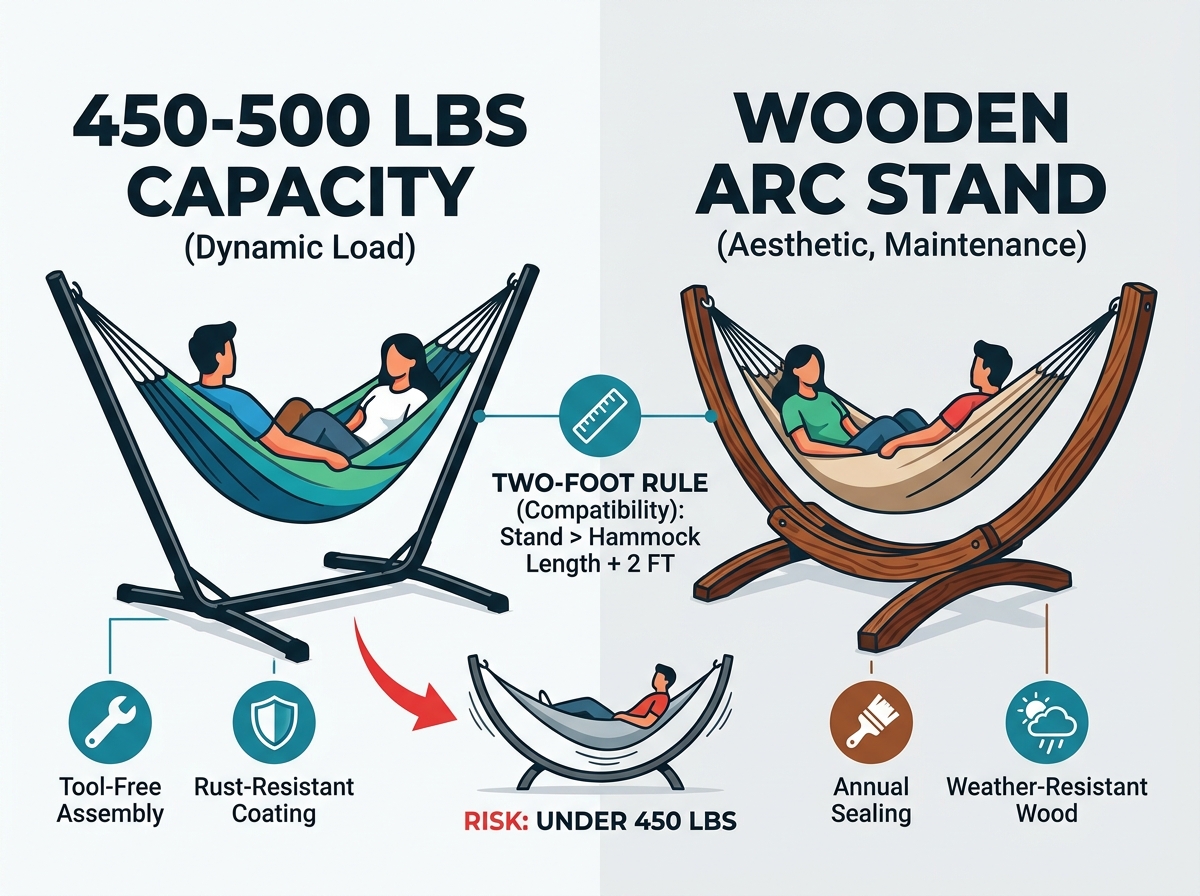
Buying outdoor furniture often feels like a purely aesthetic choice. However, suspending the weight of two full-grown adults requires a serious structural investment. You need absolute confidence in the safety, stability, and longevity of your setup. Unfortunately, many products boast "heavy-duty" or "double" labels just to make a quick sale. In reality, these flimsy frames often buckle under dynamic loads. They also succumb rapidly to environmental wear, rusting away after a single season.
We will break down exactly what makes a frame genuinely reliable. You will discover an objective, criteria-based evaluation framework to filter through misleading marketing claims. By the end, you can match the perfect 2-Person Hammock Stand to your patio, yard, or travel needs while ensuring complete hardware compatibility.
Key Takeaways
- Minimum Safe Capacity: A true 2-person hammock stand must support a static load of at least 450 to 500 lbs to account for dynamic movement.
- Material Trade-Offs: Powder-coated steel offers the best structural-to-cost ratio, while wood (larch, cedar) provides superior aesthetics but requires annual maintenance.
- Size Matching: The stand should ideally be 2 feet longer than your hammock's total length (when fully stretched) unless it features an adjustable chain-and-hook system.
- Footprint Reality: Double stands require significant floor space (typically 9 to 15 feet). Measure the intended setup area before purchasing.
Assessing Structural Integrity and Weight Capacity
When selecting a frame to suspend two people, structural integrity becomes a non-negotiable safety requirement. You must look beyond standard weight ratings and understand how materials respond to physical stress in real-world scenarios.
Static vs. Dynamic Weight
Manufacturers typically test their products using static weight. They gently place stationary weights onto the frame to determine its maximum limit. However, human bodies do not behave like static weights. People shift, swing, and bounce. We call this moving force dynamic weight. A frame rated for exactly 400 pounds might easily warp or tip if two adults weighing a combined 350 pounds shift their positions suddenly. The resulting kinetic energy acts as a multiplier, temporarily exceeding the static threshold. You must account for this discrepancy to ensure safety.
The 450+ lb Rule
Industry best practices establish a strict baseline for double-occupancy setups. We highly recommend establishing 450 to 500 pounds as the non-negotiable baseline weight capacity for any dual-user frame. This specific threshold provides a crucial safety buffer. It absorbs the extra force generated when a heavy user drops into the fabric too quickly. Frames failing to meet this standard pose significant risks of bending or collapsing during normal use.
Hardware Vulnerabilities
A heavy-duty frame means nothing if the suspension hardware fails. Buyers must rigorously inspect the quality of the included connection points. A frame is only ever as strong as its weakest link. Pay close attention to the following components:
- S-hooks: Check for thickness and closed loops. Cheap S-hooks can easily straighten out under tension.
- O-rings: Ensure they feature seamless, welded construction. Unwelded rings will inevitably pull apart over time.
- Carabiners: Look for heavy-duty, load-bearing ratings rather than flimsy keychain-style clips.
- Chain links: Verify the chain utilizes hardened steel capable of handling high tensile stress without stretching.
Base Stability
Base stability dictates how well the frame resists lateral tipping. When two people use a shared space, they rarely enter or exit at the exact same moment. This uneven loading shifts the center of gravity drastically to one side. To prevent a dangerous rollover, you need a wide base stance. Extended crossbars at the foot of the frame counteract this lateral pull, keeping the entire structure firmly planted on the ground.
![A sturdy two-person hammock stand setup outdoors]()
Evaluating Stand Materials for Your Environment
Matching the material to your specific climate prevents premature failure. No single material excels in every single environment. You must balance visual appeal against durability and weather resistance.
Powder-Coated Steel (The Pragmatic Choice)
Steel dominates the outdoor furniture market for good reason. It delivers excellent strength-to-weight performance.
- Pros: Steel offers extremely high durability. It boasts standardized weight limits you can trust. Furthermore, steel designs often feature snap-together, tool-free assembly systems.
- Cons/Risks: You must treat "rust-resistant" claims with skepticism. Powder coating provides an excellent initial barrier. However, rough handling often creates microscopic scratches in this coating. If you leave a scratched frame outside year-round, moisture will penetrate the surface and cause localized rust.
Wooden Arc Stands (The Aesthetic Choice)
For many homeowners, a wooden 2-Person Hammock Stand serves as the ultimate backyard centerpiece. The sweeping, curved architecture transforms any garden into a luxury retreat.
- Pros: Wood delivers unmatched visual appeal for patio and garden settings. The dense, substantial weight of a wooden base also provides excellent lateral stability against wind and uneven loading.
- Cons/Risks: Wood requires mandatory periodic maintenance. You must apply fresh stains or sealants annually. Always look for certified weather-resistant woods like Larch, Cypress, or Teak. You should completely avoid untreated pine, as it rots rapidly when exposed to ground moisture.
Aluminum (The Niche Choice)
Aluminum caters specifically to users prioritizing mobility over maximum rigidity.
- Pros: Aluminum remains entirely rust-proof. It is also exceptionally lightweight, making it highly portable for travelers.
- Cons/Risks: Engineers rarely design standard aluminum frames to hold two adults safely. Achieving a 500-pound capacity with aluminum requires thick-gauge extrusion, which commands a massive price premium.
Material Comparison Chart
| Material Type | Primary Advantage | Main Drawback | Ideal Environment |
| Powder-Coated Steel | High strength and affordable | Prone to rust if scratched | Covered patios, seasonal lawns |
| Weather-Resistant Wood | High stability and aesthetics | Requires annual sealing | Permanent garden installations |
| Aluminum | Rust-proof and portable | Expensive to achieve dual capacity | Humid climates, coastal areas |
Sizing, Dimensions, and Hammock Compatibility
Buying a robust frame solves only half the equation. You must ensure your fabric bed actually fits the structure. A mismatch leads to uncomfortable hangs, ground-scraping, or outright unusable setups.
The "Two-Foot Rule"
If you purchase a non-adjustable frame, you must follow the industry-standard "two-foot rule." A standard rule of thumb dictates matching a frame that is exactly two feet longer than your fabric bed. For example, a 13-foot fabric bed generally pairs best with a 15-foot frame. This calculation uses the total length of the bed when fully stretched from ring to ring. This extra space provides the perfect geometric tension, allowing the fabric to form a comfortable arc without sagging into the dirt.
Universal vs. Fixed-Length Stands
Frame designs generally fall into two distinct mechanical categories.
Fixed-length frames feature stationary hooks welded directly to the end caps. They demand exact measurements. Conversely, universal systems utilize an adjustable chain-and-hook mechanism. We strongly recommend universal stands for buyers who plan to swap styles over time. The adjustable chains let you easily modify the tension. You can seamlessly transition from a flat, tightly strung design to a deeply curved Brazilian design using the same hardware.
Spreader Bar vs. Gathered-End Compatibility
Fabric style heavily dictates structural requirements.
Flat spreader-bar designs use wooden bars at each end to keep the fabric open. They require a much tauter suspension and significantly longer frames. If you use a short frame, the rigid bars will force the center of the bed to drop dangerously close to the ground.
Gathered-end designs lack wooden bars. They bunch up at the ends, requiring a deeper "U" shape curve to cradle the body correctly. They easily adapt to shorter, more compact spaces. Always verify which style you own before finalizing a purchase.
Assembly, Portability, and Storage Realities
Your lifestyle dictates how you should manage assembly and storage. A heavy, permanent fixture suits a dedicated garden space, while lightweight mechanics favor the avid traveler.
Tool-Free vs. Bolted Assembly
The method used to join the tubing together drastically alters the user experience.
Tool-free setups rely on spring-loaded snap-button mechanisms inside steel tubing. These buttons pop into pre-drilled holes, locking the joints instantly. We consider snap-button tubing ideal for quick teardown and rapid winter storage.
Conversely, heavy bolted assemblies require wrenches and significant time to build. These bolted joints offer slightly better rigidity. They serve as the better choice for permanent patio fixtures where you never intend to move the structure.
Winterizing Your Investment
Environmental exposure acts as the primary enemy of outdoor furniture. We must remind buyers that leaving a large frame fully exposed to freezing temperatures or continuous rain dramatically reduces its lifespan. Trapped moisture inside steel tubes can freeze, expand, and crack the metal.
You must factor ease of disassembly into your buying decision. If you live in a region with harsh winters, prioritize frames you can dismantle in under ten minutes. Proper winterizing involves cleaning the components and storing them in a dry garage or shed.
Portability for Camping
Some users wish to take their dual-occupancy setup on the road. If your primary goal involves RV travel or car camping, you must evaluate the packed dimensions.
Assess the total packed weight carefully. Most steel models easily exceed 30 pounds, making them unsuitable for long hikes. Check whether the manufacturer includes a durable carrying case. A good carrying bag keeps heavy steel tubes organized and prevents them from damaging the interior of your vehicle during transit.
Conclusion
Selecting the right support structure requires careful evaluation of safety, materials, and space. You must approach this purchase systematically to guarantee long-term satisfaction.
Start your shortlisting logic by filtering out weak products. Demand a weight capacity of at least 500 pounds. Next, filter by your specific environment. Choose powder-coated steel for covered patios or weather-resistant wood for open garden aesthetics. Finally, finalize your choice by confirming compatibility. Ensure the frame perfectly matches the length and style of your fabric bed.
For your next steps, grab a measuring tape immediately. Measure your current hammock from ring to ring while pulling it taut. Then, measure your intended patio or yard space to ensure a 15-foot footprint will not block walkways. If you want a foolproof solution, choose a pre-matched combo set to guarantee flawless compatibility before you click buy.
FAQ
Q: Can one person use a 2-person hammock stand comfortably?
A: Yes. A single user can comfortably enjoy a double frame. The stand simply provides a wider, more robust, and highly stable footprint. It prevents accidental tipping during entry. Ultimately, your physical comfort depends entirely on the fabric style and material you choose, not the rigid support frame itself.
Q: Do I need a specific stand for a hammock with spreader bars?
A: Yes. Spreader bar hammocks are distinctly less forgiving with length. Because they hang relatively flat, they require longer, wider frames. You typically need a 12 to 15-foot stance. This extra length provides the necessary tension to prevent the center of the bed from sagging too close to the ground.
Q: How do I prevent a steel hammock stand from rusting?
A: Bring it indoors during harsh winters or extended rainy seasons. You should immediately touch up any visible scratches in the powder coating with a high-quality rust-inhibiting spray paint. Furthermore, strictly avoid dragging the frame across concrete patios, as this friction quickly strips away the protective base layer.