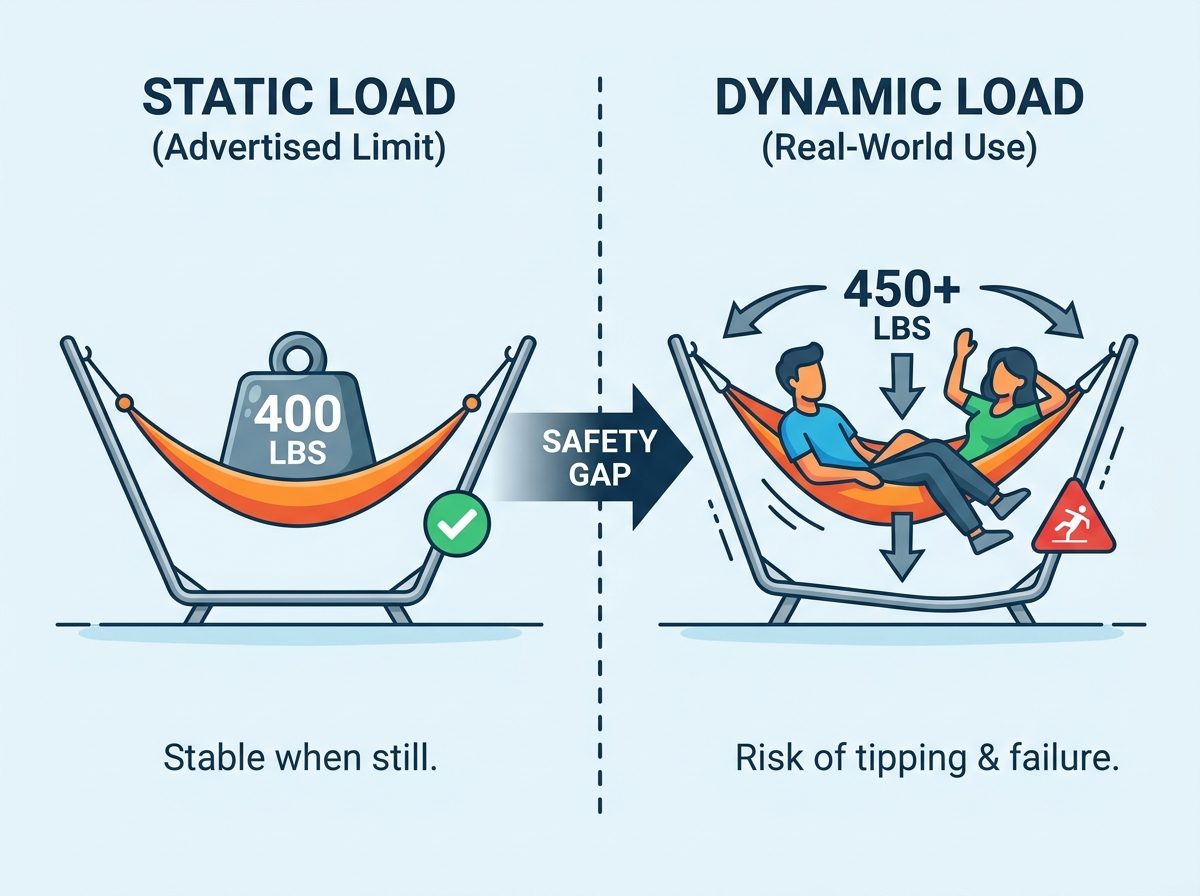
You finally bought a luxurious hammock for your backyard. You picture lazy afternoons shared with a partner. But setting it up quickly reveals a hidden flaw. Many advertised weight limits ignore real-world dynamic loads. When two people climb in, they shift, turn, and adjust constantly. An undersized frame brings immediate safety risks. You might experience lateral tipping or sudden structural failure. It also ruins comfort by causing severe sagging. You could even bottom out against the central bar.
We move past generic marketing claims to protect your physical safety. This guide focuses strictly on verifiable structural integrity. We examine verified dimensions and actual long-term weathering realities. You will learn exactly how to identify a truly secure setup for dual occupancy. We want you to relax without constantly worrying about frame collapse.
Key Takeaways
- Load Reality: A true 2-person hammock stand requires a minimum static weight capacity of 450 lbs to safely accommodate dynamic shifting.
- Material Impact: Powder-coated steel offers the best cost-to-durability ratio for most buyers, while wooden arch stands require ongoing maintenance debt for their aesthetic appeal.
- Top Recommendation: (Placeholder for Top Pick) balances a 500 lb capacity with tool-less assembly and wide-stance anti-tip safety.
- Compatibility: Not all stands fit all hammocks; identifying your hammock type (spreader bar vs. gathered-end) is the necessary first step before purchasing.
Evaluation Criteria: How We Define "Comfort and Durability"
We evaluate frames using strict engineering and safety standards. True durability goes far beyond basic visual appeal. We look closely at structural limits and daily usability.
Dynamic vs. Static Load
Static load ratings simply measure resting weight. They tell you how much sandbag weight a frame holds before bending. However, humans move. When two 200 lb adults adjust their positions, they create kinetic force. This multiplies the stress placed on the joints. A 400 lb static rating proves insufficient for active double occupancy. You need at least a 450 lb capacity to handle these dynamic load spikes safely.
Footprint & Stance Geometry
Base width directly determines lateral stability. Narrow stances tip over easily if someone pushes them from the side. You need a wide base to prevent rolling. This becomes crucial for families. Children and pets often bump into furniture. A geometrically sound footprint anchors the entire assembly firmly to the ground.
Weathering Defenses
Outdoor gear faces harsh environmental attacks daily. Cheap, thin-gauge metals suffer from interior condensation. They quickly rust from the inside out. True outdoor durability requires heavy powder coating over thick-gauge steel. Alternatively, it requires kiln-dried, pressure-treated timber. You must match the material resilience to your local climate conditions.
Hammock Compatibility (Adaptability)
One frame rarely fits all fabrics perfectly. A gathered-end Brazilian hammock drapes differently than a flat Mayan style. Spreader-bar designs require distinct tension angles. We check whether a frame includes adjustable chains. We also look for multiple S-hook placement holes. Good adaptable frames let you swap fabrics as your preferences change over time.
![2-person hammock stand structure and comfort comparison]()
Detailed Comparison: The Top 5 2-Person Hammock Stands
We applied our evaluation framework to the current market. These five models represent the safest and most reliable options available today. We outline transparent assumptions for each choice.
1. Vivere Universal Double Stand: Best Overall for Balanced Durability and Safety
This model consistently hits the sweet spot for residential users. It features an incredibly sturdy U-shape architecture.
- Success Criteria: It easily hits the 450 lb threshold. The wide anti-tip base prevents lateral rolling during entry. The heavy powder-coated finish resists rain and humidity remarkably well.
- Limitations: The dense steel construction makes it slightly heavy. It requires dedicated garage space during winter storage. You cannot easily carry it long distances.
2. Sunnydaze 15-Foot Heavy-Duty Stand: Best Heavy-Duty Steel Stand for Permanent Patios
This frame acts as a permanent backyard fixture. It offers unmatched structural rigidity for massive spreader-bar hammocks.
- Success Criteria: It boasts a genuine 500+ lb capacity rating. The heavy-gauge steel prevents any center sagging. It locks together firmly, offering maximum confidence for heavier couples.
- Limitations: It becomes very difficult to move once fully assembled. The massive 15-foot footprint creates constraints for small decks or crowded patios.
3. Petra 14-Foot Wooden Arch Stand: Best Wooden Arch Stand for Aesthetic Integration
Many buyers prioritize backyard aesthetics over pure utility. A 2-Person Hammock Stand crafted from wood transforms a simple lawn into a luxury resort space.
- Success Criteria: It delivers high-end visual appeal. The sturdy laminated pine and cypress construct provides excellent tension. The wide arc allows for optimal comfort without pinching your shoulders.
- Limitations: It demands high maintenance. You must commit to annual oiling and weather sealing. It also carries a premium price point compared to standard metal alternatives.
4. ENO Nomad Stand: Best Portable Stand for RVs and Camping
Travelers need reliable sleep systems away from home. This model breaks down rapidly for life on the road.
- Success Criteria: It features true tool-less assembly. It packs down neatly into an included carrying case. The rust-resistant aluminum construction keeps the travel weight highly manageable.
- Limitations: It possesses a lower dynamic weight tolerance. The narrower base requires cautious, centered entry to avoid tipping over at the campsite.
5. Zupapa 9-Foot Space-Saving Stand: Best Space-Saving Stand for Tight Footprints
Urban dwellers often lack sprawling lawns. This compact frame solves the space problem cleverly.
- Success Criteria: It utilizes a condensed U-shape design. It accommodates gathered-end Brazilian hammocks comfortably. It completely avoids taking up 12 to 15 feet of patio space.
- Limitations: It fundamentally lacks compatibility with long spreader-bar hammocks. It also positions the user slightly higher off the ground than traditional frames.
Material Realities: Choosing Your Stand Architecture
Your local environment dictates your material choice. Each category presents inherent structural trade-offs. You must align these realities against your maintenance patience.
Below is a quick reference guide comparing structural materials.
| Material Type | Durability Factor | Maintenance Level | Best Use Case |
| Tubular Steel | High (thick gauge) | Low to Medium | Permanent backyard setups |
| Laminated Wood | Medium (rot risk) | High (requires sealing) | Luxury aesthetics, covered patios |
| Aluminum | Medium (bend risk) | Very Low | Camping, RV travel, frequent moves |
Tubular Steel
Steel remains the outdoor furniture industry standard. You must pay attention to gauge thickness. Lower gauge numbers indicate thicker, stronger metal. Thick steel absorbs dynamic movement without warping. However, you must accept the reality of powder coating. It will eventually scratch. Once moisture penetrates those scratches, rust develops. You should keep touch-up paint handy to extend its lifespan.
Laminated Wood
Wood represents the premier aesthetic choice. A well-crafted 2-Person Hammock Stand integrates naturally into garden landscapes. But wood introduces specific vulnerabilities. You face the constant reality of wood rot. UV rays degrade the factory finish quickly. You must use breathable covers during heavy rain. Furthermore, these units often weigh over 80 lbs, making relocation incredibly difficult.
Aluminum
Aluminum dominates the portable gear sector. It naturally resists rust, making it excellent for coastal environments. Unfortunately, it historically costs more to produce. It also proves prone to bending under severe dynamic stress. If manufacturers engineer it incorrectly, the joints fail faster than steel. Choose aluminum only if you prioritize daily mobility over maximum weight limits.
Implementation Risks: Setup, Safety, and Family Use
Purchasing the right frame solves only half the problem. Improper setup introduces massive safety liabilities. You must implement strict usage rules for your household.
The "Drop Test" & Clearances
Always map out your physical clearances before assembling the frame. You need at least two feet of empty buffer space around the entire swing radius. This prevents heads from striking walls or nearby tables. Next, find perfectly level ground. Uneven terrain causes unequal weight distribution. This unequal stress shears metal joints over time. Perform a gentle "drop test" by placing heavy objects inside before human use.
Family Safety (Kids & Pets)
Children naturally treat hanging furniture like playground swings. This creates extreme tipping hazards. You must instruct kids to enter from the absolute center. Do not let them swing aggressively. We strongly recommend low-clearance stands for family backyards. If someone falls, a shorter drop minimizes injury. Additionally, you should replace basic open S-hooks with strictly locking carabiners to prevent accidental disconnections.
Assembly Realities
Know what you are buying regarding hardware. "Tool-free snap-button assembly" works beautifully for seasonal users. You can break it down in ten minutes before winter hits. However, snap buttons inherently allow slight wobbling. "Bolted hardware assembly" provides a far more secure, rigid structure. But bolts rust together over time. Bolted models essentially become semi-permanent outdoor fixtures once tightened down.
Shortlisting Logic: How to Finalize Your Purchase
You have reviewed the criteria and materials. Now you must narrow down your final choice. Use these strict elimination rules to guide your purchase.
- If you own a Spreader Bar Hammock: Rule out space-saving frames immediately. Wooden spreader bars require flat tension. You must buy a 12-foot to 15-foot frame to accommodate the necessary suspension angles.
- If you prioritize low maintenance: Eliminate all wood options from your cart. Buy a heavy-gauge powder-coated steel model instead. Pair it directly with a waterproof winter storage bag to prevent off-season rust.
- If your combined weight exceeds 400 lbs: Ignore any product boasting under a 500 lb static rating. You must prioritize heavy-duty steel. Look specifically for wide, flared bases to support dynamic shifting without tipping.
Conclusion
A reliable dual-occupancy frame serves as an investment in safety first. Comfort always follows structural integrity. You cannot relax if you feel the metal bending beneath you. Start by evaluating your exact hammock type. Next, assess your regional weather patterns. Finally, measure your available patio space carefully.
Choose your preferred model based on your primary constraint. Do you need a compact footprint? Do you want seamless garden aesthetics? Or do you require absolute maximum load capacity? Answer that question, lock down your heavy-duty carabiners, and prepare for years of secure outdoor relaxation.
FAQ
Q: What happens if we exceed the weight limit on a hammock stand?
A: Exceeding the weight limit causes immediate structural stress. You risk joint shearing, where the metal connectors tear apart. You also induce metal fatigue, permanently bending the support tubes. Finally, overloaded frames lose their center of gravity, drastically increasing the risk of lateral tipping.
Q: Can I leave a steel hammock stand outside year-round?
A: We do not recommend it. "Rust-resistant" does not mean "rust-proof." Constant exposure to snow, ice, and pooling rainwater will degrade the powder coating. Moisture enters the hollow tubes and causes internal rust. You should disassemble steel frames for winter storage.
Q: Do I need a 12-foot or 15-foot stand?
A: You can determine this with a simple measurement formula. Take your hammock's total length (from ring to ring) and add two feet for necessary chain adjustments. If your hammock measures 13 feet, you need a 15-foot frame for proper tension.