Buying a double hammock usually feels like a massive win until you realize it arrives without a frame. Generic stands often buckle, tip over, or rust quickly when forced to hold two adults swinging side by side. You cannot treat this purchase as a simple backyard accessory. Finding a sturdy 2-Person Hammock Stand requires treating it as a critical safety and longevity investment. When you suspend hundreds of pounds of shifting human weight in mid-air, you need absolute structural reliability.
We are going to cut through fluffy marketing jargon to reveal what actually keeps you safe. This guide offers a skeptical, engineering-focused look at hammock frames. You will learn exactly how to choose functional, durable support. We cover everything from heavy-duty backyard lounging to lightweight car camping setups. By the end, you will know exactly what to look for before making a final decision.
Key Takeaways
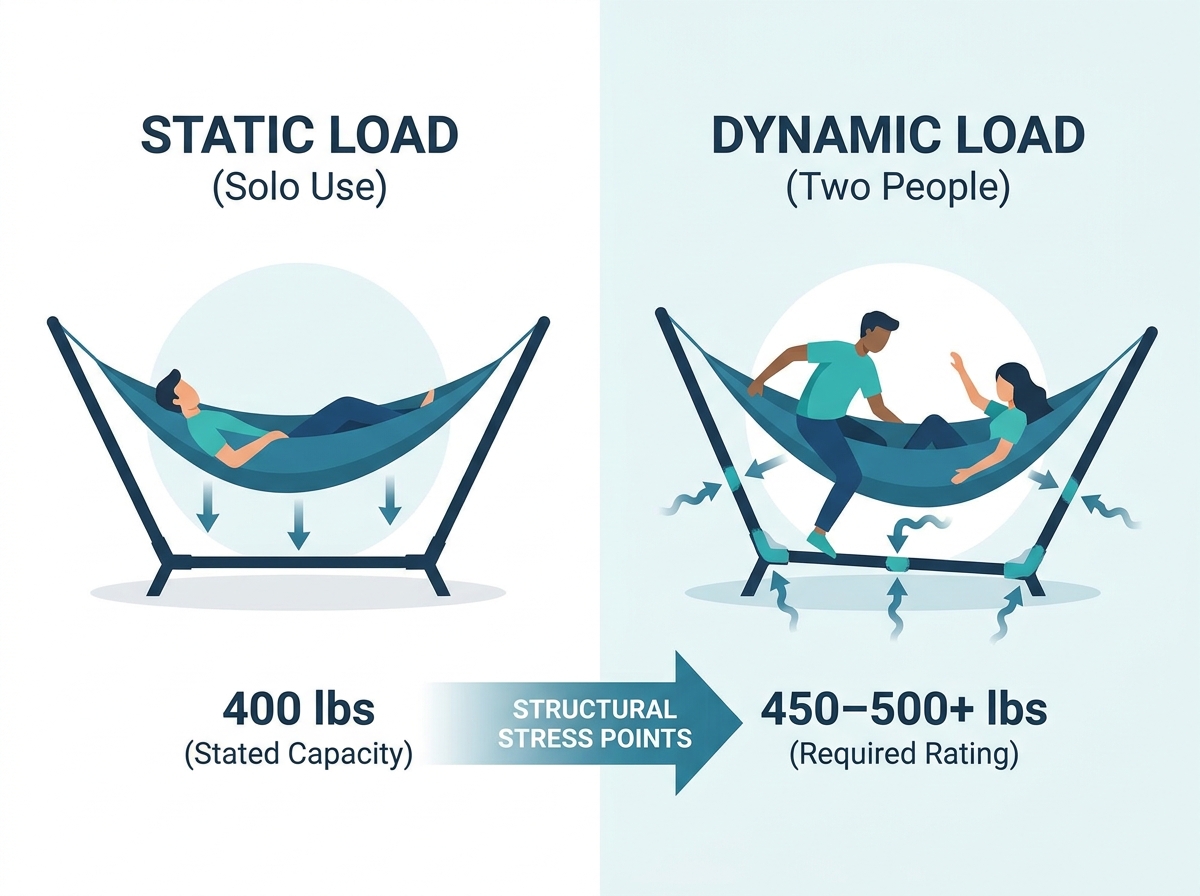
- Dynamic vs. Static Load: A stated "400 lb capacity" often refers to static weight; true 2-person stands require a 450–500+ lb rating to safely handle shifting weight.
- Material Matters: Powder-coated heavy-gauge steel is mandatory for backyard permanence, while specialized aluminum alloys are required for portable car-camping setups.
- Length Compatibility: 2-person hammocks are typically longer (up to 14 feet); a reliable stand must offer adjustable chain or hook systems to accommodate varying fabric lengths.
- Footprint Realities: Safe 2-person stands require a wider base and a larger physical footprint (often 4–5 feet wide) to prevent tipping.
Why Standard Frames Fail for Two People (The Capacity Problem)
Many consumers mistakenly believe a solo hammock frame can handle two people if they simply squeeze together. This dangerous assumption ignores fundamental physics. Standard frames undergo testing for solitary, stationary users. Adding a second person changes the structural math completely.
The Dynamic Weight Reality
Manufacturers often advertise static load capacities. Static testing involves gently placing heavy sandbags onto the fabric. Sandbags do not shift, sneeze, or bump hips. Dynamic load testing accounts for actual human behavior. Two people getting in and out generates significant kinetic energy. When one person adjusts their shoulders, the force multiplies across the frame. A sudden drop into the seat temporarily exerts forces far exceeding your combined body weight. Standard frames warp under this sudden kinetic shock. You need an over-engineered capacity to absorb these everyday jolts.
Structural Weak Points
Cheaply made frames fail in highly predictable locations. The center junction bears the highest stress load. If the base pieces simply slide together without robust locking pins or reinforced sleeves, they will eventually sag in the middle. Weld points represent another major vulnerability. Poorly executed spot welds crack under lateral tension. You should always look for continuous seam welds around the base. Finally, the base of the upright arms takes intense leverage. When two adults swing even slightly, the upright arms act like giant crowbars prying against the base joints. Weak tubular steel simply tears at these critical intersections.
The Tipping Hazard
Center of gravity dictates stability. A solo user creates a predictable, centralized downward pull. Two people create a wide, shifting center of gravity. If you and your partner lean slightly in the same direction, the balance point moves outside the base footprint. Standard solo frames feature narrow bases. They frequently cap out around three feet wide. This narrow stance invites catastrophic tipping. To stay safely grounded, a reliable two-person setup requires a significantly wider stance. Look for bases spanning at least four to five feet across. This expanded footprint acts as an anchor against lateral shifts.
![2-person hammock stand structure and stability]()
Essential Evaluation Criteria for a 2-Person Hammock Stand
You must evaluate potential purchases using strict criteria. Aesthetics matter, but structural integrity keeps you off the ground. Pay close attention to materials, adjustability, and finishing processes.
Weight Capacity & Steel Gauge
We establish 450 pounds as the absolute minimum baseline for any double stand. However, we strongly recommend securing a rating of 500 pounds or more for everyday use. Padding the capacity ensures you never push the metal to its breaking point. This safety buffer dramatically extends the lifespan of the product.
Total frame weight tells an incomplete story. Tubular steel thickness matters more. Manufacturers measure this thickness in gauges. Lower gauge numbers mean thicker steel walls. A 12-gauge steel tube resists bending far better than a thinner 14-gauge tube. Do not blindly trust total weight. A heavy frame might just use bulky, low-quality metal. Demand specifications on wall thickness and steel grade.
Adjustability & Hammock Compatibility
Hammock beds stretch and shrink. Canvas tightens in the cold. Nylon stretches over time. You must measure your hammock from O-ring to O-ring while it lays flat on the floor. You then match this measurement to common frame lengths. You will typically find 9-foot, 12-foot, or 15-foot options on the market.
A rigid hook placement ruins your suspension sag. You must achieve a 30-degree hanging angle for optimal comfort and minimal shear force. Multi-link chain systems allow precise tension adjustments. Adjustable hook nodes moving up and down the upright arms serve the same purpose. Without these micro-adjustments, you will either drag on the grass or feel squeezed like a taco.
Hammock Length to Stand Length Matching Chart
| Hammock Length (O-Ring to O-Ring) | Recommended Stand Length | Required Hardware |
| Under 10 Feet | 9-Foot Stand | Direct hook or short carabiner |
| 10 to 12 Feet | 12-Foot Stand | Adjustable S-hooks or short chains |
| 13 to 14 Feet | 15-Foot Stand | Extended multi-link chain systems |
Weather Resistance & Finish
Backyard equipment battles sun, rain, and morning dew continuously. Basic spray paint flakes off within months. High-grade powder coating provides a much tougher shell. Manufacturers bake dry powder into the metal surface, creating a resilient, unified barrier.
We must address a hard reality: no metal frame remains 100% rust-proof forever. A stray lawnmower pebble or careless dragging will scratch the coating. Once bare metal touches moisture, oxidation begins. You should mitigate this by checking the hardware. Ensure the included S-hooks, chains, and bolts utilize zinc plating or stainless steel. These materials actively resist corrosion even when heavily scratched.
Choosing Your Setup: Backyard Permanence vs. Portable Camping
Your ideal frame depends entirely on where you plan to use it. A stationary patio fixture requires completely different engineering than a weekend camping accessory. You need to align your purchase with your dominant lifestyle.
The Heavy-Duty Backyard Stand
Permanent backyard fixtures prioritize mass and stability over everything else. These robust frames form the backbone of a relaxing patio environment.
- Pros: They deliver maximum stability and the highest weight capacities on the market. Many routinely support up to 600 pounds. They feature thick weather-resistant coatings designed for prolonged UV exposure.
- Cons: They weigh heavily on the scale. Most clock in between 40 and 60 pounds. Once you assemble them, moving them across the yard becomes a frustrating chore.
- Best for: Patios, permanent lawn fixtures, heavy woven fabrics, and large spreader-bar hammocks.
The Portable / Folding Stand
Nomadic adventurers need agility. Portable frames sacrifice sheer mass for clever, collapsible engineering.
- Pros: They offer tool-free breakdown. They easily pack down into included carrying cases. Most fit comfortably into a standard car trunk.
- Cons: They inherently feature lower weight ceilings. They usually cap strictly at 400 to 450 pounds. To save weight, they also utilize narrower bases, demanding more care when climbing in.
- Best for: Car camping, RV road trips, beach days, and lightweight parachute nylon hammocks.
Feature Comparison Chart: Backyard vs. Portable
| Feature Matrix | Heavy-Duty Backyard Setup | Portable Camping Setup |
| Primary Material | Powder-coated heavy-gauge steel | Specialized aluminum or thin steel |
| Average Weight | 40–60 lbs | 15–25 lbs |
| Assembly Time | 10–20 minutes (semi-permanent) | 2–5 minutes (quick release) |
| Storage Footprint | Bulky; often requires a shed | Compact; fits in a trunk bag |
Shortlisting the Best 2-Person Hammock Stands (Decision Matrix)
Finding the right product requires matching engineering to your specific environment. We categorized the top architectural styles currently available. Review these categories to pinpoint your exact needs.
- Best Overall for Heavy-Duty Backyard Use: Look exclusively at 15-foot steel frames. These giants boast 500-pound capacities. They feature extra-wide bases designed to anchor securely onto flat patios or reinforced decks. They easily accommodate massive American-style spreader bar hammocks. The extended length ensures you never touch the ground, even as the fabric stretches over the summer.
- Best for Portability & Camping: Target hybrid steel-aluminum blends. These models utilize lightweight aluminum for the upright arms and reinforced steel for the base junction. You must demand tool-free snap-button assembly. Ensure the package includes a heavy-duty canvas carrying bag. Weak bags tear under the weight of metal poles after just two or three camping trips.
- Best Space-Saving Stand: Sometimes you lack a sprawling lawn. Focus on 9-foot frames specifically engineered for Brazilian-style setups. Brazilian fabrics lack spreader bars, allowing them to hang in a deeper U-shape. This requires less horizontal clearance. A compact 9-foot frame fits beautifully onto tight apartment balconies or small urban patios while safely holding two adults.
Assembly, Safety, and Long-Term Maintenance Risks
Even a premium 2-Person Hammock Stand degrades if neglected. Proper assembly and mindful maintenance prevent sudden accidents. You must actively manage your equipment season after season.
The "Tool-Free Assembly" Myth
Many brands boast about tool-free assembly. They use spring-loaded snap buttons or hand-tightened friction knobs. While convenient, this creates a false sense of security. Daily swinging causes micro-vibrations. These vibrations gradually loosen threaded knobs and wear down snap buttons. Periodic tightening remains mandatory. You should inspect every joint and wiggle the upright arms once a month. If you detect excessive wobble, re-secure the connections immediately.
Surface Selection
Where you place the base matters just as much as how you build it. Never set up a fully loaded double frame on soft mud. The narrow metal tubes act like cookie cutters, sinking deep into the soil. Uneven gravel causes dangerous weight distribution, stressing single weld points. Sloped ground shifts the center of gravity downward, making tipping highly likely. Always seek out flat, firm surfaces. Concrete patios, wooden decks, or densely packed, dry earth offer the best foundations.
Common Safety Mistakes to Avoid
- Placing the frame too close to brick walls or glass windows.
- Allowing children to use the frame as a playground swing set.
- Ignoring squeaking metal sounds, which often indicate joint friction.
- Using mismatched carabiners not rated for human weight.
End-of-Season Maintenance
Do not leave your frame exposed year-round. Winter weather destroys metal joints. We recommend completely disassembling the unit before the first freeze. Carefully inspect the inside of the tubular steel. Condensation often pools inside, causing invisible internal rust. Turn the tubes upside down to drain any trapped water. Before sliding the pieces back into their storage bag, apply a light coat of silicone spray or rust inhibitor to the male connection joints. This prevents the pieces from seizing together while in storage.
Conclusion
Securing reliable outdoor suspension requires looking past superficial aesthetics. The right choice ultimately comes down to matching your frame length to your fabric style and your primary location. Spreader bar hammocks demand massive 15-foot backyard anchors. Gathered-end nylon hammocks thrive on compact, portable tripods.
Do not compromise on weight capacity or base width when two adults plan to use it simultaneously. Over-engineering your purchase provides peace of mind and prevents painful accidents. Your very next step should be grabbing a tape measure. Stretch your current fabric flat on the ground and record the exact length from loop to loop. Use that number to select a frame that offers the perfect 30-degree hanging angle. Check those specifications carefully before you finally click "add to cart."
FAQ
Q: Will a 2-person hammock fit on a standard 9-foot stand?
A: It only fits if you use a gathered-end Brazilian style meant to hang low in a deep curve. Spreader bar double hammocks physically cannot fit. They typically require 12 to 15-foot stands to maintain proper tension.
Q: What happens if we exceed the weight limit by 10-20 lbs?
A: Exceeding the limit rarely causes an instant, catastrophic collapse. Instead, it causes accelerated metal fatigue. Over time, the joints warp, and the base bends. Padding your capacity rating ensures longevity.
Q: Do I need a stand with wheels?
A: Wheels add great utility if you keep heavy steel frames on flat concrete patios. They allow you to chase the shade. However, small wheels prove useless and often sink if you place the frame on soft grass.
Q: Can a hammock stand damage my lawn or patio?
A: Yes. Bare metal tubes scratch composite decks and slice into soft turf. You should use thick rubberized end-caps or specialized furniture pads for patios. On grass, distribute the weight by placing wooden boards under the feet.