Standard ultralight hammocks frequently fail under sustained outdoor use, high tension, or payloads exceeding 250 lbs. For serious camping, users need a shelter system, not a backyard toy. You cannot rely on cheap nylon when navigating remote wilderness environments. Upgrading to a robust system solves durability issues instantly. However, it introduces new complexities regarding tension forces, suspension requirements, and thermal management. You must understand how dynamic loads interact. This guide evaluates the structural criteria of high-capacity models in detail. It breaks down the implementation mechanics required for a safe, consistent sleep system. We explore anchor points, hardware limitations, and modular insulation strategies. You will learn to properly engineer a perfectly flat lay. You will also learn how to troubleshoot common issues like calf ridge. Master these essential techniques to elevate your outdoor sleeping experience. By the end, you will confidently deploy your gear anywhere.
Key Takeaways
- Material dictates performance: High-denier fabrics and double-layer construction are required to eliminate fabric stretch and prevent tear-outs.
- Suspension is the weak link: Factory-included hardware is often insufficient; upgrading to zero-stretch polyester straps and high-kN carabiners is critical.
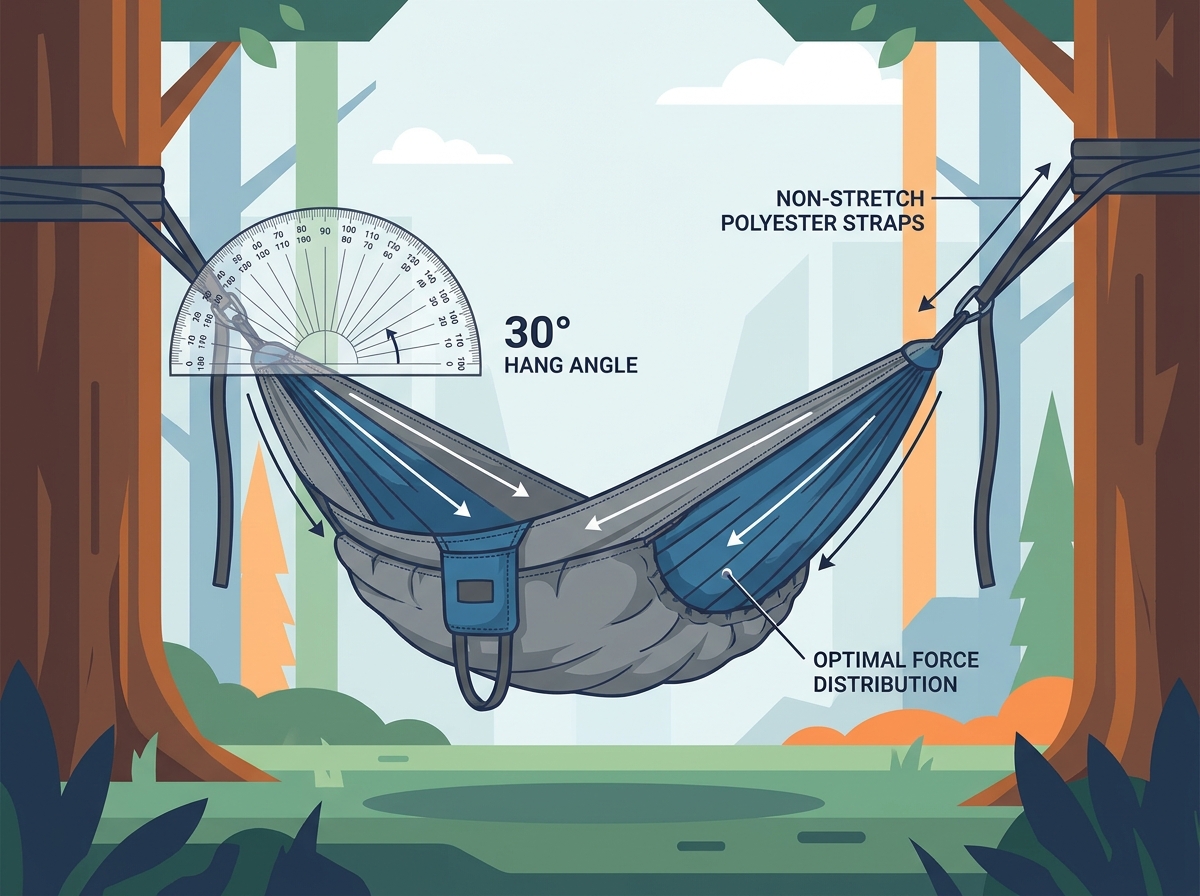
- Geometry mitigates risk: Adhering to the 30-degree hang angle prevents excessive shear force on the hammock fabric and anchor points.
- Insulation is strictly modular: Standard sleeping bags fail in hammocks due to compression; bottom insulation (underquilts) is a non-negotiable requirement for overnight use.
Framing the Requirement: When to Upgrade to a Heavy Duty Hammock
Casual setups rely entirely on 210T parachute nylon. This fabric feels soft but degrades rapidly under continuous dynamic loads. Shifting weight during sleep stresses the material heavily. High winds create sudden shock loads on the anchor points. Storing heavy gear inside adds constant strain to the fibers. You need a dedicated Heavy Duty Hammock for extended wilderness trips. Thin nylon simply cannot survive rugged environments long-term.
Evaluating payload realities requires careful mathematical consideration. Manufacturers often quote "breaking strength" on cheap equipment. They rarely advertise the true "working load limit." Breaking strength represents absolute structural failure. Working load limit dictates safe, continuous use over time. A stated weight capacity must account for multiple variables. It includes the sleeper and internal gear. It also includes the intense kinetic force of entering and exiting. Plunking down heavily multiplies your static weight dramatically. A 200-pound camper can easily exert 400 pounds of dynamic force.
Success criteria for rugged gear go beyond simple weight limits. You require zero overnight fabric stretch. Fabric stretch ruins your careful lay geometry completely. It causes severe morning back pain. You also need high abrasion resistance. Zippers, utility belts, and boots easily puncture thin parachute nylon. A true high-capacity model provides a minimum working load rating of 350 to 500 lbs. This ensures absolute safety in remote areas.
Regular equipment inspections guarantee your safety in the field. Look for early warning signs of fabric fatigue. Small micro-tears near the gathered ends indicate impending structural failure. Discoloration from UV damage also signals weakened fibers. Replacing worn gear proactively prevents disastrous midnight accidents. Do not wait until your equipment breaks.
- Avoid trusting max weight capacity as a comfortable working limit.
- Never ignore micro-tears near the gathered ends before a trip.
- Stop storing sharp objects directly on thin single-layer nylon.
Evaluating the Core Components (What Actually Makes It "Heavy Duty")
Fabric specifications define baseline performance and longevity. You must compare standard 70D ripstop nylon against double-layer construction. 70D ripstop resists punctures and tears effectively. Double layers offer distinct physical advantages. They allow you to insert a foam sleeping pad securely. The pad stays perfectly positioned between the fabric layers all night. Double layers also significantly increase overall tensile strength. They eliminate unwanted sagging under heavy payloads.
Fabric Specification Comparison
| Material Configuration | Tensile Strength Rating | Stretch Factor | Ideal Use Case |
| Single Layer 210T Nylon | Low (Approx. 250 lbs) | High (Sags overnight) | Backyard lounging, day trips |
| Single Layer 70D Ripstop | Medium (Approx. 350 lbs) | Moderate (Minimal sag) | Backpacking, moderate camping |
| Double Layer 70D Ripstop | High (500+ lbs) | Zero (Maintains geometry) | Heavy payloads, winter camping |
Stitching and seam integrity matter immensely for long-term safety. Triple-interlocking stitches on the end channels represent the baseline requirement. End channels bear the entire load of your suspension system. Single or double stitching is an immediate disqualifier for demanding use. They unravel under repeated stress cycles quickly. Check these seams before every major deployment. Look for pulled threads or separated fabric layers.
Hardware and continuous loops form the next crucial structural link. Factory setups often include standard paracord or cheap S-hooks. These components bend or snap under heavy loads instantly. You must evaluate models utilizing Amsteel continuous loops instead. Amsteel is incredibly strong and remarkably lightweight. Pair these loops with climbing-rated carabiners. Ensure they hold a rating of 12kN or higher. This guarantees they will never fail during a severe shock load event.
Carabiner selection directly impacts your setup speed and safety. Climbing-rated wire gate carabiners offer the best performance. They resist freezing in winter conditions. They also clear dirt and debris effortlessly. Solid gate carabiners work well but weigh slightly more. Never use unrated accessory clips for your main suspension.
![Heavy Duty Hammock setup and components]()
Implementation Risks: Site Selection and Suspension Dynamics
Anchor point assessment prevents catastrophic accidents outdoors. You must identify load-bearing, healthy trees carefully. Look for a minimum diameter of six inches. Inspect the root system and canopy thoroughly. Strictly avoid widowmakers during your site selection. Dead branches or rotting trunks pose severe safety risks. They can crush you silently in the night. Always look up before deploying your straps.
Suspension system realities often surprise beginners. You must use polyester or UHMWPE tree straps. Dyneema is an excellent UHMWPE option. Nylon straps stretch continuously under heavy loads. This stretching causes your setup to sink overnight. You will wake up resting on the cold ground. Polyester maintains its exact length regardless of tension or moisture. It protects the tree bark while securing your Heavy Duty Hammock safely.
The 30-degree rule is an absolute physical requirement. Hanging your gear too tightly multiplies sheer force drastically. A perfectly horizontal strap acts like a tensioned guitar string. It pulls intensely against the trees. It strains the fabric channels beyond their engineered limits. A 30-degree strap angle distributes this sheer force correctly. It drops the tension load to a manageable, safe level. It also provides the necessary slack for physical comfort.
Understanding suspension knots provides critical field redundancy. While mechanical tensioners like cinch buckles are popular, knots never fail mechanically. Master the Beckett hitch or the Marlin spike hitch. These knots release easily even after bearing heavy loads. They allow you to bypass broken hardware entirely during emergency situations.
- Always use tree straps at least one inch wide to protect bark.
- Verify your hang angle using your thumb and index finger.
- Keep the lowest point of your setup roughly 18 inches off the ground.
Setup Mechanics: Engineering the Flat Lay
Diagonal positioning is the true secret to overnight comfort. The assumption you should sleep straight down the middle is a myth. Sleeping in a straight line forces your body into a tight banana shape. This causes immediate lower back pain and joint stress. You must sleep diagonally across the fabric axis. This flattens your body entirely. It prevents painful hyperextension of your knees.
Structural ridgelines lock in your exact comfort parameters. Implement a fixed-length cord between the gathered ends. Typically, you cut this cord to 83% of the total fabric length. This guarantees the exact same sag ratio every time. It works perfectly regardless of tree spacing. You never have to guess the correct tension again. The ridgeline does all the structural math for you.
Tension troubleshooting prevents a frustrating, sleepless night. Many campers experience "calf ridge" occasionally. This feels like a tight band of fabric pressing under your legs. It cuts off circulation quickly. You can eliminate calf ridge easily through minor adjustments. Adjust the foot-end suspension 10 to 12 inches higher than the head-end. This shifts your center of gravity toward the wider middle section.
Head and neck support differs greatly from a traditional ground setup. The fabric itself provides natural elevation for your head. Using a large home pillow pushes your chin awkwardly into your chest. This restricts your airway and strains your neck. Use a small, compressible camp pillow instead. Sometimes, rolling up an extra fleece jacket works perfectly.
- Center your body mass exactly in the middle of the fabric.
- Shift your feet 15 degrees to the right side.
- Shift your head 15 degrees to the left side.
- Adjust your position until your knees rest perfectly flat.
- Lower your pillow height; you need less neck support than in a bed.
Environmental Defense and System Scalability
Thermal loss realities threaten your safety in cold weather. Convective cooling attacks you directly from below. The underside exposes you to constantly moving air. A standard sleeping bag provides top insulation perfectly. However, the bottom insulation is completely crushed beneath your body weight. This reduces its thermal R-value to near zero. Cold air strips away your body heat relentlessly. You will experience Cold Butt Syndrome within hours.
The underquilt solution solves this convective cooling entirely. You suspend the insulation directly outside the fabric. This allows the down or synthetic fill to retain its full loft. Evaluate underquilt temperature ratings based on heavy-duty, multi-season usage. Select a quilt rated 10 degrees colder than your expected environment. Use primary and secondary suspension cords to dial in the fit. Draft collars seal the ends to trap warm air effectively.
Modular weatherproofing keeps you completely dry during fierce storms. You must properly size a silnylon or Dyneema composite tarp. The tarp ridgeline must extend a minimum of 12 inches past both ends. This overlap prevents driving rain from soaking the suspension lines. Secure the tarp independently from your sleep system. This prevents rainwater from channeling down your tree straps.
Water management requires meticulous attention to detail. Rainwater travels down suspension lines easily through capillary action. It will soak your quilts if left unchecked. Tie a simple cotton string around your suspension lines under the tarp canopy. This acts as a water break or drip line. Water hits the string and drops safely to the ground.
Conclusion
Transitioning to rugged sleep systems requires moving past basic setup assumptions. It demands a working understanding of structural components. You must grasp suspension forces and modular insulation thoroughly. Audit your current setup before your next major trip. Discard low-rated suspension hardware immediately. Verify the denier or layer count of your main body. Secure a reliable structural ridgeline. Take time to practice these techniques in a controlled environment first. Do not attempt a complex setup during a dark, rainy night in the wilderness. Familiarity with your hardware builds confidence. These exact action steps guarantee you sleep safely and comfortably in any rugged environment. Master these mechanics to completely transform your wilderness experience.
FAQ
Q: How much weight can a heavy duty hammock realistically hold?
A: A true heavy-duty model supports a safe working load limit of 350 to 500 lbs. Some specialized double-layer variants reach working limits of 800 lbs. Manufacturers often test breaking strength well over 1000 lbs. Always verify the working load limit, not just the breaking strength, for daily safety.
Q: What is the practical difference between a double-layer and single-layer hammock?
A: Double-layer models use two sheets of fabric sewn together. They allow you to slide a foam or inflatable sleeping pad between the layers. This keeps the pad from shifting at night. They also stretch significantly less under heavy loads, providing better back support and increased durability against punctures.
Q: Can I use standard ropes to hang a heavy-duty hammock?
A: No. Standard rope stretches constantly under dynamic loads, causing you to sink overnight. More importantly, thin ropes bite into tree bark and cause severe permanent damage to the cambium layer. Always use wide polyester or UHMWPE tree straps to protect nature and maintain your exact suspension tension.
Q: Do I absolutely need a structural ridgeline for hammock camping?
A: It is not mandatory, but it is highly recommended. A structural ridgeline locks in the perfect sag ratio (typically 83% of the total length). It ensures you get the exact same comfortable lay regardless of how far apart your anchor trees are spaced.
Q: Why is my back cold even when using a sub-zero sleeping bag in a hammock?
A: This is called Cold Butt Syndrome. Your body weight crushes the insulation beneath you, destroying its ability to trap warm air. Cold air passing under the fabric pulls heat directly from your body via convection. You must use an underquilt or an internal sleeping pad to stop this heat loss.