Upgrading from a single hammock to a double model completely changes your setup physics. You suddenly introduce dynamic weight shifts into the equation. Two resting adults create a moving load. This movement requires a significantly wider and more stable center of gravity. Relying on an under-specced frame quickly leads to hardware failure. You might experience uncomfortable bottoming out. Worse, you risk sudden tipping hazards when both users adjust their positions.
We built this guide to give you a clear, unbiased evaluation framework. You will learn exactly how to assess a 2-Person Hammock Stand based on critical performance metrics. We cover load capacity, material durability, and exact spatial footprint requirements. Proper sizing prevents expensive mistakes. By the end, you can confidently choose the ideal structural anchor for your outdoor relaxation space.
Key Takeaways
- Capacity Base Line: A true 2-person stand requires a verified dynamic load rating of at least 400–450 lbs.
- Material Trade-offs: Powder-coated steel offers cost-effective portability; treated wood provides heavy-duty aesthetic permanence but demands seasonal maintenance.
- Dimensional Alignment: The stand must extend 1.5 to 2 feet beyond the total length of your hammock, or feature high-grade adjustable chain systems.
- Compatibility: Not all stands fit all hammocks (spreader-bar vs. gathered-end styles dictate anchor height).
Defining Baseline Load Capacity and Safety Tolerances
Filtering out undersized stands requires understanding manufacturer weight claims. Structural safety should always dictate your final decision. You must look past basic numbers on a box. True safety involves dynamic physics.
Static vs. Dynamic Weight Ratings
Many budget brands advertise a 350-pound "static" rating. This number represents dead weight gently placed onto the fabric. Static testing ignores real-world human movement. When two adults settle in, they shift their bodies. Someone adjusts their posture. A partner gets up to grab a drink. This movement creates kinetic energy.
Kinetic energy multiplies the downward force applied to your anchor points. A 350-pound static limit routinely fails under moving loads. You will notice metal groaning or bolts flexing. We recommend targeting a minimum capacity of 450 pounds. This buffer absorbs shock loads safely. It protects both the hardware and the users.
Base Width and Tipping Risks
Hammocks encourage gentle lateral swinging. This swinging motion pushes against the frame sideways. Narrow bases cannot counteract this lateral momentum. A safe dual-capacity frame needs a footprint spanning at least four feet wide.
Look closely at the contact points touching the ground. Bare metal slides easily on smooth decks. It also scratches expensive patio surfaces. High-quality bases utilize rubberized caps or wide flat feet. These additions increase surface traction. They prevent the frame from walking or slipping during active use.
Hardware Integrity Check
The main beams rarely break first. Hardware failure poses the biggest threat. You must evaluate the load-bearing S-hooks, carabiners, and chains.
- S-hooks: Avoid open hooks made from thin gauge wire. They slowly bend open over time.
- Chain Links: Welded links offer superior strength. Bent links can pull apart under heavy tension.
- Carabiners: Climbing-grade, closed-loop carabiners perform best. They lock securely and refuse to warp.
![2-Person Hammock Stand Selection]()
Material Evaluation: Steel vs. Wood 2-Person Hammock Stands
Aligning your material choice requires evaluating your local climate. You must also consider your budget and your willingness to perform maintenance. Every material presents specific trade-offs.
Powder-Coated Tubular Steel
Tubular steel dominates the portable market. This material offers moderate to high weight capacities at a reasonable weight.
Outcomes: You gain high portability. Assembly usually requires zero tools. Manufacturers frequently use snap-button mechanisms. You simply slide the tubes together until they click. This design allows rapid breakdown before severe weather strikes.
Risks/Drawbacks: Moisture remains the primary enemy. Powder coating protects the exterior beautifully. However, rain often seeps into the tube joints. Internal standing water causes hidden rust. Furthermore, snap-buttons can develop "play" or wobble. Frequent assembly and disassembly wears down the connecting holes.
Lumber/Wood (Cypress, Pine, Larch)
Wooden frames bring high architectural appeal to outdoor spaces. They act as permanent furniture centerpieces. Common woods include cypress, treated pine, and larch.
Outcomes: Wood provides exceptional rigidity. These frames inherently feature wide, heavy bases. They naturally resist tipping forces. The sheer mass dampens swinging vibrations effectively. A wooden 2-Person Hammock Stand feels incredibly solid under maximum loads.
Risks/Drawbacks: Wood restricts your mobility. Relocating a heavy timber frame across a yard requires two strong people. It also demands seasonal maintenance. You must apply oil or sealant annually. Skipping this chore leads to splintering, discoloration, and eventual rot.
Verdict Framework
Choose steel for seasonal flexibility. It stores easily in winter. Choose wood for permanent backyard installations where aesthetics matter highly.
Material Comparison Matrix
| Material Type | Assembly Style | Weather Resistance | Maintenance Level | Best For |
| Powder-Coated Steel | Tool-free (Snap-button) | Moderate (Prone to internal rust) | Low (Keep dry) | Renters, seasonal patios |
| Treated Wood | Bolt & Wrench | High (If properly sealed) | High (Annual oiling) | Permanent yards, garden features |
Sizing and Hammock Style Compatibility
Ensuring the stand mechanically fits your hammock prevents endless frustration. Not all frames accommodate every fabric design. You must align the anchor points precisely.
Matching Stand Length to Hammock Length
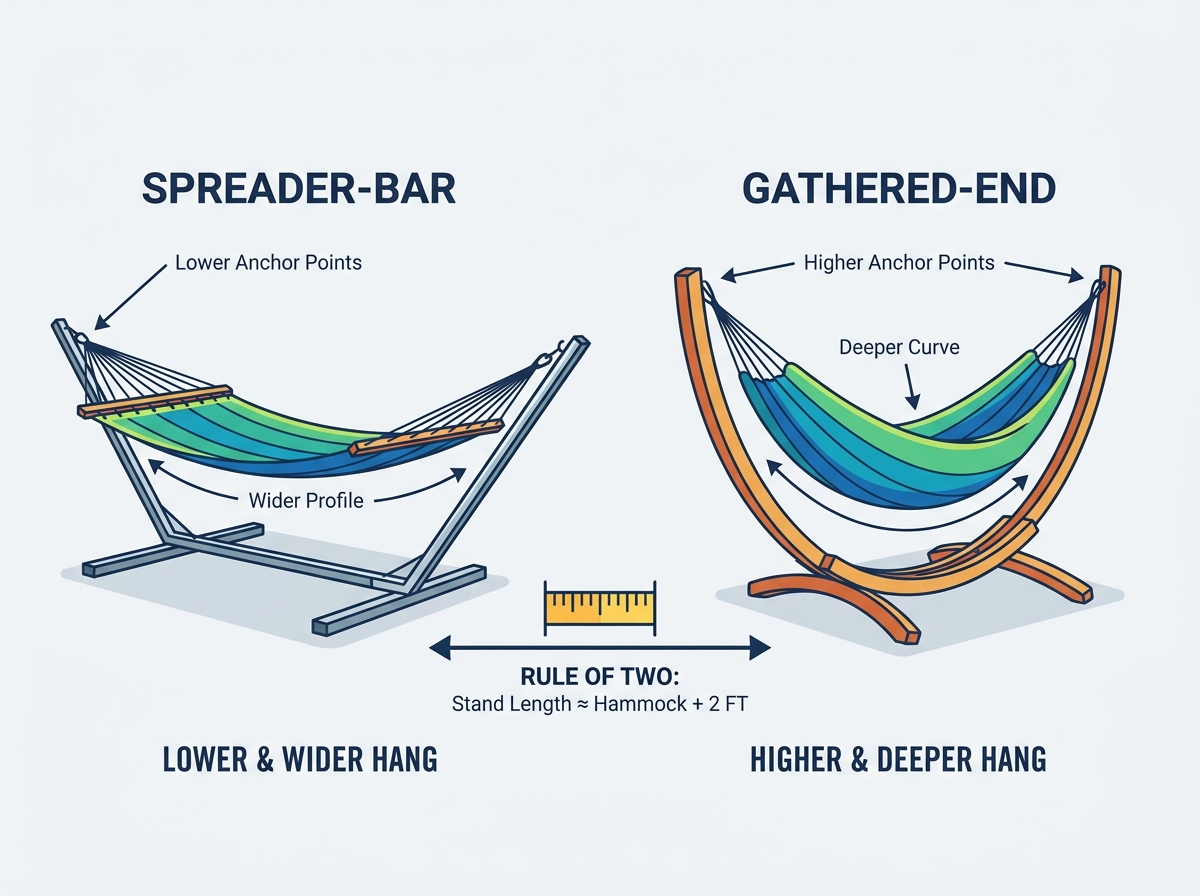
Industry professionals rely on the "Rule of Two." Your chosen frame should extend roughly two feet longer than your hammock's total length. You measure from the end ring to the opposite end ring.
Most dual-capacity hammocks measure 13 to 15 feet long. Therefore, you require a 14.5 to 15-foot frame. Shorter frames cannot generate proper tension. You will sink too low to the ground. Longer frames require massive chain extensions, which compromise stability.
Spreader-Bar vs. Gathered-End (Brazilian/Mayan)
Different bed styles dictate completely different anchor heights. You must identify your bed type before buying the frame.
- Spreader-Bar Needs: These feature wooden bars at both ends. They pull the fabric flat and tight. This flat profile requires lower, wider anchor points. They flip easily, so a low center of gravity keeps you safe.
- Gathered-End Needs: Mayan and Brazilian styles bunch the fabric at the ends. They envelop you like a cocoon. These designs require higher anchor points. You need a taller "U" shaped frame. The goal is achieving a 30-degree hang angle. This angle prevents your body from bottoming out against the central beam.
Adjustability Features
Cotton and nylon fabrics stretch over time. Your initial setup will inevitably sag after one month of daily use. Heavy-duty chain suspension systems provide massive value here. You simply move the carabiner up two links. This fine-tunes the sag instantly. Look for frames offering at least 18 inches of chain adjustability per side.
Spatial Footprint and Setup Realities
Buyers often experience post-purchase spatial regret. They underestimate the real estate required for a proper outdoor setup.
Measuring the True Footprint
You cannot simply measure the exact length of the metal base. You must account for dynamic movement. A 15-foot frame requires at least 17 feet of linear clearance.
This two-foot buffer zone is non-negotiable. It prevents users from swinging into nearby walls. It keeps the fabric away from rough fencing. It also ensures safe passage for people walking past the setup. You need a five-foot width clearance to accommodate gentle swaying.
Assembly and Breakdown
Evaluate "tool-free" claims carefully. Steel pipes push together easily on day one. By day ninety, slight rust makes them stubborn. Keep a rubber mallet handy for gentle disassembly.
Consider your storage footprint before winter arrives. Does the steel frame break down into a manageable carrying case? Long tubular sections consume significant garage space. Ensure your storage area can house multiple five-foot pipes.
Mobility After Assembly
Moving a fully assembled rig presents a challenge. Steel models are relatively lightweight. You can often drag them across a lawn easily. Wood requires careful handling. Dragging timber legs across concrete ruins the sealant. If you buy wood, strongly consider adding a wheel kit. Small caster wheels attached to one end transform a cumbersome structure into a mobile unit.
Final Shortlisting Logic: Making Your Selection
You now possess the core knowledge needed for a smart purchase. Condense these criteria into actionable next steps. Follow this logic sequence before entering your credit card details.
- Step 1: Verify the Math. Calculate the total combined weight of the primary users. Add a 20% safety buffer. This final number equals your absolute Minimum Load Rating. Do not compromise here.
- Step 2: Measure the Space. Grab a tape measure. Ensure a 17x5 foot footprint is genuinely available on your deck or lawn. Mark the corners using chalk or rocks to visualize the intrusion.
- Step 3: Check the Warranty. Prioritize brands offering clear protection. Look for 1-year minimums on steel components against rust. Ensure the brand readily supplies hardware replacements for lost bolts or chains.
Red Flags to Avoid
Always inspect product specifications for warning signs. Avoid thin gauge steel. Any wall thickness under 1.5mm will warp under dual-occupancy loads. Reject frames using plastic end-caps at weight-bearing junctions. Plastic shatters in cold weather. Finally, walk away from unverified load claims. If the manufacturer hides the weight limit in small print, find another brand.
Choosing a reliable 2-Person Hammock Stand ensures years of safe relaxation. Taking ten minutes to verify measurements and hardware quality saves you endless future headaches.
Conclusion
The best structural support prioritizes mechanical safety and spatial fit over pure aesthetics. You must calculate dynamic loads correctly. Remember that a 450-pound capacity serves as the bare minimum for dual use. Match your bed style to the correct frame shape. Gathered ends require height, while spreader bars require width. Treat your chosen materials appropriately to extend their lifespan. Always measure your intended setup area and your fabric’s total length before proceeding to checkout. Accurate measurements prevent frustrating returns and ensure an immediately comfortable backyard oasis.
FAQ
Q: Can one person comfortably use a 2-person hammock stand?
A: Yes. One person can comfortably use a larger frame. Solo users should lay diagonally across the fabric bed. This position provides the best ergonomic back support. The wider base will not negatively impact a solo user. It actually offers increased stability and tip resistance.
Q: Do I need special tools to assemble a heavy-duty hammock stand?
A: Most modern steel models use push-button joints. These require absolutely no tools to assemble. Wooden frames usually require a basic socket wrench or an Allen key. The manufacturer typically includes the necessary bolt hardware and a basic assembly tool in the box.
Q: How long do powder-coated steel stands last outdoors?
A: They typically last 5 to 7 years with proper winter storage. You must immediately treat any scratches using touch-up paint. If you leave the frame exposed year-round in harsh climates, internal rust can compromise the joints within 2 to 3 years.
Q: Will a 15-foot stand fit a 12-foot double hammock?
A: Yes. A 15-foot frame accommodates a 12-foot bed beautifully. The frame must include adjustable suspension chains. These chains easily bridge the three-foot gap. They allow you to maintain proper fabric tension and fine-tune your preferred hang angle.