Standard office chairs and car seats degrade over time. The internal foam compresses and loses its original supportive shape. This structural failure leads to bottoming out, pressure buildup, and compromised posture during long sitting sessions. You end up shifting constantly. You try to find a comfortable position. The resulting ache distracts you from your daily tasks.
A well-designed Seat Cushion Pad is not a medical cure-all. It serves instead as a practical, structural bridge to extend chair life. It effectively redistributes localized pressure away from sensitive pelvic regions. Many people purchase these products blindly. They focus on immediate softness rather than mechanical support.
We provide an objective, evidence-based framework here. You will learn how to evaluate core materials, sizing options, and design constraints. We aim to help you select a cushion tailored specifically to your biomechanical and environmental needs. Proper evaluation prevents wasted money and ensures long-term seating comfort.
Key Takeaways
- Material dictates performance: Memory foam offers contouring, gel provides temperature regulation, and high-density hybrids prevent long-term flattening.
- Thickness alters ergonomics: Adding a pad changes your relationship with the floor, desk, and armrests; adjustability is required elsewhere in your setup.
- Durability over initial plushness: Cheap foams degrade within months; professional-grade cushions rely on density, not just softness, for all-day support.
- Hygiene and stability matter: A non-slip base and a machine-washable cover are non-negotiable for daily use.
The Biomechanics of Sitting: Why Your Current Chair Fails
When you sit for extended periods, gravity works continuously against your body. Standard chair designs often fail to support the human pelvis adequately. They rely on basic foam layers. These layers flatten under continuous load.
Pressure Point Accumulation
Flat or degraded seat pans concentrate your entire body weight onto two primary areas. These are the tailbone, anatomically known as the coccyx, and the sit bones, called the ischial tuberosities. Over hours of sitting, this intense localized pressure restricts capillary blood flow. Deep tissue fatigue sets in quickly. You begin to experience numbness in your lower extremities. This discomfort forces you to constantly shift your weight.
The Pelvic Tilt Factor
Without proper structural support, your body naturally seeks the path of least resistance. This lack of resistance encourages a posterior pelvic tilt. You likely know this posture as slouching. The top of your pelvis rolls backward. This movement forcibly flattens the natural inward curve of your lower back. It ultimately places immense mechanical strain on your lumbar spine. Ligaments stretch, and spinal discs endure uneven compression.
Success Criteria for a Pad
To counter these complex biomechanical issues, a functional Seat Cushion Pad must achieve three strict criteria. If it fails one, it fails completely.
- Distribute weight evenly: It must expand the contact area across your entire thigh and gluteal surface.
- Suspend the tailbone: It needs a physical void to eliminate direct compression on the sacrum.
- Maintain structural integrity: It must resist complete compression after eight or more hours of continuous load.
Core Material Types: Assessing Solution Categories
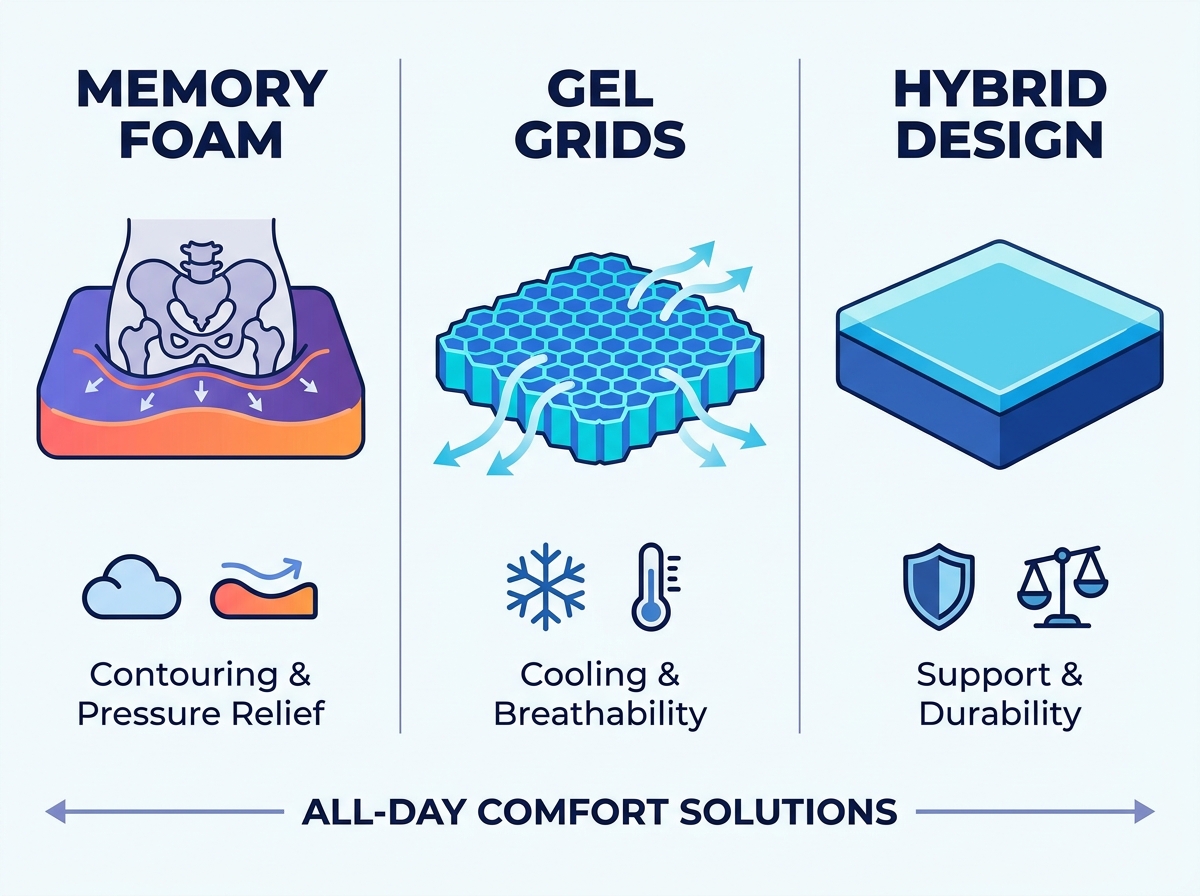
Understanding internal materials helps you match a product to your daily reality. Different base components react uniquely under sustained body weight and varying room temperatures. Manufacturers utilize three primary material categories.
100% High-Density Memory Foam
Viscoelastic polyurethane foam responds directly to body heat and pressure. It softens upon contact to mold precisely to your unique anatomical shape. We highly recommend this material for deep pressure relief and gentle posture correction. It cradles the sit bones securely. The main risk involves heat retention. Standard memory foam traps body heat efficiently. It may also become excessively firm and unforgiving in cold environments. It requires a few minutes to warm up and contour.
Cooling Gel Grids / Gel-Infused Foam
Gel options use buckling column technology or thermal-conductive gel layers. These highly elastic structures actively dissipate heat away from your body. They are the best choice for hot environments and long driving shifts. You gain maximum breathability and continuous airflow. However, a significant risk involves overall weight. Solid gel grids often weigh significantly more than foam. They can sometimes feel highly unstable or jiggly under your body.
Hybrid Designs (Foam Base + Gel Top)
Hybrid cushions combine the best traits of multiple materials. They utilize the rigid structural support of high-density foam as a base layer. They then bond a surface cooling gel layer on top. This creates a balanced, compromise-free option. It works perfectly for general all-day office workers. You get the targeted contouring of memory foam alongside the thermal regulation of cooling gel.
The chart below summarizes how these materials perform across crucial seating metrics.
| Material Type | Pressure Relief | Temperature Regulation | Structural Stability |
| Memory Foam | Excellent | Poor (Retains Heat) | High |
| Gel Grids | Good | Excellent (Maximum Airflow) | Moderate (Can feel unstable) |
| Hybrid (Foam + Gel) | Very Good | Good (Surface Cooling) | High |
![Article Image]()
Key Evaluation Dimensions: Separating Professional Pads from Gimmicks
Navigating the ergonomic market requires looking past aggressive marketing buzzwords. You must evaluate structural components directly. A proper Seat Cushion Pad relies on precise engineering, not just soft materials.
Density vs. Softness (The "Bottoming Out" Test)
Immediate plushness almost always serves as a red flag. Ultra-soft cushions feel fantastic for the first five minutes. They then compress completely under your body weight. We call this "bottoming out." Look for high density metrics or fast rebound speeds. Professional foam requires substantial force to compress. It will not flatten to less than an inch under a full adult load. Firmness indicates durability.
Ergonomic Cutouts (The U-Shape)
You must evaluate rear coccyx cutouts carefully. They must be wide enough to physically suspend the tailbone. If the cutout channel is too narrow, it causes lateral hip pinch. This pinches the sciatic nerve and creates entirely new pain points in your legs. The gap must accommodate your specific anatomy.
Dimensions and Surface Area
You need to match the pad dimensions directly to your existing seat pan. Overhang at the front edge restricts circulation. It causes severe back-of-leg numbness over time. Conversely, an undersized pad creates uncomfortable edge-pressure right under your heavy thighs. Measure your chair before purchasing.
Cover Material and Maintenance
Assess the outer cover for maximum breathability. 3D mesh fabrics typically outperform velour or plush fabrics for all-day office use. Furthermore, a removable, machine-washable cover equipped with heavy-duty zippers remains absolutely essential. Daily sitting accumulates sweat, dead skin, and dust. You must be able to wash the exterior easily.
Friction and Anchoring
A good cushion stays exactly where you put it. It requires a rubberized, non-slip bottom layer. Without this high-friction surface, the pad slides forward incrementally as you move. This sliding motion forces your pelvis forward. It ruins your posture and entirely defeats the ergonomic purpose of the product.
Use this simple numbered checklist to evaluate any potential purchase:
- Test the core material rebound speed after applying heavy manual pressure.
- Measure your current chair's seat pan width and depth accurately.
- Verify the rear coccyx cutout width accommodates your pelvis comfortably.
- Check the zipper quality and stitching on the removable fabric cover.
- Inspect the bottom surface for dense, rubberized gripping dots.
Cheap vs. Expensive Seat Cushions: Is the Upgrade Justified?
Price tags usually reflect material density and manufacturing complexity. The market offers a massive range of options. Understanding these price tiers helps you manage expectations.
Budget Tier (Under $25)
In this low price range, physical reality sets in quickly. These cheap cushions often use low-density polyurethane foam. They lack advanced viscoelastic properties. They work well enough for occasional, short-term use. You might take them to sports stadiums or use them on short domestic flights. However, they typically flatten out permanently within two to three months of standard 40-hour workweeks. The cell walls inside the foam literally burst under sustained load.
Premium Tier ($40–$100+)
Stepping up to premium products changes the sitting experience completely. These units utilize proprietary high-density memory foam or advanced hyper-elastic grid gels. They hold their structural shape for years. They include premium, breathable, washable covers. Manufacturers confidently back them with significantly longer warranty periods.
The ROI of Durability
You must calculate the financial cost of replacing cheap pads frequently. A budget pad might fail three to four times a year. Compare that ongoing expense against investing in a single, structurally sound cushion. The premium option saves you money over a two-year timeline. More importantly, it prevents the recurrent daily discomfort associated with degraded foam. High-quality materials simply last longer under compression.
| Feature | Budget Tier (<$25) | Premium Tier ($40+) |
| Foam Density | Low (Compresses easily) | High (Resists heavy loads) |
| Lifespan | 2 to 4 months | 2 to 5+ years |
| Cover Quality | Thin, non-removable | Durable, 3D mesh, washable |
| Ergonomic Design | Generic flat shapes | Contoured with precise cutouts |
Implementation Risks: How a Cushion Impacts Your Workstation Setup
Adding anything to your chair changes your spatial relationship with your environment. You elevate your body artificially. You must adjust your entire workstation accordingly to prevent new ergonomic injuries.
The Armrest Offset
Placing a two-inch pad on your seat elevates your entire torso by two inches. Consequently, your armrests become too low. You will naturally drop your shoulders or lean sideways to reach them. Assess whether your chair features height-adjustable arms. You need to raise them to compensate for your new seated height. Proper arm support prevents severe neck and shoulder strain.
Desk Height and Leg Clearance
Elevating your seating position creates immediate vertical clearance issues. Ensure this new height does not force you to hunch forward over a low desk. Additionally, you must verify you still have adequate physical clearance under the desk drawer. Pinching your upper thighs against the desk frame restricts blood circulation quickly. It can lead to deep vein issues.
Foot Placement
Elevating the seat sometimes disconnects your feet entirely from the floor. Dangling feet pull downward on your pelvis. This traction strains your lower back muscles severely. A supportive, angled footrest often becomes necessary. A footrest keeps your feet firmly grounded. It helps maintain the ergonomically correct 90-degree knee angle required for healthy circulation.
Shortlisting Logic: Which Seat Cushion Pad is Right for You?
Matching your specific environment to the right physical product ensures maximum benefit. No single design works perfectly for every human body.
For the Office Worker (8+ Hours)
Your environment usually features climate control. Prioritize high-density memory foam models. Make sure the unit features a wide, U-shaped coccyx cutout. Always opt for a breathable mesh cover. This specific combination offers the absolute best sustained support for stationary indoor environments. It corrects posture while minimizing tailbone pressure during endless meetings.
For the Commuter or Truck Driver
Vehicle seats possess distinct rearward angles and highly limited headroom. Prioritize gel grids or extremely thin hybrid models here. These materials will not drastically alter the vehicle's original seating height. They keep your head safely clear of the roof. They also preserve your crucial blind-spot visibility. Furthermore, gel maximizes airflow during long, hot summer drives.
For Heavy or Plus-Size Users
Avoid low-density memory foams entirely. They will compress instantly and provide zero mechanical benefit. Seek out extra-wide, extra-thick models designed specifically for higher weight capacities. Look for a Seat Cushion Pad measuring at least three inches in overall depth. They must be explicitly labeled as extra-firm. This ensures they successfully resist high-load compression over months of daily use.
Conclusion
A high-quality cushion serves as a highly effective, low-cost ergonomic intervention. It extends your chair's utility while significantly reducing daily bodily discomfort. You now possess the knowledge to avoid cheap, ineffective products.
Your next steps require precise action. First, measure your current chair's seat pan accurately. Second, determine your material preference based on your personal heat sensitivity and work environment. Third, review your desk and armrests to ensure you can accommodate a two-inch height increase. Finally, select a product that explicitly lists its foam density or provides a robust return policy for real-world testing. Take control of your seating posture today.
FAQ
Q: How thick should a seat cushion pad be?
A: It should typically range between 2 to 3 inches thick. Anything thicker heavily disrupts your overall chair ergonomics, armrest height, and under-desk leg clearance. Anything thinner usually fails to provide adequate pressure relief for long sessions.
Q: Do memory foam cushions make you sweat?
A: Standard memory foam can retain body heat. It relies on your heat to soften. If temperature regulation is a primary concern for you, look for gel-infused options. You can also choose pads featuring 3D breathable mesh covers to improve ambient airflow.
Q: Can a seat cushion fix lower back pain?
A: It can alleviate pressure caused by poor seating surfaces. It also promotes better pelvic alignment by preventing slouching. However, it remains a supportive tool. It is never a complete substitute for targeted medical treatment, ergonomic chairs, or regular physical movement.
Q: How do I clean my seat cushion?
A: Never put the raw foam or gel core into a washing machine. This destroys the structural integrity. You should unzip and wash the outer cover on a gentle cycle. Simply spot-clean the inner core using a damp cloth and mild soap, then air dry.
Q: Will a cushion work on a soft couch or recliner?
A: No. Seat cushion pads require a relatively firm, flat substrate to function correctly. Placing them on a sagging couch or deeply cushioned recliner will just cause the pad to cave inward. This bends the foam awkwardly and offers zero ergonomic support.