Buying outdoor gear often feels overwhelming. Choosing a hammock confuses many new buyers. Shoppers frequently assume naming conventions perfectly dictate actual usage.
This buying dilemma is very real. Most buyers assume singles serve one person while doubles comfortably accommodate two. Such misconceptions often lead to frustrating purchases failing actual use cases.
In reality, solo users overwhelmingly prefer larger models for a flatter overnight sleep, while hikers prioritize singles for aggressive weight savings. We will provide an evidence-based evaluation framework. You will learn to choose the right size based on sleep mechanics, packability, and intended use.
Key Takeaways
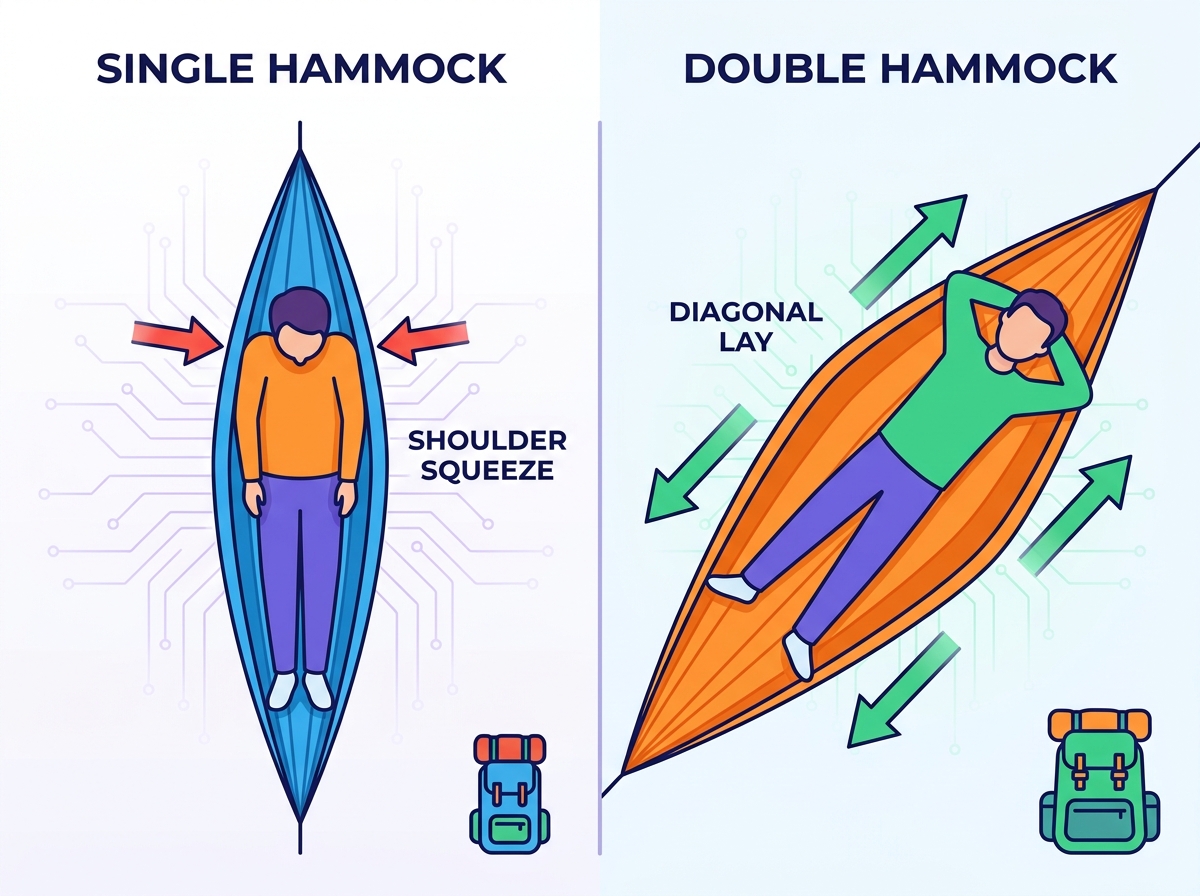
- For Solo Sleep Comfort: A double hammock provides the necessary width for an ergonomic "diagonal lay," eliminating shoulder squeeze.
- For Backpacking/Ultralight: Single hammocks save critical pack weight and volume, making them the standard for fast-and-light hikers.
- For Couples: A standard double hammock is excellent for shared lounging, but highly impractical for two adults sleeping overnight without a specialized two-person suspension system.
- The "Double" Distinction: "Double" refers to fabric width, not fabric thickness (double-layer) or necessarily sleeping capacity.
The Core Differences: Dimensions, Weight, and Capacity
Understanding physical differences between hammock sizes prevents costly mistakes. Manufacturers use distinct parameters for each category. These parameters directly influence user experience.
Defining the Single Hammock
Single models prioritize efficiency. They appeal primarily to minimalist campers. Every design choice revolves around reducing bulk.
- Typical Width: They measure between 4 and 5 feet wide. This narrow profile reduces excess material.
- Weight Profile: Singles maximize ounces saved. They usually feature lighter suspension systems. Hardware components remain small.
- Capacity Constraints: Most safely hold 250 to 300 lbs. The physical space heavily restricts movement. Users cannot roll around easily.
Defining the Double Hammock
A Double Hammock focuses on luxury and space. They cater to comfort-driven outdoor enthusiasts. The expanded dimensions create an entirely different sleep environment.
- Typical Width: They span 6 to 6.5+ feet wide. This extra fabric drastically alters sleeping angles.
- Weight Profile: They add 4 to 10 ounces of fabric weight. The bulk increases noticeably compared to singles.
- Capacity Capabilities: These models often hold 400 to 500 lbs. They require more robust stitching. Carabiners and straps must handle heavier dynamic loads.
Evaluating Packability
Packability heavily influences your buying decision. Compressed volume matters deeply when organizing a backpack. You must consider internal gear storage limits.
A single model typically compresses down to the size of a grapefruit. It slips easily into external water bottle pockets. It barely impacts a lightweight 40L backpack loadout. Conversely, larger models compress to the size of a honeydew melon. They consume valuable main-compartment space. A 65L backpack easily absorbs this extra bulk. However, smaller ultralight packs struggle to accommodate the larger dimensions.
Below is a specification comparison detailing these core differences.
| Feature | Single Models | Double Models |
| Fabric Width | 4 to 5 feet | 6 to 6.5+ feet |
| Weight Penalty | Base weight (minimal) | +4 to 10 ounces |
| Weight Capacity | 250–300 lbs | 400–500 lbs |
| Packed Size | Grapefruit | Melon |
![Double hammock setup showing wide fabric and comfortable sleeping posture]()
The Sleep Comfort Factor: Why Solos Often Choose a Double Hammock
New campers frequently experience poor sleep during their first trip. They often blame the suspension concept itself. In reality, incorrect sizing usually causes the discomfort.
The "Diagonal Lay" Mechanics
Human bodies do not bend backward comfortably. Sleeping parallel to the suspension line creates a banana shape. This posture guarantees severe back pain.
Flat, comfortable overnight sleep requires a specific technique. You must lie at a 30-degree angle across the centerline. We call this the "diagonal lay." A Double Hammock offers the necessary fabric width. It allows you to achieve this angle perfectly. Your feet and head will not spill over the edges. Your spine remains anatomically flat. You can even sleep comfortably on your side.
Mitigating "Shoulder Squeeze"
Single models present a notorious comfort issue. The narrow fabric wraps tightly around the upper body. Campers call this phenomenon "shoulder squeeze."
This tight wrapping causes distinct problems. First, it induces mild claustrophobia. Second, it physically compresses your insulation. When sleeping bags press hard against tight nylon, they lose loft. This compression creates distinct cold spots. Broad-shouldered users suffer the most. Upgrading to wider dimensions entirely eliminates this uncomfortable squeezing sensation.
Managing Excess Fabric (The Trade-off)
Extra width solves posture problems. However, it introduces a new challenge. We call this the "cocoon effect."
Smaller-framed individuals face specific annoyances. They may experience loose, flapping fabric in their faces. Wind easily catches this excess material. It can block your view of the campsite. You can mitigate this issue effectively. Use side tie-outs to stake down the edges. This simple step keeps the excess fabric tensioned and out of your face.
Activity-Based Evaluation: Matching Size to Your Scenario
No single gear piece excels everywhere. Your intended activity dictates the ideal dimensions. Carefully evaluate your trip requirements before purchasing.
- Backpacking & Thru-Hiking (Verdict: Single Hammock)
Thru-hikers obsess over gram-counting. Every ounce matters on steep inclines. You need minimal pack volume. Narrower designs also allow tighter tree-spacing requirements. You can set up in denser forests easily. The inherent risk is sacrificing optimal sleep posture. You trade overnight luxury for daytime mobility.
- Car Camping & Basecamping (Verdict: Double Hammock)
Car camping eliminates weight concerns. You transport gear directly in your trunk. Therefore, you should prioritize maximum sleep comfort. Wider dimensions offer immense lounging space. You can spread out fully. You can read, relax, or sleep flawlessly under the stars.
- Backyard Lounging & Day Trips (Verdict: User Preference)
Day trips offer flexibility. Wider models provide room to sit crossways. You can comfortably share the space for a few hours. You can lounge with a partner or a dog. Conversely, a single model is adequate for quick setups. It serves perfectly for minimalist park trips where deep sleep is unnecessary.
Clarifying Industry Misconceptions Before You Buy
Marketing terms frequently mislead consumers. Industry jargon creates unnecessary confusion. Clearing up these myths ensures you buy exactly what you need.
The "Two-Person Sleep" Myth
Marketing photos frequently show couples sleeping happily together. These images are highly deceptive. Two adults cannot sleep comfortably overnight in standard gathered-end models.
Physics dictates the reality. Gravity pulls both bodies toward the lowest center point. You will inevitably slide into the middle. You will spend the night crushing together. Shoulders and hips will ache. We recommend true two-person spreader-bar systems for actual shared sleeping. Those specific designs keep the bed physically separated and flat.
Double Size vs. Double Layer
Many beginners confuse these two distinct terms. Understanding the terminology prevents buying the wrong configuration.
"Double hammock" simply means extra fabric width. It defines the footprint. "Double-layer hammock" means two sheets of fabric sewn together. Manufacturers leave a gap between the layers. You slip a sleeping pad inside this gap. This prevents the pad from sliding around beneath you. Double layers also increase overall weight capacity. Furthermore, mosquitoes cannot bite through two layers of heavy nylon.
Length Matters as Much as Width
Buyers obsess over width. They often ignore length entirely. This oversight ruins sleep quality.
An 11-foot single model often offers a flatter lay than a 9-foot double model. Short lengths create steep hanging angles. The fabric will force your knees to bend backward. Width cannot compensate for inadequate length. Always check the overall length specification. Adults over six feet tall should strictly pursue 11-foot lengths regardless of width.
Decision Framework: Shortlisting Your Best Option
You now understand the mechanics. You know the industry terminology. Use this final framework to solidify your decision.
User Height and Build
Your physical dimensions heavily influence your choice. Be honest about your body type.
Are you under 5'6" (167cm) with a slim build? A single model is highly viable. You will likely fit diagonally without shoulder pressure. You save money and weight.
Are you over 5'10" (177cm) or do you possess broad shoulders? Wider dimensions become practically mandatory. You will struggle to achieve a flat lay in narrow designs. Prioritize comfort over weight savings.
Insulation Integration Strategy
Cold weather requires insulation. How you stay warm impacts your size requirements.
If you use an underquilt, extra width helps. It allows more room to adjust your body diagonally. You can move without snapping the quilt tension cords. If you use a sleeping pad inside the main compartment, wider designs shine again. They provide extra fabric walls. These walls keep the slippery pad from sliding out during the night.
Next Steps for Evaluation
Do not trust the large font on the packaging. Always check manufacturer specifications carefully.
Look for actual numerical dimensions. Verify the denier rating of the nylon. Higher denier numbers indicate better durability. Finally, ensure the suspension strap length fits your intended environment. Dense forests require shorter straps. West coast environments often require massive 15-foot straps to wrap around massive tree trunks.
Conclusion
Choosing the right gear directly dictates your outdoor experience. We have broken down the core differences in dimensions and weight. We explored how width impacts overnight sleep mechanics. We also matched specific sizes to popular outdoor activities.
Here is your final decision matrix. Buy a single model for strict weight savings on the trail. You will move faster and pack lighter. Buy a wider model for superior solo overnight comfort. It provides the best diagonal lay and excellent casual shared lounging space.
Take action before your next trip. Measure your available pack space carefully. Assess your shoulder width realistically. Then, proceed to read specific brand reviews matching your identified category. Finding the perfect fit guarantees years of exceptional outdoor sleep.
FAQ
Q: Can two people actually sleep in a double hammock?
A: Yes for naps, no for a full night of quality sleep due to gravity pulling both bodies to the center.
Q: Will a single hammock fit a tall person?
A: Only if it is unusually long, like 11 feet, but shoulder squeeze remains a high risk.
Q: Do double hammocks require different straps?
A: No, the suspension straps are interchangeable, but the anchor points [trees] may need to be slightly further apart to accommodate the wider sag.
Q: Is the extra weight of a double hammock noticeable in a backpack?
A: Yes, typically half a pound, which matters to ultralight hikers but is negligible for standard campers.