Finding perfectly spaced, mature trees is a rare luxury today. Relying on arbitrary anchor points compromises both your safety and comfort. Many homeowners attempt to tie straps to fence posts or porch columns. These structures simply cannot handle horizontal shear forces. For couples or families, suspension failure represents a serious safety risk. Gravity and dynamic motion multiply the stress on any mounting point. Therefore, deciding to invest in a standalone frame requires careful consideration. You must balance maximum load capacity against your available spatial footprint and desired portability. This article delivers an objective, evidence-based breakdown. We explore whether a 2-Person Hammock Stand is a necessary investment for your home. We analyze structural pros and cons in detail. We define strict evaluation criteria for heavy-duty frames. Finally, we highlight common failure risks you should check before making a purchase. You will have all the knowledge needed to hang safely.
Key Takeaways
- The Capacity Rule: A true 2-person hammock stand requires a tested static weight capacity of at least 400–500 lbs; anything less risks catastrophic failure under dynamic load.
- The Trade-off: High stability requires a large footprint (typically 9 to 15 feet in length). True portability often comes at the expense of dual-occupancy safety.
- Material Alignment: Powder-coated tubular steel offers the best cost-to-durability ratio for seasonal mobility, while heavy timber models serve strictly as permanent architectural fixtures.
- Compatibility: Not all stands fit all hammocks. Spreader-bar hammocks and traditional gathered-end hammocks require different tension angles and stand lengths.
The Practical Case: Solving the Environmental Dependency Problem
Most outdoor enthusiasts chase the "perfect tree" myth. They search endlessly for two sturdy trunks positioned exactly 10 to 15 feet apart. This specific span allows for an optimal 30-degree hang angle. It creates the perfect sag for ergonomic comfort. However, natural landscapes rarely cooperate. Backyard trees grow at irregular intervals. They often feature weak branches or shallow root systems.
Modern housing realities further complicate traditional suspension methods. Homeowner Association (HOA) rules strictly govern exterior modifications. Rental property agreements typically prohibit drilling heavy anchor bolts into exterior walls. Tree conservation also matters greatly. Wrapping thin ropes around trunks causes severe bark damage. It strips the cambium layer and harms the tree. You need a better, less destructive approach to outdoor lounging.
A worthwhile standalone frame must overcome these environmental hurdles. Buyers should judge any potential purchase using three strict success criteria:
- Predictable Tension: The frame must mathematically guarantee the correct hang angle every time you set it up.
- Weather Resilience: Materials must withstand UV exposure, humidity, and sudden rain without losing structural integrity.
- Certified Load Rating: The equipment must safely bear the weight of two moving adults without bending or tipping laterally.
You want a solution offering peace of mind. It should provide robust support without dominating your entire usable patio or yard space.
![2-person hammock stand setup]()
Pros and Cons of a 2-Person Hammock Stand
Transitioning from tree straps to a freestanding frame changes your entire lounging experience. You must weigh the structural realities before adopting this equipment. Below, we examine the transparent advantages and limitations.
The Advantages (Pros)
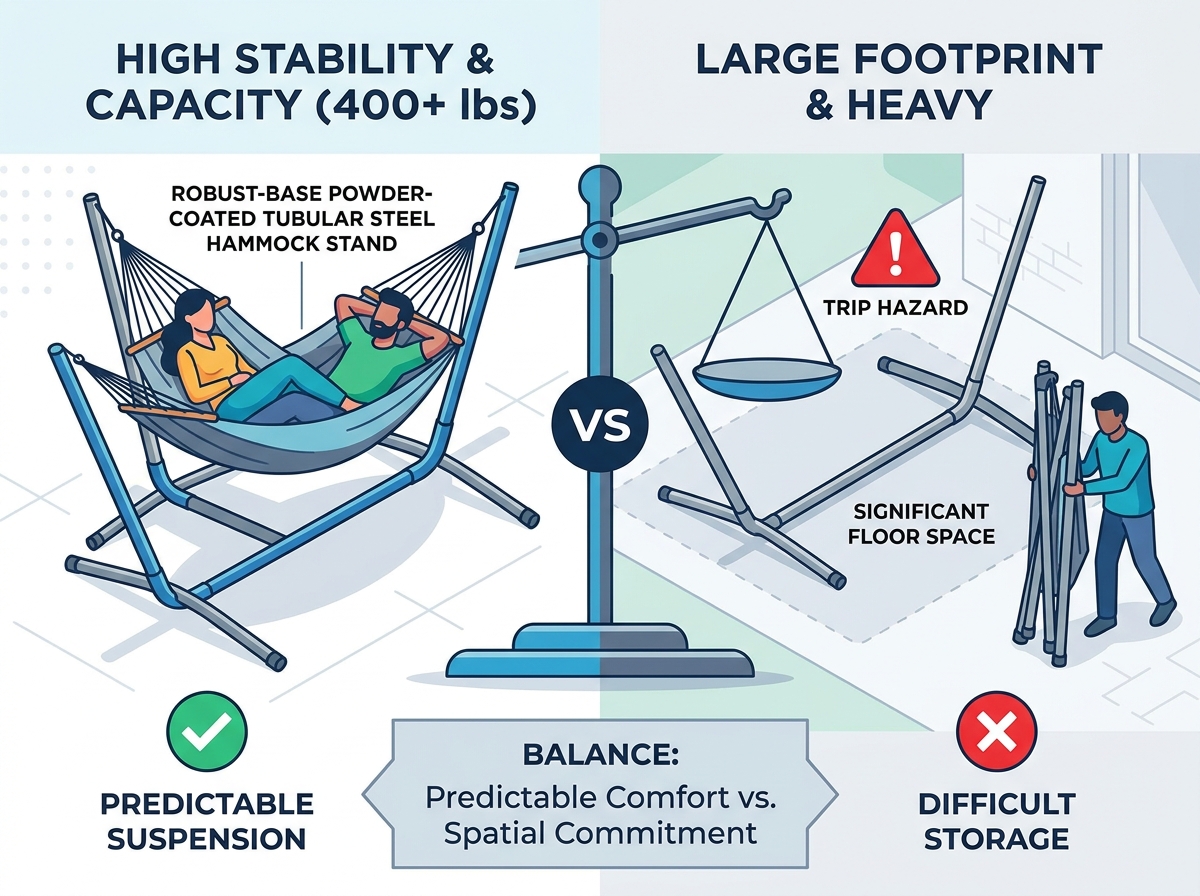
First, freestanding frames deliver predictable suspension. They eliminate stressful guesswork entirely. The distance between anchor points remains mathematically fixed. This guarantees optimal ergonomics for your back. You no longer need to adjust strap heights endlessly.
Second, these frames offer location agnosticism. You can easily move them across your yard to chase the sun or find deep shade. They allow for indoor winter use. You can simply drag them out of the way during weekly lawn maintenance.
Third, they ensure structural independence. They pose zero risk to property infrastructure or landscaping. You avoid ripping down gutters, snapping fence posts, or damaging expensive masonry. Your home remains completely untouched.
The Limitations (Cons)
Despite the benefits, freestanding models introduce clear spatial challenges. Large dual-occupancy models demand significant floor space. They often measure up to 15 feet long and 4 feet wide. This creates frustrating tripping hazards in tight patio areas.
Weight and storage also present seasonal hurdles. High-capacity frames are inherently heavy. They typically weigh between 30 and 70 pounds. Lugging these steel or wooden beams into a garage complicates off-season storage.
Finally, buyers face the dreaded "Taco Effect" risk. You must perfectly match the frame length to the fabric length. Occupants will experience excessive sag if the frame is too short. Conversely, a frame stretched too far causes claustrophobic bunching around your shoulders.
| Evaluation Dimension | The Advantages | The Limitations |
| Space & Location | Mobile across yards; zero tree reliance. | Consumes up to 60 sq ft of floor space. |
| Structural Safety | No property damage; fixed math ensures sag. | Taco effect occurs if improperly sized. |
| Handling | Provides reliable, independent support. | Heavy frames (30-70 lbs) complicate storage. |
Core Evaluation Criteria for Heavy-Duty Models
Not all frames handle two adults safely. You must evaluate heavy-duty models using expertise-driven dimensions. Features directly dictate safety outcomes.
Static vs. Dynamic Load Ratings
Manufacturers typically advertise static load ratings. This number represents the absolute maximum weight the frame holds while perfectly still. However, humans generate dynamic loads. Getting in and out of the bed multiplies the physical force exerted on the frame. A 400-pound static rating acts as the absolute minimum baseline for two adults. Anything lower risks bent tubing or sheared bolts when two people shift weight simultaneously.
Material Selection & Weathering
Your climate should dictate your material choice. Different materials offer distinct durability profiles.
- Tubular Steel: Look for heavy-gauge steel featuring a rust-resistant powder coating. Steel provides the best everyday utility. It handles minor impacts well and disassembles quickly.
- Treated Wood/Bamboo: These materials offer premium, resort-style aesthetics. However, they require rigorous annual sealing to prevent rot. They are exceptionally heavy and effectively immobile once assembled.
| Material Type | Best Use Case | Maintenance Level | Expected Lifespan |
| Powder-Coated Steel | Flexible patios, seasonal setups | Low (keep dry in winter) | 5-10 years |
| Treated Arc Wood | Permanent backyard spaces | High (annual oil/sealant) | 10+ years |
| Aluminum | Lightweight travel (rare for 2-person) | Minimal | Varies by gauge |
Base Stability & Foot Design
A high weight limit means nothing if the frame tips over easily. You must evaluate the width of the base legs carefully. Wider stances effectively prevent lateral tipping. This becomes a critical safety factor when two people shift their weight unevenly. Look for models featuring rubberized caps on the feet. These caps prevent sliding on smooth concrete surfaces.
Tool-Less Assembly
Consider how often you plan to move the unit. Assess the necessity of spring-pin construction versus bolted construction. Spring-pin designs allow for rapid, tool-less teardown before major storms. Bolted hardware offers supreme rigidity but requires wrenches and significant time to dismantle. Choose spring-pins for seasonal flexibility.
Implementation Risks: What Goes Wrong After Purchase?
Even premium equipment can fail if deployed improperly. Real-world conditions often expose hidden risks. You must mitigate these issues to protect your investment.
Soft ground sinking stands out as the most common post-purchase failure. Narrow steel feet concentrate massive amounts of weight into tiny surface areas. The frame will sink unevenly if you place it on wet mud or soft grass. This causes immediate structural imbalance. It warps the central ridge pole. You should always place heavy frames on flat, dense surfaces or structural pavers.
Hardware degradation represents another silent killer. S-hooks, chains, and carabiners usually fail before the main structural beams. Rain pools in the threaded joints. Rust quickly weakens these vital connection points. We recommend inspecting all connection hardware seasonally. Replace any pitted or rusted S-hooks immediately with climbing-rated carabiners.
Incompatible lengths ruin the lounging experience. Buying a 9-foot frame for a 12-foot traditional gathered-end bed simply will not work. Some buyers attempt to force a fit using long extension chains. Chain extensions have strict safety limits. They alter the geometry of the hang angle dramatically. They increase the risk of the fabric scraping the ground.
Finally, buyers frequently overlook the child safety factor. Freestanding frames are designed strictly for static, downward weight. They are not backyard swing sets. Lateral swinging drastically increases the risk of catastrophic tipping. A heavy steel frame falling on a child presents a severe danger. Adult supervision remains absolutely required when children use a 2-person frame.
Shortlisting Logic: Which Architecture Fits Your Space?
Choosing the right architecture depends entirely on your lifestyle and available square footage. Use this decision framework to determine your next step.
Scenario A: The Permanent Backyard Oasis
If you own a large home with a dedicated garden space, focus on aesthetics and permanence. Recommendation: Wooden arc stands. They offer incredibly high aesthetic value. They look like expensive architectural fixtures. Because they are exceptionally heavy, they easily withstand high wind storms. They are designed specifically for dedicated spaces where they will live year-round.
Scenario B: The Flexible Patio / Car Camper
If you rent a house or have a small concrete patio, prioritize modularity. Recommendation: Steel space-saving stands (typically 9 to 10 feet long). These are highly modular. You can easily pack them down into a canvas carrying case in minutes. They prove highly practical for flat surfaces. They provide an excellent 2-Person Hammock Stand experience without permanently consuming your patio.
Scenario C: The Hardcore Outdoor Enthusiast
If you prioritize extreme mobility and backcountry use, heavy-duty frames will frustrate you. Recommendation: Tensegrity stands or specialized lightweight folding aluminum frames. However, note this strict caveat: these ultralight models rarely support two adults safely due to strict weight limits. In this specific scenario, you are often better off reverting to high-quality tree straps and individual beds.
Conclusion
A high-capacity freestanding frame offers incredible independence and comfort. Our final verdict is clear: investing in this equipment is worth the money only if you lack optimal, damage-free anchor points and possess at least 12 feet of dedicated floor space. Proper clearance ensures you avoid frustrating tripping hazards.
When you prepare to buy, follow a strict purchase directive. Prioritize verifiable static weight capacities of 400 pounds or more. Choose warranty-backed, powder-coated steel over cheap, unbranded aluminum knock-offs. Quality materials directly prevent injuries caused by sudden collapses.
Your immediate next step requires a tape measure. Measure your intended patio or yard space accurately. Then, lay your current hammock completely flat on the ground. Measure it from O-ring to O-ring. Always know these exact dimensions before selecting a frame size.
FAQ
Q: Can one person comfortably use a 2-person hammock stand?
A: Yes, absolutely. Using a dual-capacity frame as a solo user provides extra diagonal sleeping space. Lying diagonally across the fabric is optimal for achieving a flatter, more ergonomic posture. The sturdy frame simply offers superior stability while you rest alone.
Q: Is it safe for kids to play on a freestanding hammock stand?
A: Freestanding frames are designed specifically for static, downward weight. Lateral swinging drastically increases the risk of tipping the heavy frame over. They are not designed to function as playground swing sets. Strict adult supervision is always required when children are present.
Q: Can I leave a steel hammock stand outside all year?
A: While powder-coated, prolonged exposure to snow and standing water will inevitably cause joint rust. Water seeps into the connection points and weakens the metal. Disassembly and dry storage during off-seasons are strongly recommended to maintain long-term structural integrity.
Q: How do I know if my hammock will fit a stand?
A: Your stand should ideally be 1 to 2 feet longer than your fabric's total length when laid completely flat on the ground. This specific extra length allows for proper tension angles. It also provides enough room to make necessary chain adjustments.