You have moved past casual curiosity and are now ready to invest in a serious outdoor sleep system. Choosing the right gear requires moving beyond marketing buzzwords. A proper setup dramatically improves your backcountry recovery and backyard relaxation. Unfortunately, colorful marketing language often obscures critical technical specifications. This lack of transparency leads many buyers to choose incorrect sizing. It causes them to misjudge weight limits or buy gear entirely mismatched for their actual environments. This guide deconstructs manufacturer specifications to provide clarity. We will break down essential dimensions, fabric weight metrics, and suspension safety ratings. We aim to provide an objective framework for your final purchase decision. You will learn exactly how to analyze a spec sheet like a seasoned outdoors expert. By the end, you will confidently match your specific body mechanics and camping style to the perfect gear.
Key Takeaways
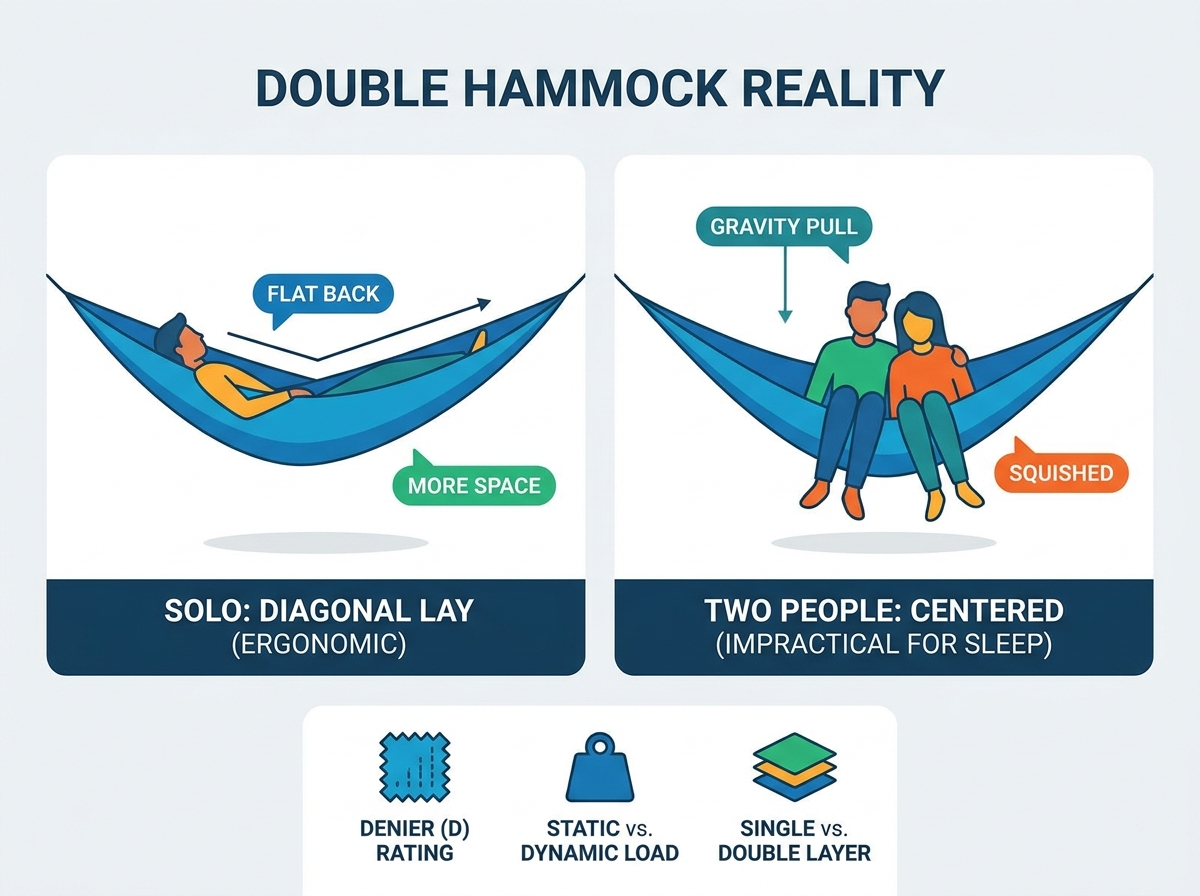
- Sizing Reality: A double hammock is rarely used for two adults sleeping overnight; its primary benefit is allowing a single occupant to achieve a flat, ergonomic "diagonal lay."
- Fabric Matters: Denier (D) ratings directly dictate the trade-off between pack weight and long-term durability.
- Load Ratings: Manufacturer weight capacities denote *static* weight; dynamic movement requires a 20-30% safety margin.
- Layering: Double-layer hammocks offer structural advantages for sleeping pads and mosquito defense that single layers cannot match.
The "Double" Misconception: Clarifying Your Success Criteria
Many buyers misinterpret the naming conventions used by outdoor gear manufacturers. Understanding what these labels actually mean is your first step toward a successful purchase.
The Solo Sleeper Advantage
Experienced campers rarely share their sleep space. In fact, seasoned hikers intentionally purchase a Double Hammock for solo use. The reasoning comes down to biomechanics. Extra fabric width allows you to position your body asymmetrically across the centerline. This diagonal angle flattens your sleeping posture out naturally. It eliminates the painful "banana shape" curve. Sleeping flat prevents hyperextension of your knees and stops morning backaches entirely. Solo sleepers need this extra room to achieve true ergonomic comfort overnight.
The Two-Person Reality
Couples must set transparent, realistic expectations before they buy. Sharing a wide bed is highly enjoyable for afternoon lounging. You can read a book or watch the sunset comfortably together. However, overnight sleeping presents a major physical challenge. Gravity forces both occupants down into the lowest central point of the fabric curve. You will inevitably crash into each other. This constant compression makes deep sleep practically impossible. Most couples who camp together actually hang two separate setups on adjacent trees.
Success Criteria
You must define what constitutes a successful purchase before analyzing technical numbers. Consider your primary environment carefully. A backyard installation requires extreme UV resistance and structural durability. Conversely, a backcountry hiker prioritizes packability and ultra-low weight. You cannot optimize for every single scenario simultaneously. Identify your core use case early. This focus prevents you from overpaying for unnecessary technical features.
![Double hammock dimensional sizing and outdoor setup]()
Dimensional Specifications: The Mathematics of Comfort
Comfort relies entirely on structural mathematics, not marketing magic. You must evaluate dimensions strictly against your own physical height.
Length-to-Height Ratio
Industry experts follow a strict evaluation rule regarding overall length. Standard models often measure around 9.5 to 10 feet long. If you stand over 5 feet 10 inches tall, you must avoid these shorter lengths. You should strictly filter for models measuring 11 feet or longer. Shorter lengths create a tense ridge of fabric right under your legs. We call this "calf ridge pressure." It causes severe cramping and ruins your sleep. Longer dimensions distribute fabric tension much more evenly across your entire body.
Width Measurements
Standard single models measure approximately 4 to 5 feet wide. A double version expands this width to around 6 or 6.5 feet. This abundant extra material enables the comfortable diagonal sleeping angle mentioned earlier. However, you must tension the suspension straps correctly. A loose setup leaves excess side fabric sagging inward. This loose material can wrap over your face during the night. It often feels highly claustrophobic for restless sleepers. You must learn the 30-degree hang angle to keep this wide fabric open and breathable.
Packed Volume
You must contrast the fully deployed size with its compressed dimensions. Manufacturers usually list packed volume in liters or cubic inches. Wider fabrics obviously require much larger compression sacks. This added bulk impacts ultralight backpackers directly. A larger packed volume consumes precious space inside a 40-liter hiking pack. You must balance your need for sleeping comfort against your limited cargo capacity.
Dimensional Sizing Guidelines
| User Height | Recommended Length | Recommended Width | Risk of Calf Ridge |
| Under 5'5" | 9.5 ft to 10 ft | 4.5 ft to 5 ft | Low |
| 5'5" to 5'9" | 10 ft to 10.5 ft | 5 ft to 6 ft | Moderate |
| 5'10" and taller | 11 ft or longer | 6 ft to 6.5 ft | High (if under 11 ft) |
Material Engineering: Evaluating Fabric Denier and Layers
Fabric construction dictates both pack weight and long-term durability. We must evaluate thread thickness and structural layering carefully.
Decoding Denier (D)
Denier measures the linear mass density of fibers. A higher number indicates thicker, heavier, and tougher threads. Here is how standard ratings compare:
- 20D-30D Nylon: These ultralight materials compress incredibly well. Hikers love them for long mileage trips. However, they demand highly careful site selection. You must avoid sharp belt buckles, thorny bushes, or rough pinecones to prevent instant punctures.
- 40D-70D Nylon: This represents the industry standard for a dependable Double Hammock. It balances tear resistance effectively against a moderate carrying weight. It withstands frequent packing and unpacking very well.
- Canvas/Cotton: Reserve these robust materials strictly for permanent backyard installations. They trap heavy moisture and invite mold growth quickly. They are simply too bulky and heavy for any form of human-powered transport.
Single-Layer vs. Double-Layer Construction
The implementation reality between layers drastically affects your climate control. Single layers use one sheet of nylon. They weigh less and breathe incredibly well. They are perfect for humid, sweltering summer nights.
Double layers feature two sheets stitched together along the edges. They offer two major structural advantages. First, you can slide a foam sleeping pad between the two fabrics. This pocket prevents the slippery pad from shifting out from underneath you. Second, mosquitoes often bite directly through thin single layers. The dual fabric acts as a physical barrier against insect stingers.
Breathability vs. Wind Resistance
Parachute nylon undergoes various chemical treatments during manufacturing. You must evaluate these treatments based on your environment. Calendared nylon features a melted, glossy finish on one side. This treatment blocks biting alpine winds effectively. However, it traps body heat and sweat. Non-calendared nylon maximizes airflow perfectly for humid, tropical environments. Always match the fabric treatment to your typical regional climate.
Suspension Systems and Structural Security
Your suspension hardware carries your entire body weight over hard ground. You must never compromise on structural security specifications.
Weight Capacity Transparency
Manufacturers frequently advertise weight limits reaching 400 to 500 lbs. You must understand they are quoting static weight capacity. Static weight implies a motionless object resting gently on the fabric. Humans move dynamically. Dropping forcefully into your seat multiplies your actual weight load through kinetic energy. A 200-lb camper might exert 300 lbs of dynamic force during a slip. We strongly advise calculating a strict 30% safety buffer. If a system claims a 400-lb limit, treat its safe dynamic limit as 280 lbs.
Tree-Safe Anchor Specifications
Environmental stewardship requires proper anchoring gear. You must avoid using raw paracord or thin ropes entirely. Thin ropes dig violently into tree bark under tension. They strip the vital cambium layer, which slowly kills the tree. They are also prone to slipping dangerously.
Instead, look exclusively for polyester webbing straps. They should measure 1-inch to 1.5-inches wide. Polyester stretches far less than nylon overnight, keeping your setup tight. Inspect the strap ends for thick, heavy-duty loop stitching. Multiple rows of bar-tack stitching guarantee the loops will not burst under heavy loads.
Hardware Ratings
Examine the metal connectors included in the box. Discard any cheap, non-load-bearing accessory clips immediately. They often bend or snap abruptly under dynamic loads. You should verify that your carabiners are wire-gate aluminum models rated for rock climbing. Look for a kilonewton (kN) stamp directly on the metal spine. A rating of 12kN or higher ensures absolute security for human suspension.
Shortlisting Framework: Matching Specs to Your Use Case
We can now connect these technical metrics to real-world applications. Use this framework to filter down your final options.
For the Car Camper / Backyard Lounger
- Prioritize durability: Filter for tough 70D+ fabric to handle playful kids or dog paws.
- Maximize width: Choose dimensions exceeding 6.5 feet wide for sprawling out.
- Ease of setup: Look for thick daisy-chain straps. They require zero knot-tying skills.
- Weight consideration: Ignore pack weight entirely. It is a non-factor for trunk storage.
For the Backcountry Hiker
- Prioritize length: Strictly filter for an 11-foot minimum length to guarantee proper spinal alignment.
- Minimize weight: Stick to 30D or 40D nylon to save precious ounces on the trail.
- Upgrade suspension: Offset the extra fabric weight of a Double Hammock by modifying the hardware. Replace heavy metal carabiners and thick webbing with ultralight Dyneema whoopie slings.
For the Cold Weather Sleeper
- Prioritize insulation features: Convection cooling pulls body heat away rapidly from underneath.
- Require double layers: Ensure the specification includes dual layers to securely hold your foam insulation pad.
- Check compatibility: Verify the physical dimensions work perfectly with aftermarket down underquilts. Cold air flowing under a loose underquilt will freeze you by midnight.
Conclusion
Moving from casual interest to a confident purchase requires analyzing technical specifications objectively. Your final checklist should prioritize function over aesthetics. Verify the overall length strictly matches your physical height to prevent calf ridge pressure. Ensure the fabric denier handles your expected environmental hazards, from backyard thorns to backcountry rocks. Finally, confirm your suspension hardware carries appropriate safety ratings for dynamic loads.
Do not let colorful patterns distract you from material engineering. We advise prioritizing core dimensions and fabric layers above bundled accessories. You can always upgrade cheap straps or bug nets later, but you can never fix an uncomfortable, undersized sleep system. Apply these rules strictly, and your next outdoor adventure will feature unprecedented comfort and security.
FAQ
Q: Can two adults actually sleep comfortably in a double hammock?
A: It is fine for a daytime nap, but overnight sleeping is highly uncomfortable for most. Gravity inevitably pulls both occupants down to the lowest center point. This forces you to crush against each other, making deep, restorative sleep almost impossible.
Q: Does a double hammock require a larger tarp or bug net?
A: Yes. A standard 10-foot rain tarp often fails to provide adequate weather coverage for an 11-foot double setup. Water will run down the exposed suspension lines. We recommend upgrading to a 12-foot hex tarp for proper storm protection.
Q: How much heavier is a double hammock compared to a single?
A: You will typically carry an additional 6 to 12 ounces compared to a single model. This extra weight depends heavily on the specific fabric denier you choose. Note that this metric excludes the weight of the suspension straps.
Q: Do I need an underquilt if I buy a double-layer hammock?
A: A double layer only holds a sleeping pad securely in place. It does not replace the fundamental need for bottom insulation when temperatures drop below 65°F. You will still need either a thick foam pad or a dedicated down underquilt.