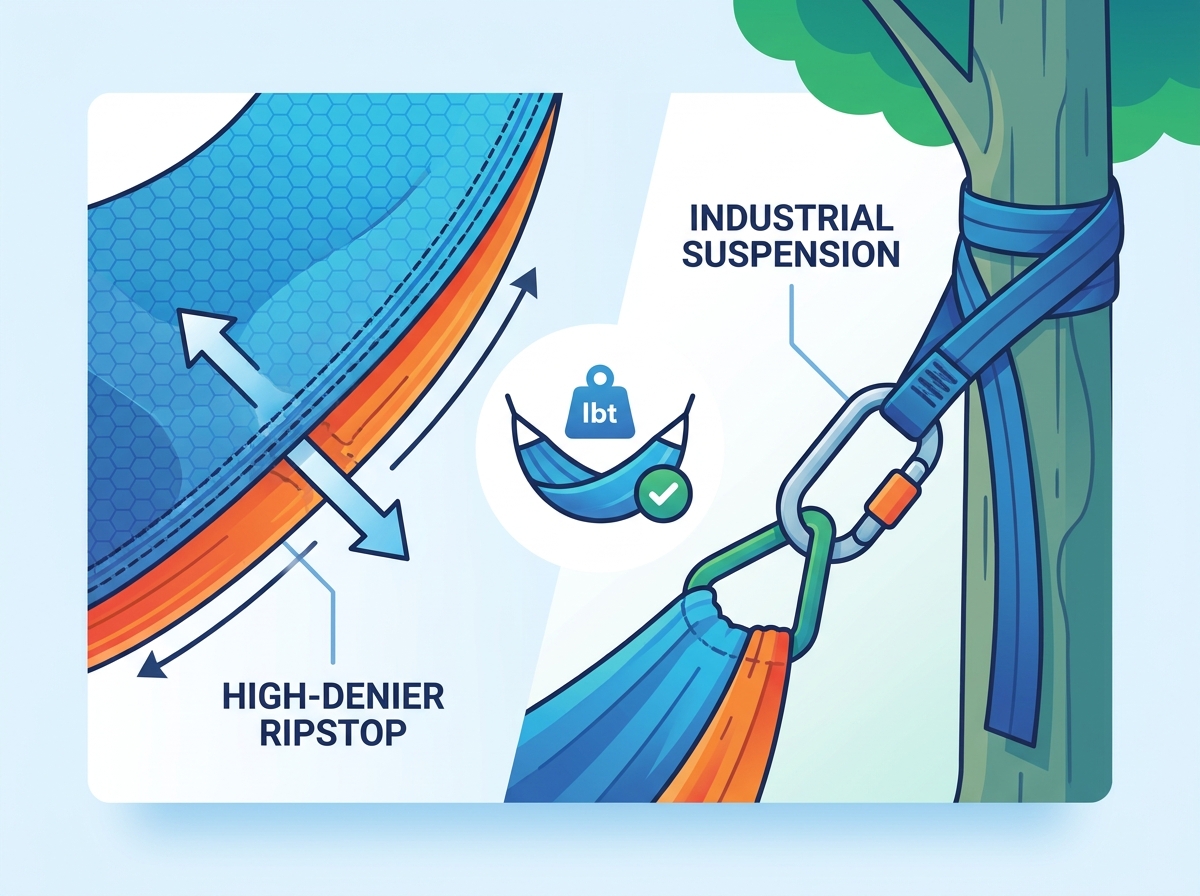
Standard outdoor gear often promises the world but delivers disappointment. A sudden tear or a snapped rope can ruin a perfectly good weekend. Outdoor enthusiasts know how quickly cheap equipment deteriorates. Sun exposure, moisture, and rough handling accelerate wear and tear. Standard hammocks frequently fail under consistent use or higher weight loads. They create frustrating safety risks and waste your money.
A true heavy duty hammock is not just about a high static weight limit. It requires high-denier fabrics, reinforced stitching, and industrial-grade suspension. Finding reliable gear changes the entire experience. We evaluated dozens of products across various environments. Today, we will explore the top five options available.
We based these selections on verified material durability, dynamic load safety, and long-term comfort. Our final recommendations prioritize your safety and relaxation. You will learn exactly what specifications matter. We will also show you how to hang your gear safely. You can confidently upgrade your outdoor lounging setup today.
Key Takeaways
- Dynamic vs. Static Load: Never buy based solely on advertised static weight; dynamic movement requires a safety buffer (aim for 400–500+ lbs capacity).
- Material Dictates Application: 70D+ ripstop nylon is mandatory for heavy-duty camping; thick canvas or quilted polyester is required for UV-resistant patio setups.
- Suspension is the Weak Link: Even the strongest hammock will fail if paired with cheap ropes; tree-friendly polyester webbing straps and climbing-grade carabiners are non-negotiable.
- The 30-Degree Rule: Durability and comfort rely on proper implementation—hanging a heavy-duty hammock too tight stresses the seams and reduces lifespan.
The Evaluation Framework: What Makes a Hammock Genuinely "Heavy Duty"?
Not all outdoor products survive rigorous use. Marketing departments often inflate weight ratings. We must look beyond the box to find genuine quality. You need a strict evaluation framework to assess true durability. We break down the four most critical components below.
Working Load Limits (WLL)
Weight capacity numbers often confuse buyers. Manufacturers usually test products in a laboratory. They load static weight until the material finally rips. Industry professionals call this the breaking strength. However, humans do not sit perfectly still. We shift, bounce, and adjust our positions.
Dynamic movement drastically increases the force applied to the fabric. You should look at the Working Load Limit instead. The WLL represents the actual safe capacity for real-world use. A product might break at 1,000 pounds in a lab. Its safe working load might only be 400 pounds. Always ensure the WLL comfortably exceeds your expected user weight.
Fabric Integrity & Weave
Fabric density determines long-term survival. We measure synthetic fabrics using denier (D) or thread count (T). Standard camping gear often uses 20D or 40D nylon. These thin materials save weight but sacrifice strength. Genuine heavy-duty applications require 70D nylon or higher. Some ultra-tough models use 210T nylon.
The weave pattern matters just as much as the thickness. You should look for ripstop patterns. Manufacturers weave thicker reinforcement threads into a grid across the fabric. If a sharp object punctures the material, the grid stops the tear. The micro-tear cannot spread further. For cotton models, look for a heavy 14-ounce canvas weave.
Construction Tolerances
Strong fabric means nothing if the seams fail. Sewing creates tiny holes in the material. Poor stitching turns these holes into perforated tear lines. You must inspect the construction tolerances closely. Triple-stitched seams are mandatory for weight-bearing joints.
Pay special attention to the gathered ends. We call this area the whipping. The whipping bundles the fabric together and attaches to the suspension loop. It must distribute tension evenly across the entire width. Poorly gathered ends place stress on the outer edges. This uneven tension causes premature tearing near the loops.
Hardware Specifications
Your hardware must match your fabric strength. Many brands cut corners on carabiners and loops. Avoid cheap ropes at the gathered ends. Require continuous loops made from Amsteel or high-tensile polyester. Amsteel is incredibly light but stronger than steel cable.
Examine the included carabiners carefully. Standard accessory clips belong on keychains, not suspension systems. You need climbing-grade hardware for absolute safety. Look for wire-gate or solid steel carabiners. They should boast a rating of at least 12kN. This rating equals roughly 2,697 pounds of breaking strength.
![Heavy duty hammock suspended securely outdoors]()
The Top 5 Heavy Duty Hammocks (Categorized by Use Case)
We categorized our top picks based on specific environmental needs. No single product excels in every situation. A backpacker needs different features than a homeowner. Review the categories below to find your perfect match.
1. Best Overall for Outdoor Durability: The High-Denier Parachute Nylon Double
Parachute nylon remains the gold standard for active outdoor use. It offers incredible strength-to-weight ratios. The high-denier double version provides massive space. Two adults can sit comfortably without stressing the seams. It packs down to the size of a grapefruit.
This style shines during rugged camping trips. It dries quickly if caught in a rainstorm. The ripstop grid easily handles rough bark and pine needles. You can toss it into your car trunk for impromptu stops. It requires minimal maintenance.
- Success Criteria: 500 lb capacity, 70D+ ripstop nylon, highly packable.
- Best For: Backpackers and campers who need industrial strength without excessive pack weight.
- Pros: Exceptional tear resistance and lightweight portability.
- Cons: Lacks the padded comfort of backyard models and offers no insulation from cold air.
2. Best for Patio & Backyard: The Quilted Polyester with Spreader Bars
Backyard lounging requires maximum comfort. A Heavy Duty Hammock featuring quilted polyester transforms your patio. The spreader bars keep the fabric pulled flat. You do not sink into a deep cocoon. It feels more like a floating mattress.
Polyester excels against harsh sun exposure. It resists harmful UV rays much better than nylon. The synthetic fibers also prevent mildew buildup after rain. Solid hardwood spreader bars add structural integrity. They create a beautiful aesthetic for permanent seasonal setups.
- Success Criteria: 450+ lb capacity, UV/mildew-resistant synthetic fabric, hardwood spreader bars.
- Best For: Permanent seasonal outdoor installations where weather exposure is constant.
- Pros: Highly comfortable and sun-resistant for long summer days.
- Cons: Inherently unstable with a flipping risk. It is also bulky and difficult to store.
3. Best for Long-Term Setup: The Heavy-Weight Cotton Canvas Classic
Nothing matches the tactile feel of pure cotton canvas. It offers a soft, skin-friendly texture. The heavy 14-ounce canvas provides incredible structural stability. It wraps around you securely without feeling claustrophobic. The tight weave blocks cool breezes on chilly evenings.
This option thrives in dry, sheltered environments. It is the ultimate choice for a covered porch. Many users hang them indoors for daily reading. The breathable weave keeps you cool in warm, dry climates. You must protect it from moisture to ensure longevity.
- Success Criteria: Tightly woven 14oz+ cotton canvas, 400 lb capacity, breathable weave.
- Best For: Covered porches, indoor use, or dry-climate lounging.
- Pros: Unmatched tactile comfort and structural stability.
- Cons: Highly susceptible to mold and mildew if left in the rain.
4. Best Freestanding Solution: The Heavy-Duty Steel Stand Combo
Not everyone has mature trees in their yard. Renters often cannot install anchor hooks in walls. A heavy-duty steel stand combo solves these problems instantly. It provides complete independence from your environment. You can move the setup across your lawn anytime.
The frame relies on thick, 12-gauge steel tubing. A wide stance prevents tipping during use. Powder-coated finishes protect the metal from rust. This combo eliminates all guesswork regarding suspension angles. The geometry is perfectly calculated by the manufacturer.
- Success Criteria: 12-gauge powder-coated steel frame, wide stance, 450 lb combined capacity.
- Best For: Renters, treeless yards, and users prioritizing setup consistency.
- Pros: Eliminates suspension variables and completely removes tree damage risks.
- Cons: Heavily restricts portability due to the massive weight of the steel frame.
5. Best for Tall/Heavy Users: The Asymmetric Heavyweight Sleeper
Standard dimensions often fail taller individuals. If you are over six feet tall, standard lengths cramp your legs. An asymmetric heavyweight sleeper solves this ergonomic nightmare. These models measure eleven feet or longer. They utilize a structural ridgeline to maintain consistent sag.
You lie diagonally across the fabric. This position flattens your body perfectly. It eliminates the dreaded curved spine posture. Heavyweight users appreciate the massive 500-pound capacity limit. It serves excellently as an overnight sleep replacement during long camping trips.
- Success Criteria: Extended length (11+ feet), structural ridgeline, 500 lb capacity.
- Best For: Users over 6'2" or those using the hammock for overnight sleep replacement.
- Pros: Provides a perfectly flat, ergonomic lay for superior back support.
- Cons: Requires a longer distance between anchor points to hang correctly.
Implementation Risks: Suspension and Anchor Point Failures
Buying strong fabric only solves half the problem. Most catastrophic accidents happen because the suspension fails. You must treat the entire system as a single chain. The system is only as strong as its weakest link. We will examine common implementation mistakes below.
The Hardware Bottleneck
Many users assume the fabric represents the only failure point. They attach strong nylon to cheap hardware. Metal S-hooks are notorious for bending under dynamic tension. When you bounce, the S-hook flexes outward. Eventually, it straightens out and drops you entirely.
Cheap paracord presents another major hazard. Paracord stretches significantly under heavy loads. The friction generates heat, which degrades the inner nylon strands. Dynamic tension destroys unrated cordage quickly. You must upgrade to static polyester webbing and rated carabiners. They do not stretch, and they securely lock your system.
Tree Safety & Compliance
We must protect the environments we enjoy. Hanging gear from trees requires responsible practices. Thin ropes act like saw blades against tree bark. When you apply 400 pounds of pressure, ropes slice into the cambium layer. This damage can permanently stunt or kill a healthy tree.
You should always follow "Leave No Trace" principles. State and national parks strictly regulate suspension methods. They require 1-inch to 2-inch wide polyester webbing straps. Wide straps distribute the pressure safely over a larger surface area. They prevent bark stripping and keep you compliant with park regulations.
Angle of Tension
Understanding the physics of your hang prevents disaster. Many beginners try to hang their setup as tightly as possible. They pull the straps taut at a 0-degree angle. They want a flat surface, but they create a dangerous physics problem.
A taut line exponentially multiplies the lateral force on anchor points. If you weigh 200 pounds and hang flat, you apply hundreds of pounds of sheer force to the seams. We highly recommend the 30-degree hang angle. It safely distributes your weight downwards. This angle ensures maximum longevity for both the fabric and the suspension.
Shortlisting Logic: How to Choose Your Heavy Duty Hammock
Narrowing down your choices requires practical evaluation. You must match the product specifications to your lifestyle. Impulse buying leads to incorrect gear choices. Follow our logical progression to identify your ideal setup.
Assess Environmental Exposure
Your local climate dictates your material choice. Think about where this gear will live. Will you pack it away daily after use? Choose nylon for its portability and quick-drying nature. It handles damp mornings perfectly.
Will you leave it in the sun all summer? Standard nylon degrades rapidly under constant UV exposure. You should choose quilted polyester or premium Sunbrella fabrics. They resist fading and weather damage during long seasonal deployments.
Material Suitability by Environment | Environment | Recommended Material | Primary Benefit |
| Backcountry Camping | 70D+ Ripstop Nylon | Ultra-lightweight and highly packable. |
| Sunny Backyard/Patio | Quilted Polyester | UV resistance and soft padding. |
| Covered Indoor Porch | 14oz Cotton Canvas | Maximum tactile comfort and breathability. |
| Wet/Humid Climates | Synthetic Blends | Prevents mold and dries extremely fast. |
Calculate Total User Weight
Never play it close to the maximum limit. Calculate the total combined weight of all potential users. Include yourself, your partner, and even your pets. Once you have that number, add a safety buffer.
We recommend adding a 20% safety buffer to your expected combined weight. If you expect 300 pounds of total user weight, target a 360-pound minimum capacity. This buffer accounts for dynamic movement and unexpected drops. It protects your investment over the long term.
Measure Anchor Distance
Verify your available space before purchasing. Many people buy large models without checking their trees. Heavy-duty options, especially 11-foot asymmetric models, require significant room. You need proper distance to achieve the correct 30-degree hang angle.
Standard models generally require 10 to 12 feet of space. Extended sleepers require 13 to 15 feet between anchor points. Measure the distance between healthy, mature trees. If you plan to use structural posts, ensure they are anchored deeply in concrete.
Conclusion
Investing in a heavy duty hammock ensures lasting comfort and security. Cheap alternatives often fail quickly, resulting in injuries and wasted funds. High-quality materials and strict construction tolerances provide absolute peace of mind. You can relax fully when you trust your equipment.
Your safety also depends on your suspension hardware. Upgrading your straps and carabiners guarantees the integrity of your entire system. Proper hanging techniques extend the lifespan of your gear significantly.
Take action before your next outdoor adventure. Measure your intended hanging space carefully. Audit your current suspension hardware and throw away cheap S-hooks. Select the product category that perfectly matches your primary environment. You are now ready to enjoy unparalleled outdoor relaxation.
FAQ
Q: Can any tree support a heavy duty hammock?
A: No. You must choose healthy, mature hardwoods to anchor your setup safely. Look for trees with at least a 6-to-8-inch trunk diameter. Dead branches or young saplings can easily snap under dynamic weight, causing severe injury.
Q: How do you wash a heavy-duty nylon hammock?
A: First, remove all carabiners and suspension hardware. Use a front-loading washing machine on a delicate cycle with cold water. Add a mild, technical gear detergent. Never machine dry the fabric; always hang it outside in a shaded area to air dry.
Q: Do high weight capacities mean the hammock is indestructible?
A: No. Weight capacity only indicates structural tension strength. It does not measure puncture or abrasion resistance. Sharp objects like keys, pocket knives, or dog claws will still destroy high-capacity fabrics instantly.
Q: Are spreader bar hammocks safer for multiple people?
A: No, this is a dangerous myth. Spreader bars create a flat surface, which raises the center of gravity. This makes them significantly more prone to flipping. Even if the weight capacity is sufficient, sudden movements can easily eject multiple users.