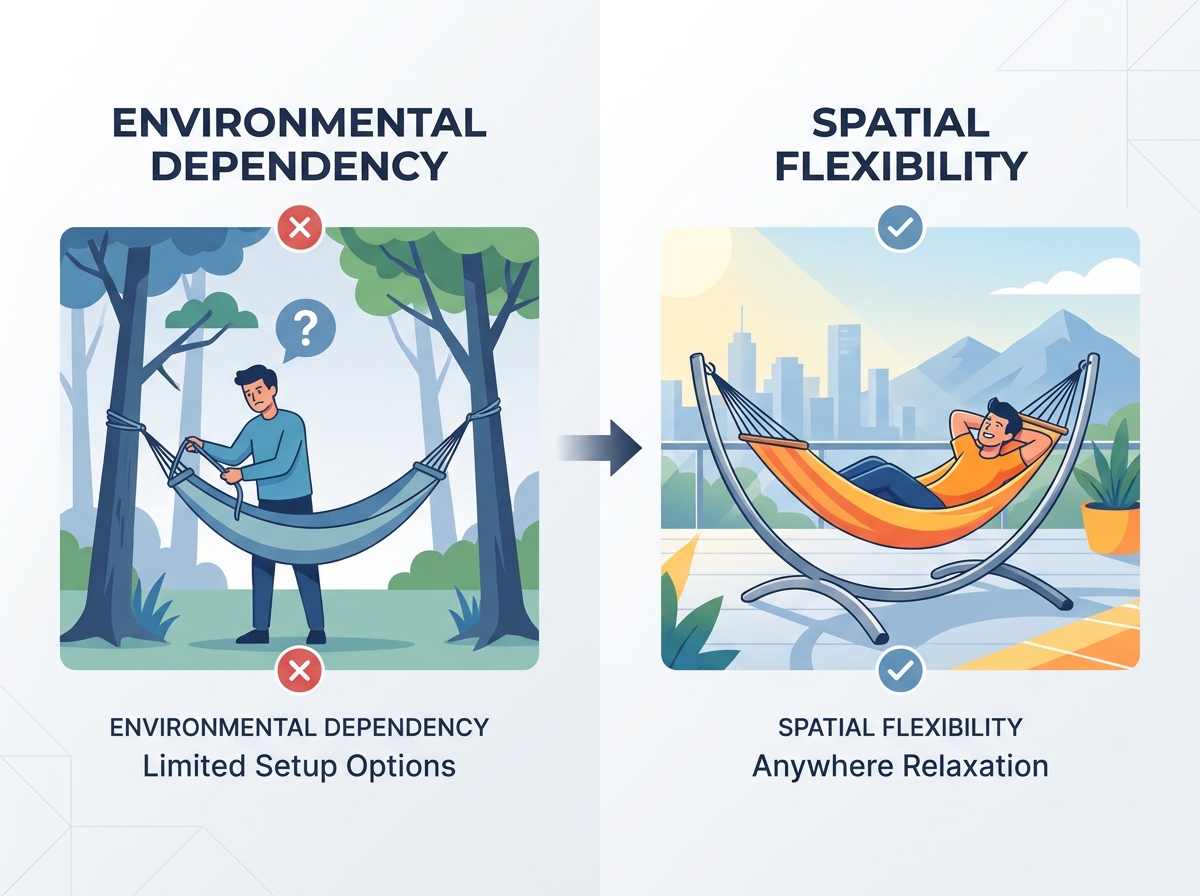
Picture a perfect afternoon outdoors, a gentle breeze blowing, and nowhere to hang your hammock. Traditional hammocks demand perfectly spaced, sturdy trees or structural posts, leaving many modern backyards completely incompatible. You shouldn't have to modify your property or hire a contractor just to relax outside.
A Hammock with Stand offers an immediate solution through spatial flexibility. It allows for instant setup on patios, decks, or open lawns without drilling into walls or assessing tree health. You can enjoy outdoor lounging the moment you bring it home.
This guide bypasses marketing fluff to evaluate the top freestanding hammocks available today. We will analyze them based on structural stability, material longevity, footprint requirements, and verified weight capacities. Read on to discover the exact setup that matches your outdoor space and relaxation habits.
Key Takeaways
- Space dictates choice: A standard hammock with stand requires a minimum clearance of 9 to 14 feet; measuring your designated outdoor space is the critical first step.
- Material trade-offs are inevitable: Cotton offers superior breathability and comfort but degrades rapidly if left exposed to rain, whereas polyester and Sunbrella fabrics sacrifice slight comfort for essential weather resistance.
- Weight capacity vs. structural integrity: A high stated weight limit (e.g., 450 lbs) is only as reliable as the stand's joint construction and hardware quality. Steel stands offer durability, while wooden stands provide aesthetic value but require annual sealing.
The Strategic Advantage of a Hammock with Stand
Hanging a hammock traditionally involves unpredictable variables. You must gauge tree bark health, measure exact distances, and calculate suspension angles. A dedicated stand removes these pain points entirely. It transforms a complex installation process into a simple, reliable furniture setup.
Eliminating Environmental Dependencies
Relying on natural structures often leads to frustration. Trees might be too far apart, or their branches might obstruct your view. Tying ropes to patio columns can cause severe property damage over time. The lateral force generated by a swinging adult can pull wooden deck posts out of alignment. A freestanding frame completely removes the need for structural assessments. It bears the entire load internally, mitigating any risk to your home or landscaping.
Mobility and Sun Tracking
Fixed hammocks lock you into one location. If you hang it in a shady spot, you might feel too cold by late afternoon. Freestanding units solve this through effortless mobility. You can easily reposition them to follow the shade or chase the sun throughout the day. When severe weather hits or winter approaches, you can move the entire assembly indoors or into a garage. This portability extends the lifespan of your equipment significantly.
Standardized Comfort
Achieving the perfect hammock sag is a known challenge. Hammock enthusiasts call the ideal hanging curve the "smile." When you tie straps between trees, tension varies wildly based on distance. You often end up laying too flat or deeply cocooned. A dedicated stand ensures a consistent, optimal hanging curve every single time. The frame dimensions dictate the exact distance between the suspension points. You get predictable, ergonomic comfort without endless strap adjustments.
Our Evaluation Methodology: Separating Quality from Claims
The outdoor furniture market often relies on inflated product specifications. Manufacturers frequently boast about extreme weight limits or weatherproof materials. We cut through these claims by applying a strict, four-point evaluation methodology. We want to ensure you invest in a product that actually performs under real-world conditions.
- Load-Bearing Verification: We look past the printed weight limit. We assess whether the frame and suspension hardware can genuinely support dual-occupancy weights. We check for joint flex, metal groaning, or structural bowing when two adults use the product simultaneously.
- Material Resilience: Outdoor furniture faces brutal environmental conditions. We evaluate the hammock bed's resistance to UV fading, mold, and mildew. We also examine the stand itself. We look at powder-coating thickness on steel frames and wood-treatment quality on timber arcs. These factors determine rust and rot prevention.
- Assembly and Breakdown Friction: A portable setup should actually be portable. We measure the time, tool requirements, and physical effort needed to assemble the unit. We heavily favor tool-free, snap-button steel frames. They allow a single person to set up or break down the unit in under five minutes.
- Footprint-to-Usability Ratio: Space is a premium in most backyards. We analyze how much ground space the stand requires versus the actual lounging area provided. A massive frame that only holds a single-sized bed represents poor spatial efficiency.
![Hammock with stand set up for outdoor relaxation]()
The Top 5 Hammock with Stand Options for 2024
Based on our rigorous methodology, we categorized the best freestanding options on the market. Whether you prioritize luxury, mobility, or budget, one of these configurations will meet your specific needs.
1. The Best Overall: Heavy-Duty Steel Double Hammock with Stand
- Target Use Case: Everyday backyard relaxation for one or two adults.
- Key Specs: 450 lb capacity, 9-foot steel frame, cotton/polyester blend bed.
- Evaluation: This configuration offers the absolute best balance of price, durability, and ease of assembly. The snap-together steel frame is highly stable and requires zero tools. You can move it across the lawn easily. The cotton/polyester blend offers a great mix of breathability and strength. However, you must remember that the fabric requires indoor storage during heavy rain to prevent mildew.
2. The Best for Premium Weather Resistance: Sunbrella Fabric Hammock with Stand
- Target Use Case: Uncovered patios and poolside setups exposed to harsh sun and rain.
- Key Specs: UV-resistant Sunbrella fabric, rust-resistant powder-coated frame.
- Evaluation: This option requires a higher upfront investment, but it yields significant returns in longevity. Sunbrella fabric is an industry standard for marine and outdoor applications. It actively resists fading, bleaching, and mildew. If you want a setup you can leave outside all summer without worrying about sudden thunderstorms, this is it. It remains the most low-maintenance option for permanent outdoor placement.
3. The Best Aesthetic Upgrade: Curved Wooden Arc Hammock with Stand
- Target Use Case: Landscaped gardens and luxury deck environments.
- Key Specs: Laminated pine or cypress frame, quilted hammock bed, 13-14 foot footprint.
- Evaluation: Nothing beats the visual impact of a sweeping wooden arc. It serves as a striking sculptural centerpiece for high-end landscapes. The wide, heavy base makes it exceptionally stable. However, the drawbacks are notable. It requires a massive footprint, taking up substantial patio real estate. Furthermore, wood requires active upkeep. You must commit to annual wood treatments, including sanding and oiling, to prevent splintering and dry rot.
4. The Best for Portability and Camping: Foldable Hammock with Stand
- Target Use Case: RV travel, car camping, and tailgating.
- Key Specs: Collapsible aluminum or lightweight steel frame, parachute nylon bed, carrying bag included.
- Evaluation: This model prioritizes extreme mobility over permanent aesthetic appeal. The accordion-style frame sets up in under two minutes. You just unfold it and lock the hinges. It stows easily in a car trunk. The trade-off is structural limitation. It features a lower weight capacity and a slightly less expansive lounging surface compared to traditional backyard models. It works perfectly for brief trips but might feel cramped for daily naps.
5. The Best Entry-Level/Budget Pick: Single-Size Brazilian Hammock with Stand
- Target Use Case: Small balconies, solo users, or first-time hammock buyers.
- Key Specs: 8-foot compact frame, 250-300 lb capacity, 100% cotton bed.
- Evaluation: If you are working with a tight budget or a tiny balcony, this is a highly cost-effective and space-efficient choice. It provides an authentic, cocoon-like sleep experience traditional to Brazilian designs. Yet, it lacks the width for diagonal laying or sharing with a partner. The lighter frame is also more susceptible to tipping if users swing aggressively. It serves best as a gentle, solo reading nook.
Decision Matrix: Matching the Setup to Your Spatial and Environmental Realities
Choosing the right Hammock with Stand requires brutal honesty about your available space and your willingness to perform upkeep. A mismatched purchase often results in a cramped patio or ruined fabric.
Assessing Your Spatial Constraints
You cannot cheat physical dimensions. A 9-foot stand is the absolute minimum requirement for standard gathered-end hammocks. You must also account for the sway. If you place a 9-foot frame flush against a brick wall, you will hit the wall the moment you lie down. Always leave at least two feet of buffer space on the sides.
Wooden arc stands present a larger challenge. They require upwards of 14 feet of linear space. Their curving design means they cannot sit neatly in tight corners. They dominate small decks quickly. Measure your intended area with a tape measure before confirming any online order. Do not rely on visual estimation.
Selecting the Right Bed Material
The frame provides the structure, but the bed material defines your daily experience. Each fabric carries distinct advantages and undeniable flaws.
- Cotton: Delivers maximum comfort and breathability. It contours perfectly to your body. However, it offers zero weather resistance. It acts like a sponge, absorbing rain and morning dew. You must take it down daily.
- Polyester/Nylon: Provides moderate comfort. It feels slightly stiffer than cotton. It shines in practicality, as it is fast-drying and highly durable against abrasions.
- Quilted/Padded: Excellent for cooler climates or crisp autumn evenings. It features layers of poly-fill for insulation. Unfortunately, it retains water heavily. If left in the rain, it takes days to dry out completely.
- Rope (Cotton or Polyester): Offers a classic, nautical look. It remains highly breathable during sweltering heat. Rope beds require a spreader bar to keep the ropes untangled, which drastically increases the risk of tipping.
Hammock Bed Material Comparison
| Material Type | Comfort Level | Weather Resistance | Maintenance Requirement |
| 100% Cotton | High (Soft, breathable) | Low (Prone to mold) | High (Store indoors daily) |
| Polyester/Nylon | Medium (Slightly stiff) | High (Quick drying) | Low (Can handle light rain) |
| Quilted Fabric | High (Padded, warm) | Medium (Fade resistant, but holds water) | Medium (Bring inside before heavy rain) |
| Sunbrella/Textilene | Medium (Textured feel) | Very High (UV and rot resistant) | Very Low (Leave outside all season) |
Implementation Risks: Assembly, Safety, and Long-Term Care
Even the highest-quality outdoor furniture requires mindful usage. Ignoring basic physics or neglecting seasonal care will ruin your investment prematurely. Understanding common implementation risks ensures safe, long-term enjoyment.
The Tipping Hazard (Spreader Bars vs. Traditional)
Many buyers gravitate toward models featuring wooden spreader bars at each end. They look flat, open, and inviting, much like a floating mattress. However, they possess a dangerously high center of gravity. This design makes them notoriously easy to flip. If you sit too close to the edge, the entire bed will roll, dumping you onto the ground.
Traditional gathered-end hammocks lack these bars. They naturally wrap around the user. This drops your center of gravity below the suspension points. They offer superior safety and stability, making them much better for restless sleepers or households with children.
Rust and Frame Degradation
Manufacturers often advertise powder-coated steel as rust-proof. In reality, no steel stand is entirely immune to oxidation. During assembly, metal tubes slide together. The friction inevitably creates tiny scratches at the joint intersections, exposing raw metal to ambient moisture.
Savvy owners act proactively. Preemptively treat connecting joints with rust-inhibitor sprays or a light coating of lithium grease before assembly. Additionally, ensure your stand utilizes thick rubber caps on the feet. Metal sitting directly on wet concrete will quickly leave permanent rust stains on your patio.
Winterization Protocol
You cannot treat outdoor relaxation gear like permanent driveway fixtures. Leaving any Hammock with Stand outdoors during freezing conditions or heavy snow is a costly mistake. Ice expansion will compromise the metal's structural integrity, popping welds or bending tubes. The harsh cold will also destroy the fabric fibers.
Factor in your available winter storage space before purchasing. A 9-foot steel stand usually breaks down into five manageable pieces that slide under a garage workbench. Conversely, a bulky wooden arc stand does not break down easily. It demands significant shed space to survive the off-season safely.
Conclusion
Finding the ideal outdoor lounging setup boils down to a few practical realities. Choose a 9-foot steel frame if you want everyday versatility and easy breakdown. Opt for a sweeping wooden arc if you prioritize luxury aesthetics and possess ample deck space. If road trips define your weekends, a portable aluminum frame is your best travel companion.
Ultimately, the best model for you is the one that aligns with your maintenance habits. If you refuse to bring fabric inside every evening, invest in synthetic, weather-resistant materials like Sunbrella. If you crave ultimate softness, buy cotton but commit to daily storage.
Before you finalize any purchase, take immediate action: grab a tape measure and verify your intended outdoor space. Ensure you have at least two feet of clearance on all sides of the unit. A well-measured space guarantees a frustration-free setup and countless hours of perfect relaxation.
FAQ
Q: Can a hammock with stand be left outside in the rain?
A: The stand can generally withstand rain if it is powder-coated steel or treated wood. However, cotton or quilted hammock beds will develop mold and rot quickly. Only synthetic fabrics like textilene or Sunbrella should be left exposed continuously. Always bring cotton fabrics indoors during inclement weather.
Q: What is the weight limit on a standard hammock with stand?
A: Most high-quality double hammocks with steel stands are rated for 400 to 450 lbs. Single-user portable or budget stands typically max out at 250 lbs. Always verify the weight limit of both the hammock bed and the stand. The lower number is your true safe capacity.
Q: Are hammocks with stands safe for sleeping overnight?
A: Yes, provided it is a gathered-end (Brazilian or Mayan style) hammock without a spreader bar. Gathered-end designs allow you to lie diagonally. This position flattens your back and prevents you from falling out. They are highly stable and ergonomic for deep sleep.
Q: How much floor space do I actually need?
A: A standard 9-foot stand requires an area of roughly 10 feet by 4 feet. This accounts for the physical frame and the swaying motion required for use. Larger 15-foot wooden stands require at least 16 feet of linear clearance to function safely.