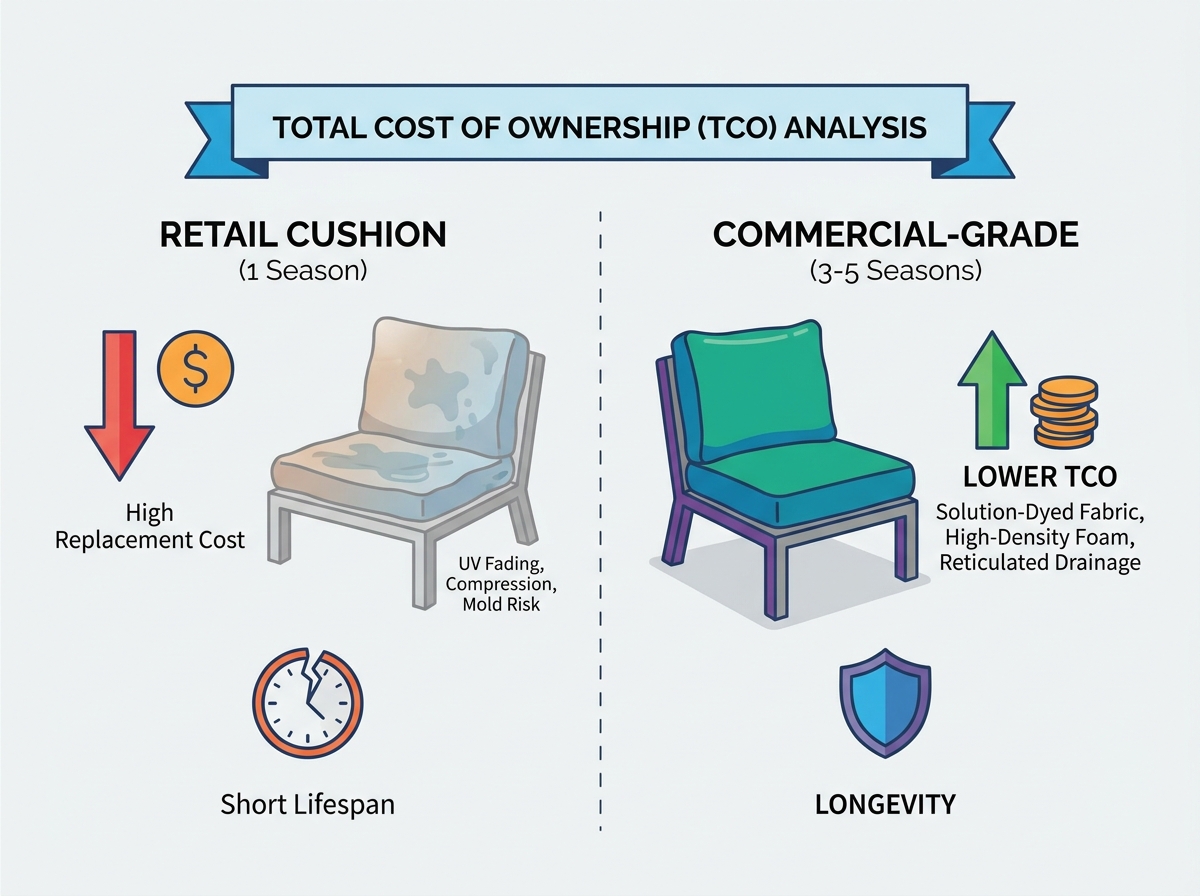
Commercial environments expose outdoor seating to relentless use and harsh elements. Hotels, restaurants, and corporate patios demand robust seating solutions. Standard retail cushions often fail within a single season under these grueling conditions. Faded fabrics and flat foam rapidly ruin the guest experience. For B2B buyers, sourcing an outdoor cushion is an exercise in mitigating risk and maintaining brand standards. You simply cannot afford continuous seasonal replacements. This guide provides an evidence-based framework for evaluating commercial-grade products. We separate basic marketing claims from hard operational realities. You will learn how to select high-performance fabrics. You will evaluate foam density for maximum longevity. We also navigate complex fire safety compliance regulations. Ultimately, this ensures your seating investments survive year-round commercial demands. Let us explore the critical components defining true commercial durability.
Key Takeaways
- Quality Over Unit Price: High-density cores and solution-dyed fabrics cost more upfront but drastically reduce multi-year replacement cycles.
- Drainage is Critical: In commercial settings, fast-drying reticulated foam prevents mold liability and minimizes seating downtime after rain.
- Compliance Matters: Commercial buyers must verify local fire safety standards (e.g., CAL 117-2013) and secure B2B-specific warranties before bulk purchasing.
- Standardization Wins: Opting for modular, standard sizes where possible simplifies future fleet maintenance and partial replacements.
The Business Impact: Retail vs. Commercial-Grade Outdoor Cushions
You might wonder why standard patio accessories fail so quickly in hospitality settings. Residential items simply lack the engineering required for continuous public use. A typical residential pad might experience usage a few times per week. Commercial seating accommodates dozens of different guests daily. This high turnover accelerates physical wear.
UV degradation poses the first major threat. Retail products often use surface-dyed fabrics. They fade rapidly under direct sunlight. Next, consider foam compression. Standard padding loses its structural integrity quickly under heavy daily traffic. Guests eventually feel the hard chair frame underneath. Seam failures occur when users constantly shift their weight. These structural failures happen long before a residential lifespan ends.
We must evaluate long-term financial impacts. Purchasing cheap replacements every twelve months severely strains operating budgets. A true commercial investment lasts three to five years. The upfront price appears higher initially. However, avoiding annual replacement orders protects your bottom line. You also save on continuous labor hours required for unboxing and installation.
Brand perception risks run deep. Faded materials signal neglect to your guests. Flat or mildewed padding directly harms the customer experience. Diners notice uncomfortable seating immediately. Unhappy guests often leave negative online reviews. An uncomfortable chair can shorten a restaurant patron's stay. This directly reduces their total spend. Your outdoor furniture sets the stage for your entire property. You must protect that first impression.
Evaluating Fabric Shells: Performance, UV Resistance, and Maintenance
Solution-Dyed Acrylic vs. Printed Polyester
The manufacturing process defines fabric longevity. Printed polyester applies color only to the material surface. Imagine slicing a radish. The color stays on the outside, while the inside remains white. Sunlight strips this surface dye away quickly. Repeated washing accelerates this fading process.
Solution-dyed acrylic operates differently. Manufacturers mix color pigments directly into the liquid polymer before extruding the yarn. Think of a carrot. The orange color penetrates all the way through. This deep saturation creates incredible UV resistance. Solution-dyed acrylic serves as the absolute baseline for commercial environments. It resists aggressive fading. Furthermore, you can clean it using bleach solutions without stripping the color.
The Waterproof vs. Water-Resistant Reality
Many suppliers claim their breathable fabrics are entirely waterproof. This represents a widespread industry myth. No breathable woven fabric offers 100% waterproof protection inherently. True waterproof materials require a rigid plastic or rubber backing. These stiff backings severely compromise seating comfort. They feel rigid and often trap heat.
Instead, commercial covers rely on Durable Water Repellent (DWR) coatings. These chemical treatments cause water to bead up and roll off. DWR coatings handle light rain perfectly. However, they demand realistic maintenance expectations. Commercial housekeeping teams use heavy-duty cleaners. Harsh detergents eventually strip away the DWR finish. You must plan for occasional reapplication. Proper maintenance ensures your outdoor cushion inventory continues repelling morning dew and unexpected drizzles.
Maintenance and Cleanability Requirements
Commercial fabrics must resist food spills and sunscreen stains. Stain resistance benchmarks help procurement teams evaluate performance. Look for materials boasting high double-rub counts. This metric indicates severe abrasion resistance.
Removable covers represent a mandatory requirement. You cannot industrially launder a sewn-shut pad. Zippers must withstand harsh outdoor elements. Standard plastic zippers snap easily. You should mandate heavy-duty YKK zippers. Alternatively, request marine-grade stainless steel hardware. These resist corrosion from saltwater and pool chemicals. Housekeeping staff need smooth-operating zippers for efficient weekly washing.
Commercial Fabric Performance Comparison
| Fabric Material | UV Resistance (Fade Rate) | Bleach Cleanable | Abrasion Durability |
| Printed Polyester | Low (Fades in 1 season) | No | Moderate |
| Olefin (Polypropylene) | Medium (Fades in 2 seasons) | Yes (Diluted) | High |
| Solution-Dyed Acrylic | Very High (3-5+ years) | Yes (Full strength) | Very High |
![commercial grade outdoor cushion core materials]()
Core Fill Materials: Balancing Guest Comfort with Structural Longevity
Foam Density and Compression Rates
The internal core dictates guest comfort and structural longevity. Standard polyurethane foam bottoms out rapidly under high-volume use. When heavy guests sit, low-density foam compresses completely. They immediately feel the metal or wood frame beneath them. Once standard foam crushes repeatedly, it never regains its original loft.
You must evaluate High-Density (HD) foam options. Density refers to the material weight per cubic foot. Higher density means more material and less air inside the structure. HD cores retain their supportive shape over thousands of seating cycles. They feel firmer initially. However, this firmness guarantees lasting support. Guests appreciate sturdy seating across extended dining or lounging sessions.
Moisture Management and Mold Prevention
Water intrusion destroys outdoor furniture faster than any other element. Solid foam acts like a giant sponge. It absorbs rain and holds it tightly. This creates massive implementation risks. Solid foam lacking proper drainage venting harbors mold rapidly. Humid climates accelerate this bacterial growth. Mold creates distinct health liabilities for your business.
Reticulated foam provides the ultimate commercial solution. Engineers call this open-cell foam. The manufacturing process removes the solid cell walls. It looks like a complex three-dimensional web. Water flows directly through the entire core. This advanced moisture management reduces dry times from several days down to just a few hours.
Many manufacturers add Dacron wraps around the reticulated core. Dacron is a polyester batting. It adds a soft crown to the seat. It enhances initial guest comfort perfectly. Unlike cotton, Dacron does not trap moisture.
To maximize moisture management, follow these steps after a heavy storm:
- Instruct staff to tilt the seats vertically against the furniture frame.
- Ensure the zipper side faces downward to let gravity pull water out.
- Wipe away any pooled water from the fabric surface using a clean towel.
- Allow direct sunlight and natural breezes to circulate around the open-cell core.
Compliance, Safety Standards, and Commercial Warranties
Navigating Fire and Safety Regulations
Public venues face strict regulatory oversight. You cannot simply place residential furniture on a hotel patio. Local fire marshals enforce mandatory commercial flammability standards. California Technical Bulletin 117-2013 (CAL 117-2013) serves as a primary benchmark across North America. It tests how materials resist smoldering cigarettes and open flames.
Relying on residential tags exposes your business to extreme operational risks. If a fire occurs, insurance investigators check these tags immediately. Non-compliant furniture often voids commercial liability policies. You must verify compliance documentation before executing any bulk purchase. Keep copies of material safety certificates on file for future municipal inspections.
Deconstructing the B2B Warranty
Retail warranties look generous on paper but fail in practice. You must deconstruct the fine print. A realistic commercial warranty covers specific manufacturer defects. This includes severe premature fabric fading or outright seam failure. It ensures the zippers do not detach from the material.
You must also understand common exclusions. Warranties never cover damage from improper winter storage. They exclude natural foam softening over time. They reject claims involving bleach damage on non-acrylic fabrics. Most importantly, ensure the document explicitly applies to commercial use. Standard consumer warranties become void the moment you place the product in a public business venue. Protect your investment by securing specialized B2B warranty agreements in writing.
Procurement Strategy: Scalability, Customization, and Fulfillment
Standardized vs. Custom Sizing
Procurement teams constantly debate standard versus custom dimensions. Custom seating templates seem appealing for unique architectural built-ins. Sometimes they remain necessary for vintage or highly specialized chairs. However, custom shapes carry significant drawbacks. They require bespoke manufacturing templates. Lead times stretch for months. Replacement costs remain permanently high.
Designing your seating around standardized, modular dimensions yields a much better return on investment. Standard sizing simplifies future fleet maintenance. If one outdoor cushion sustains severe damage, you simply swap it out. You can hold spare inventory easily. Standard sizes also enable easier supplier switching if your current vendor underperforms. You maintain operational agility by avoiding restrictive custom lock-ins.
Supplier Vetting and Pilot Testing
Never authorize a massive rollout without physical testing. You must order a prototype sample first. Place this sample in your harshest environment. Let your staff handle it. Wash the cover. See how fast the core dries after a rainstorm. Pilot testing reveals structural weaknesses before you commit thousands of dollars.
Vetting a supplier requires asking precise operational questions. Use this practical checklist during vendor interviews:
- Minimum Order Quantities (MOQs): Ensure they support both large initial rollouts and small future top-up orders.
- Lead Times: Compare domestic manufacturing speeds against cheaper overseas shipping delays.
- Phased Replacements: Confirm the supplier can guarantee fabric dye-lot matching across multiple seasons.
- Hardware Quality: Verify they exclusively use commercial-grade zippers and UV-resistant threading.
- Sample Availability: Demand cross-section foam chunks and physical fabric swatches.
Conclusion
Selecting the right seating for a B2B environment demands strategic focus. You must prioritize technical material specifications over purely aesthetic choices. Solution-dyed acrylic fabrics outlast cheaper polyester alternatives significantly. Reticulated open-cell foam prevents mold and keeps seating available after rainstorms. Ignoring local fire safety regulations invites unacceptable business risks.
Your actionable next steps are clear. First, audit your current replacement rates to understand your baseline waste. Identify any specific local compliance needs regarding fire codes. Finally, request physical fabric swatches and cross-section foam samples from your shortlisted vendors. Make your decisions based on tangible material quality. A rigorous procurement approach guarantees your outdoor spaces remain comfortable, beautiful, and highly profitable year after year.
FAQ
Q: How long should a commercial outdoor cushion last?
A: Typically, they last 3-5 years. Fabric longevity depends heavily on UV exposure and regular maintenance. High-density cores perform similarly. You must store them properly during harsh off-seasons to achieve this maximum lifespan. Solution-dyed acrylics generally reach the five-year mark easily.
Q: What is the fastest-drying material for outdoor hospitality cushions?
A: Reticulated open-cell foam provides the fastest dry times. We strongly recommend combining this core with a solution-dyed acrylic cover. Adding a mesh drainage underlining at the bottom accelerates water exit. This combination reduces dry times from days to mere hours.
Q: Can we leave commercial outdoor cushions out in the rain?
A: Yes, provided they feature proper engineering. You need open-cell foam and breathable fabrics. However, you should establish a housekeeping protocol. Staff must tilt the seats vertically after heavy rain. This simple action uses gravity to drastically accelerate the overall drying process.
Q: Do we need to buy fire-retardant outdoor cushions?
A: Yes. You must consult local fire marshal codes and your commercial insurance policies. Most jurisdictions mandate compliance with specific commercial fire ratings like CAL 117-2013. Ignoring these regulations exposes your business to severe operational liability and potential policy cancellation.