Purchasing a poorly constructed hammock causes more than a minor inconvenience. Material failure under high tension poses immediate physical risks. It also wastes your money completely. We must differentiate between cheap consumer-grade recreational hammocks and legitimately engineered heavy-duty models. Unfortunately, many brands treat "heavy duty" as a flashy marketing buzzword. They rarely provide verifiable engineering specifications to back up their claims. You need to know how to spot the difference before placing your trust in suspended fabric. To confidently select a heavy-duty model, you must look past bold marketing claims. We will explore how to evaluate baseline material specifications properly. You will learn how to assess dynamic load capabilities accurately. We will also scrutinize suspension ratings and hardware requirements. By understanding these core technical elements, you will guarantee a safer outdoor experience. These insights will also help you maximize the long-term longevity of your gear.
Key Takeaways
- True heavy-duty hammocks require a minimum verifiable static weight limit of 400 to 500+ lbs, paired with specific fabric denier ratings.
- Fabric durability is dictated by weave and denier (e.g., 70D to 210D Ripstop Nylon or heavy canvas), not just thickness.
- Suspension systems are the primary failure point; evaluate carabiner kN ratings and webbing strap stretch ratios.
- Triple-stitched seams and reinforced end-loops are non-negotiable success criteria for long-term reliability.
The Business of Load Bearing: Why Standard Hammocks Fail
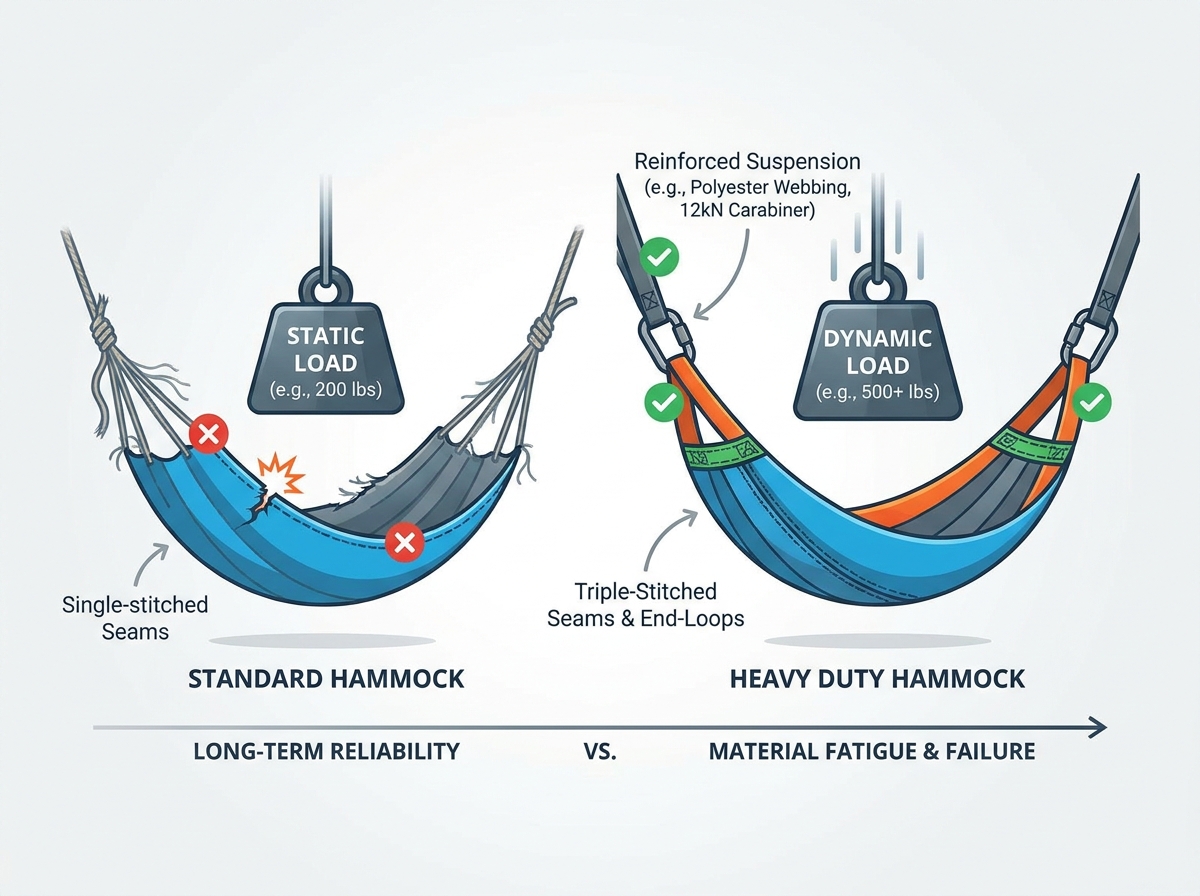
Most standard hammocks fail because manufacturers test them under ideal laboratory conditions. They rely heavily on static weight limits during these evaluations. Static testing involves placing stationary weights gently onto the fabric bed. However, real-world usage rarely mimics these controlled stationary environments. When you drop into a hammock abruptly, you create immense dynamic loads. Shifting your weight during sleep also spikes the tension levels across the fabric fibers. Adding multiple users magnifies this erratic force even further. A standard model rated for 300 pounds statically might fail under a 200-pound dynamic load.
Material fatigue serves as the second major cause of standard hammock failures. Outdoor equipment faces harsh environmental stressors constantly. Prolonged UV exposure breaks down nylon polymers at a molecular level. This sun damage makes the fabric brittle and prone to snapping. Moisture retention from rain or humidity further weakens cheap fiber weaves over time. As you use the gear, microscopic micro-tears accumulate unseen across the main body. Standard parachute nylon degrades surprisingly quickly under these combined conditions. This rapid degradation eventually leads to sudden, catastrophic failure during use.
Framing this purchase correctly requires viewing it as a safety and longevity investment. Compromising on material quality directly compromises your personal safety. A sudden drop from three feet can cause severe spinal injuries. Furthermore, buying cheap gear forces you into a cycle of constant replacement. Replacing three flimsy hammocks over two years hurts your wallet significantly. Buying one correctly specified Heavy Duty Hammock prevents this repetitive spending cycle. Properly engineered models protect your physical health while ensuring years of reliable outdoor relaxation.
![Heavy Duty Hammock structural demonstration]()
Core Evaluation Dimensions for a Heavy Duty Hammock
Evaluating fabric composition and denier ratings stands as your first vital task. The outdoor industry widely uses standard 210T parachute nylon for entry-level gear. However, 210T nylon lacks the structural weave reinforcement required for heavy loads. To ensure durability, you must look for specific structural fabric upgrades. Backpackers should actively seek out 70D, 40D, or robust 210D Ripstop Nylon. Ripstop weaves incorporate thicker reinforcement threads at regular intervals. This grid pattern stops small punctures from expanding into massive structural tears. For permanent outdoor installations, skip lightweight nylon materials entirely. Choose weather-resistant quilted canvas or heavy-duty Sunbrella fabrics instead. These thicker textiles handle constant sun exposure and heavy rain exceptionally well.
Next, you must carefully analyze the seam architecture across the entire product. The fabric panels must connect securely to withstand heavy body weights. Load-bearing seams absolutely require triple-interlocking stitching for maximum safety. Single or double stitching simply cannot handle long-term dynamic tension forces. You must also consider the specific stitch density used during manufacturing. Stitch density directly impacts overall fabric tension and baseline tear resistance. Too few stitches per inch create dangerous structural weak points. Conversely, too many stitches perforate and unintentionally weaken the base fabric. A balanced, high-quality triple stitch ensures optimal tension distribution.
Finally, inspect the end-channel reinforcement where the suspension lines attach. The gathered ends of the fabric support your entire body weight. Many manufacturers utilize standard paracord to secure these critical gathered ends. This remains a massive engineering mistake for heavy-duty applications. Paracord stretches too much and possesses a relatively low breaking strength. Continuous loops made from Amsteel are significantly superior options. Amsteel utilizes Dyneema or UHMWPE fibers to achieve incredible load capacities. These advanced materials provide exponentially higher breaking strength than standard nylon paracord.
Evaluating Suspension Systems: The True Weak Link
Even the strongest fabric fails completely if the suspension system snaps. You must carefully evaluate the materials connecting your setup to the trees. We strongly argue against using standard nylon ropes for suspension. Nylon ropes inherently stretch under heavy weights, causing your setup to sink. They also fray easily when rubbed against rough surfaces. More importantly, thin ropes bite into tree bark and cause severe environmental damage. High-density polyester webbing straps represent the superior suspension choice. Polyester prevents annoying sag by eliminating fiber stretch completely. It also resists abrasion remarkably well when rubbed against rough tree bark.
Strap width plays a crucial role in safety and environmental compliance. You must specify straps measuring at least 1-inch to 1.5-inches wide. This required width ensures strict compliance with most state park tree protection rules. Wider straps distribute friction evenly across a larger surface area on the trunk. This friction distribution prevents the bark from suffering deep, damaging cuts. It also prevents the straps from slipping downward when you apply sudden dynamic loads. Using anything narrower than one inch risks both your safety and the tree's health.
Hardware ratings demand equally rigorous inspection before making any purchase. You must actively avoid products including unmarked, unrated steel or aluminum carabiners. Unrated hardware represents a massive safety blind spot in your gear setup. Manufacturers use unrated clips strictly to cut production costs at your expense. You must establish a firm standard for any load-bearing metal hardware. Carabiners should possess a minimum verifiable rating of 12kN (kilonewtons). A 12kN rating equates to nearly 2,700 pounds of breaking strength. This rating guarantees absolute safety during dynamic, multi-person, heavy-duty use.
Suspension Hardware Comparison Guide
| Material / Hardware Type | Stretch Factor | Bark Protection | Load Reliability |
| Standard Nylon Rope | High (10-15%) | Poor (Causes Damage) | Low (Prone to fraying) |
| Polyester Webbing (1.5" Wide) | Very Low (<2%) | Excellent (Distributes force) | High (Abrasion resistant) |
| Unrated Steel Carabiner | N/A | N/A | Unknown (High risk) |
| 12kN Rated Aluminum Carabiner | N/A | N/A | Exceptional (~2700 lbs) |
Sizing and Tension: How Dimensions Affect Load Distribution
Overall width directly impacts the maximum safe weight capacity of your gear. Double hammocks typically measure over six feet wide across the center bed. This extra fabric naturally disperses heavy weights much better across the grain. Single models concentrate all load forces into a very narrow central band. This concentrated tension puts immense stress on a smaller number of fabric threads. Purchasing a wider model drastically reduces the localized strain on individual fibers. It ensures the material can support heavier static and dynamic loads safely.
Adequate width also resolves serious comfort issues for heavier users. We must address the notorious "squeeze" factor associated with narrow fabric beds. When a heavy individual lies in a narrow single model, the sides pull inward. This inward pulling creates severe shoulder compression and uncomfortable claustrophobia. Adequate fabric width prevents this painful shoulder compression entirely. Extra material allows you to lie diagonally across the center axis. This diagonal position flattens the bed out and provides proper ergonomic spinal support.
Understanding proper hang angles prevents catastrophic failure at the anchor points. You must always implement the strict 30-degree hang angle rule. The suspension lines should form a 30-degree angle from the tree down to the gathered ends. Hanging your setup too tightly creates a dangerously flat angle. This flat angle exponentially multiplies the sheer force applied to the suspension lines. It stresses the fabric ends intensely, threatening to rip the seams apart completely. A flat angle easily overrides the advertised weight capacity limits, causing rapid failure.
Best Practices for Proper Hanging Angles
- Always aim for a 30-degree descent from the anchor point to the gathered ends.
- Ensure the anchor points on the trees sit approximately six feet off the ground.
- Never pull the suspension lines completely taut to flatten the bottom bed.
- Use a structural ridgeline to maintain consistent sag regardless of tree distance.
- If the fabric feels extremely tight before entering, loosen the suspension straps immediately.
Shortlisting Logic: Selecting by Use Case
You must match your gear selection to your specific usage environment. For the backcountry heavy-hitter, prioritize a high weight-to-strength ratio above all else. You need gear tough enough to survive rocks, branches, and rough handling. Follow this specific recommendation matrix for backcountry use. Look strictly for 70D Ripstop nylon to ensure maximum tear resistance. Insist on using an ultralight Dyneema suspension system. Target a static weight limit of at least 400+ lbs. Finally, ensure the overall packed weight remains under 2.5 lbs to ease hiking burdens.
For backyard or patio permanent fixtures, your technical priorities must shift dramatically. Focus heavily on UV resistance and maximum multi-person load capabilities. Permanent installations endure relentless sun exposure and daily weather fluctuations. Follow this recommendation matrix for permanent outdoor setups. Look for thick, weather-resistant quilted polyester or solution-dyed acrylics. Choose models featuring hardwood spreader bars with heavily reinforced metal grommets. Demand weight limits exceeding 500+ lbs for safe family use. Acknowledge that packed weight and trail packability simply do not matter for backyard installations.
Taking immediate next-step actions ensures you avoid purchasing inferior equipment. You must first audit your exact use environment thoroughly. Determine if you will hang strictly from trees or use a metal stand. Evaluate the expected weather exposure, including humidity, rain, and direct sunlight. Next, ruthlessly eliminate any shortlisted brand failing to provide transparent specifications. Reject any company that does not publish exact fabric denier numbers openly. Discard options using unrated suspension hardware without clear kN ratings.
- Audit your primary environment: Decide between trail use or permanent backyard installation.
- Verify fabric specifications: Reject standard 210T nylon for heavy-duty applications.
- Check hardware ratings: Look for the '12kN' stamp on all included carabiners.
- Confirm strap dimensions: Ensure webbing straps measure at least one inch wide.
- Review warranty terms: Seek brands offering multi-year defect coverage.
Conclusion
A heavy-duty outdoor setup is only as strong as its absolute weakest point. Securing a massive 500-lb fabric limit remains completely useless if paired with 200-lb rated suspension straps. You must evaluate the fabric denier, the seam stitching, and the hardware ratings collectively. Any single point of failure compromises the entire system's integrity.
We encourage buyers to check warranty terms closely before finalizing any purchase. Brands confident in their heavy-duty specifications typically offer lifetime or multi-year warranties. They will gladly cover manufacturing defects because they trust their engineering. Beware of short 30-day return windows, as they often signal inferior material quality.
Direct your focus toward brands prioritizing verifiable load limits and specialized ripstop fabrics. Review top-rated polyester suspension straps to upgrade your current setup safely. By applying the criteria outlined above, you can invest confidently in durable, heavy-duty models. Elevate your outdoor comfort without ever sacrificing your personal safety.
FAQ
Q: What is the highest weight capacity for a heavy duty hammock?
A: Realistic heavy-duty capacities range between 500 and 1000 lbs. While some brands claim 1000 lbs, you must distinguish between verifiable laboratory limits and exaggerated marketing. Always ensure the suspension system matches this maximum fabric weight rating to guarantee structural safety under dynamic tension.
Q: Does a heavier fabric mean a stronger hammock?
A: Not necessarily. Fabric strength relies on the weave structure and material type, not just raw thickness. A lightweight 70D Ripstop Nylon features grid-reinforced threads, making it significantly stronger and more tear-resistant than much thicker, heavier standard parachute nylon.
Q: Can any tree stand support a heavy duty hammock?
A: No. You must match your hammock’s load capacity with a specifically rated steel stand. If your gear holds 500 lbs but your stand handles only 250 lbs, the frame will warp or collapse under dynamic tension. Always verify maximum stand ratings.
Q: Why do some heavy duty hammocks still rip?
A: Most rips stem from user error rather than fabric failure. Sitting with keys in your pocket, pet claws, and long-term UV degradation weaken the fibers. Additionally, improper flat hang angles create excessive sheer tension, multiplying the force and tearing the material apart.