Buyers frequently use seating terms interchangeably. This confusion leads to misaligned purchasing decisions. It happens across individual ergonomic needs and bulk procurement alike. Selecting the wrong seating modification guarantees inadequate postural support. You might cause accelerated material degradation. Ultimately, you waste your budget on ineffective seating solutions. Both options serve to enhance your daily seating experience. However, their structural profiles differ significantly. Their primary functions and complex manufacturing requirements diverge as well. We will clarify these essential differences below. You will learn how to evaluate materials accurately. You can then make an informed purchasing decision. Proper seating alignment boosts daily productivity. Neglecting this aspect invites chronic physical discomfort. Let us dive into the mechanics of these products.
Key Takeaways
- Primary Function: A seat cushion pad prioritizes structural support and pressure relief (often ergonomic), while a chair pad focuses on surface-level comfort and aesthetic enhancement.
- Material Density: Cushions typically utilize high-density memory foam, gel grids, or molded foam; pads rely on lighter polyfill, cotton batting, or thin foam layers.
- Thickness & Profile: Cushions add significant height (2–4 inches) and alter seating posture; pads offer minimal height alteration (under 2 inches).
- Cost & Lifespan: Seat cushion pads require a higher initial investment but offer greater longevity and shape retention compared to standard chair pads.
Core Definitions: Seat Cushion Pad vs. Standard Chair Pad
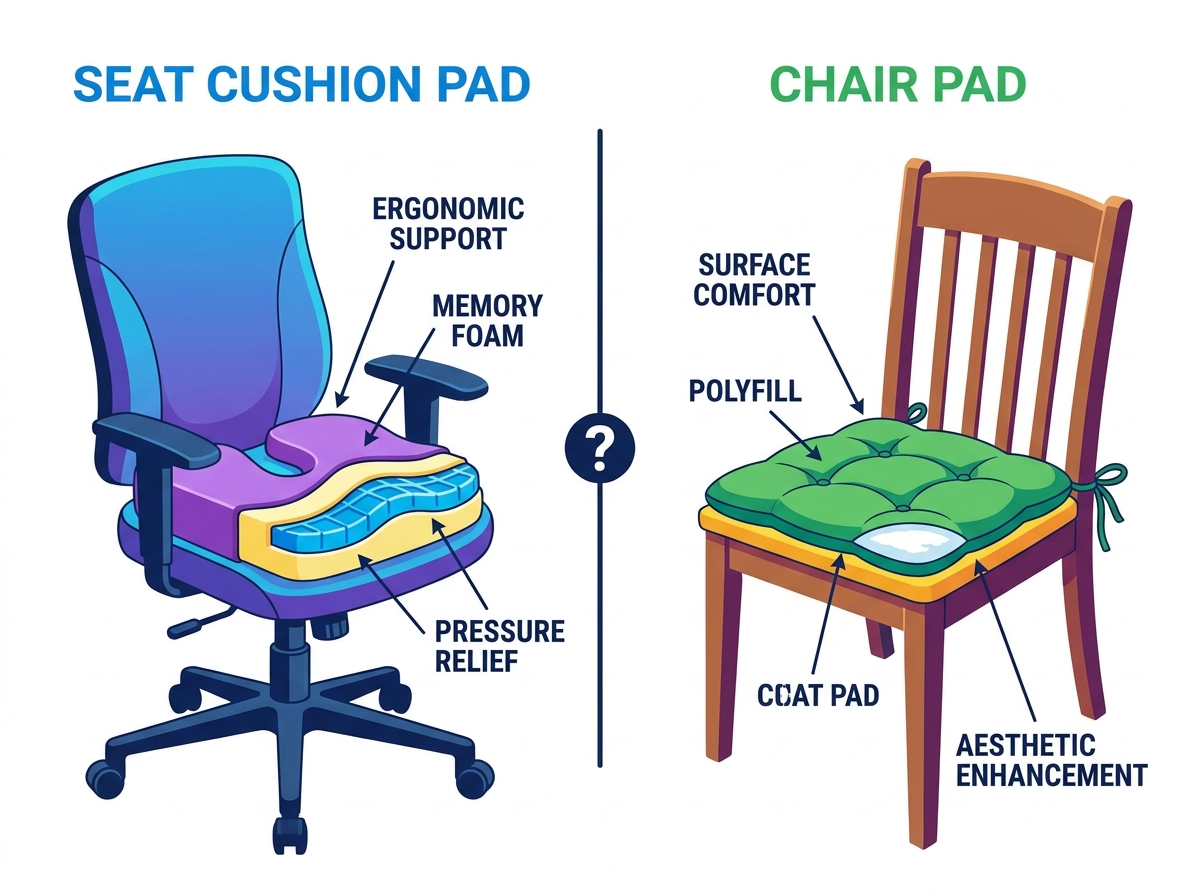
A Seat Cushion Pad serves a highly specific functional purpose. We clearly define it as an engineered seating layer. It redistributes human body weight evenly across a larger surface area. It provides precise, targeted anatomical support. Manufacturers build these ergonomic products around advanced internal structural components. You will typically find contoured memory foam inside. Some models utilize advanced hyper-elastic polymer grids. Many feature strategically placed cutouts. These cutouts suspend the tailbone over empty space. They include non-slip silicone bases. They almost always feature removable, machine-washable covers. This complex, multi-layered design elevates them far above basic textiles. You purchase them primarily for physical health benefits. They actively reduce the physical stress of prolonged sitting.
Conversely, the standard chair pad acts quite differently. We define it primarily as a functional textile accessory. It softens hard seating surfaces effectively. You see them most often on wooden dining chairs or metal stools. They protect the original chair material from daily scratches. They feature an incredibly simple construction method. Makers often tuft the fabric directly through the internal filling. This tufting keeps the loose material securely in place. They usually include attached cloth ties. You use these ties to secure the fabric to the chair backrest. They completely lack complex internal engineering. You buy them to match your dining room decor. They offer a quick, inexpensive upgrade for rigid furniture.
![Seat cushion pad vs chair pad]()
Structural and Material Evaluation Criteria
Internal Fill and Density Metrics
Cushion pads rely heavily on precise density metrics. Engineers calculate the specific molded foam density required. They test gel-infused layers thoroughly in laboratory settings. These critical metrics determine the actual support capacity of the product. They must perform flawlessly over long sitting durations. Cheap foam collapses entirely under continuous pressure. High-density materials actively resist this structural collapse. They literally push back against your descending body weight. This resistance keeps your spine aligned properly. You maintain a healthy posture effortlessly.
Chair pads utilize entirely different materials inside. They rely primarily on loose fill. Manufacturers often use low-density polyester batting. Some utilize recycled cotton fibers. These materials feel wonderfully soft initially. However, they remain highly susceptible to "bottoming out." Continuous load flattens these loose fibers rapidly. The trapped air escapes from the material quickly. You essentially end up sitting directly on the hard chair underneath. The padding merely serves as a thin fabric barrier. It provides zero structural resistance.
Exterior Covers and Manufacturing (OEM Considerations)
Premium ergonomic units often feature advanced dual-layer construction. An inner liner tightly protects the foam core. It resists accidental water damage and daily spills. A breathable outer casing wraps the entire exterior. You can quickly remove and wash this outer casing. This sophisticated design introduces higher complexity in OEM manufacturing. Factories must source multiple distinct fabrics. They must mold raw foam into specific shapes. They sew intricate zippers into the seams. This requires specialized tooling and skilled labor.
Chair pads usually feature basic single-piece construction. Factory workers stitch the internal fill and outer cover together simultaneously. We call this common process tufting. You cannot remove the cover for washing. This highly streamlined process ensures exceptionally lower production costs. It allows for vastly easier bulk scaling. Brands can produce thousands of identical units rapidly. They require very little specialized machinery. You save money, but you sacrifice long-term maintenance options.
| Feature | Cushion Pad | Standard Chair Pad |
| Core Material | High-density foam, gel grids | Loose polyfill, cotton batting |
| Construction | Dual-layer, zippered outer shell | Single-piece, tufted fabric |
| Base Type | Friction-grip rubber or silicone | Smooth fabric, relies on ties |
| Washability | Removable, machine-washable cover | Spot clean only, prone to clumping |
Ergonomics, Performance, and Implementation Risks
Postural Impact and Pain Relief Realities
Evaluate the true ergonomic impact of these products carefully. You must ignore exaggerated or unsupported medical claims. A properly engineered Seat Cushion Pad can alleviate localized pressure effectively. It targets sensitive anatomical zones like the coccyx. It provides measurable, daily sciatica relief. It elevates your hips slightly above your knee joints. This specific seating angle promotes a healthy, neutral pelvis. You naturally sit up straighter without forced muscle exertion. Your breathing deepens as your chest opens. You experience less afternoon fatigue.
Chair pads provide completely negligible postural correction. They do not alter your pelvic tilt whatsoever. Their primary outcome involves preventing basic tactile discomfort. They shield your sensitive skin from rigid wood or metal surfaces. They add necessary warmth to freezing cold patio furniture. They simply cannot fix poor posture. They lack the structural rigidity required to guide your skeletal frame. You will continue slouching if you already slouch.
Implementation Risks and Chair Compatibility
Adding thick materials fundamentally alters your seating geometry. Dimensional limits play a major role here. Adding a thick, three-inch cushion to an office chair creates new issues. Fixed armrests suddenly sit much too low relative to your body. Your ergonomic alignment relative to your keyboard suffers. You must lower the chair's central cylinder to compensate properly. If the cylinder bottoms out, you face a permanent height mismatch. You must measure carefully beforehand.
Slippage creates distinct safety and comfort hazards. Traditional chair pads lack reliable friction-grip bottoms. You must tie them tightly to the chair frame. Loose ties cause the pad to slide unexpectedly when you shift. Many modern cushions lack securing ties entirely. Instead, they utilize friction-grip rubberized bases. If this rubber grip degrades, the entire unit shifts during prolonged use. This constant micro-shifting causes hidden lower back strain over time. You tense your core muscles unconsciously to stay stable.
Cost vs. Value: Assessing Cheap vs. Expensive Models
Entry-level options consistently tempt budget-conscious buyers. They feature an attractive, significantly lower initial cost. However, rapid material degradation remains a huge, unavoidable problem. This rapid degradation causes severe structural "pancaking." The internal foam cells rupture permanently under your weight. You then face frustratingly frequent replacement cycles. Budget options suit specific, limited scenarios quite well. They work perfectly for temporary, short-term usage. They fit low-frequency guest seating nicely. They fail miserably under heavy daily workloads. You should manage your expectations accordingly when purchasing cheap models.
Premium options require a notably higher upfront investment. Resilient, advanced materials absolutely justify this initial expense. Manufacturers utilize high-resilience memory foam. They integrate advanced, heat-dissipating cooling gels. These dense materials undergo verifiable, rigorous durability testing. They maintain their physical shape for years. Your long-term physical comfort improves drastically. You eliminate the constant annoyance of flattened padding. You also avoid the physical pain associated with collapsing foam layers. Investing heavily in your daily seating pays immense physiological dividends.
Shortlisting Logic: Which Should You Choose?
You must understand exactly when to deploy each product type. Making the right choice prevents physical pain and wasted money.
When to confidently specify a Seat Cushion Pad:
- Choose it for dedicated computer task seating.
- Use it consistently in professional office environments.
- Rely on it significantly during post-surgical medical recovery.
- Specify it for heavy-duty usage exceeding eight hours daily.
- Demand measurable pressure relief as your primary success metric.
- Require easy machine washability for daily hygiene.
When to confidently specify a standard Chair Pad:
- Choose it for standard wooden dining room chairs.
- Use it outside for hard plastic patio furniture.
- Deploy it rapidly for temporary banquet or event seating.
- Select it for aesthetic-driven interior design projects.
- Prioritize immediate surface softening over structural alignment.
- Require a very low per-unit cost for bulk aesthetic upgrades.
Take immediate action by following these crucial measurement steps. Do not skip this process before buying.
- Measure the exact usable width of your target seating surface.
- Measure the exact depth of the actual chair pan from front to back.
- Evaluate your required daily sitting duration honestly.
- Determine your specific budget tier before you ever contact a vendor.
Conclusion
The ultimate purchasing decision hinges on one primary objective. You must choose definitively between therapeutic support and casual comfort. High-density cushions provide serious anatomical correction. Basic pads offer simple surface aesthetics. We highly recommend prioritizing a properly engineered Seat Cushion Pad. Choose this advanced option for any scenario involving prolonged daily sitting. You will actively prevent severe musculoskeletal strain. Protect your spinal health deliberately. Do not compromise on foundational support when your physical well-being remains at stake.
FAQ
Q: Can a seat cushion pad fix a broken or sagging office chair?
A: No. A cushion requires a stable foundation. Placing it on a sagging seat pan causes the cushion to warp. This negates its ergonomic benefits entirely. You must repair or replace the broken chair first before adding premium padding.
Q: Are standard chair pads machine washable?
A: It depends heavily on construction. Tufted pads often require spot cleaning. Gentle cycles sometimes prevent fill clumping, but risk tearing the tufts. Conversely, premium cushions usually feature removable, machine-washable covers for easy, safe maintenance.
Q: How long should a quality seat cushion pad last?
A: It depends on user weight and daily usage hours. High-density foam or gel models typically maintain optimal structural integrity. They generally last for one to three years before requiring replacement due to gradual material compression.