Gear failure during a camping trip creates genuine safety hazards. It easily ruins the outdoor experience. Ripping fabric or snapping straps can lead to sudden falls and injuries. Consumers face a confusing market landscape right now. Brands frequently toss around terms like "double hammock" to imply superior strength. These marketing phrases often mask standard material limits. They confuse buyers seeking true structural durability. The decision ultimately comes down to a clear trade-off. You must balance weight capacity and longevity against portability and flexibility. We will break down exactly what supports your weight safely. A reliable Heavy Duty Hammock uses completely different engineering than an ultralight model. We will explore material density, suspension systems, and comfort profiles. This guide helps you identify the correct gear for your specific outdoor needs.
Key Takeaways
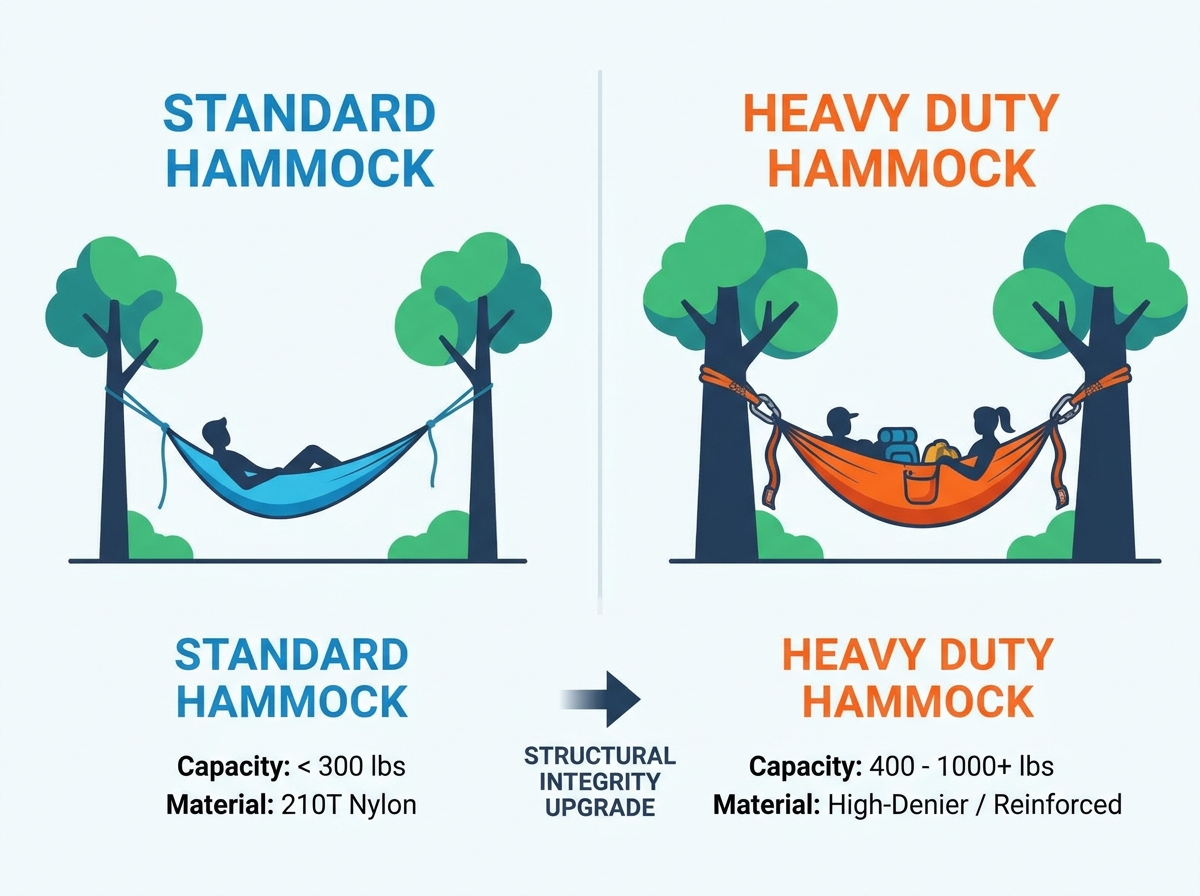
- Capacity Thresholds: Standard hammocks typically max out at 250–300 lbs, whereas a true heavy duty hammock supports 400 lbs to over 1,000 lbs.
- Material Science: Fabric density (measured in Denier) dictates not just strength, but the amount of stretch and breathability in the hammock.
- The Comfort Factor: Thicker materials offer a flatter, more supportive lay with less "shoulder squeeze," while standard materials conform more tightly to the body.
- System Integrity: A heavy-duty hammock is only as strong as its suspension system; standard straps will fail under heavy-duty loads.
Framing the Baseline Requirements: Standard vs. Heavy Duty Hammock
You cannot evaluate gear properly without establishing a clear baseline. Outdoor equipment manufacturers design different products for vastly different environments. We must separate casual weekend gear from rugged, high-capacity equipment. Understanding this baseline prevents dangerous purchasing mistakes.
Standard Hammocks (The Baseline)
Standard models dominate the consumer market. You see them hanging in local parks or strapped to ultralight backpacks. Manufacturers optimize these products for maximum portability. They prioritize shedding ounces over raw structural power.
- Materials: Builders typically construct these units from 210T parachute nylon. This fabric feels soft against your skin and packs down incredibly small.
- Specs: These units routinely weigh under two pounds. Weight capacities generally hover around the 300-pound mark.
- Primary Use Case: We recommend these for casual lounging. They excel in ultralight backpacking scenarios. They serve perfectly as temporary setups during afternoon hikes.
Heavy Duty Hammocks (The Upgrade)
High-capacity models flip the engineering script entirely. They sacrifice compact sizing to achieve massive structural resilience. You rely on these models when failure is simply not an option. They utilize industrial-grade textiles to ensure absolute safety under extreme stress.
- Materials: Manufacturers use high-denier nylon ranging from 70D up to 210D+. Some utilize ripstop fabrics, heavy canvas, or double-layer constructions. They feature heavily reinforced stitching at all gather points.
- Specs: Weight capacities range dramatically from 400 pounds to well over 1,000 pounds. The overall product weight increases significantly due to thicker textiles.
- Primary Use Case: These excel as permanent backyard installations. They support tandem use perfectly for couples or families. They accommodate heavy campers safely. Furthermore, they survive environments featuring abrasive elements like dogs jumping in.
Key Evaluation Dimensions: Evaluating Structural Integrity
You must look past basic marketing claims when evaluating structural integrity. The numbers printed on a box rarely tell the whole story. Real-world physics demand a deeper look into how materials handle stress over time. We evaluate load ratings, fabric density, and seam construction to gauge true durability.
Static vs. Dynamic Load Ratings
Most buyers misunderstand how weight ratings actually work. Manufacturer ratings generally reflect static weight limits. This represents a scenario where someone carefully and slowly sits down. Outdoor environments rarely mimic static laboratory conditions.
You need a substantial safety margin to account for dynamic weight. Dynamic weight occurs when you drop abruptly into your seat. It happens when you shift aggressively at night. High wind conditions also create dynamic stress forces. A rugged setup provides the necessary buffer to handle these sudden spikes in force without tearing.
Fabric Density and Stretch
Textile strength relies heavily on fabric density. The outdoor industry measures this density in Denier (D). A higher denier number indicates thicker, heavier threads. Standard parachute nylon usually features a low denier count.
Higher denier fabrics resist tearing much better than thinner alternatives. They also battle UV degradation effectively. Leaving thin nylon exposed to intense summer sun weakens the material rapidly. Thick fabrics survive prolonged sun exposure while maintaining their structural integrity. They stretch far less under heavy loads.
Seam Construction
Fabric represents only one half of the structural equation. The points where fabric panels join experience the highest stress levels. Standard models typically utilize basic double-stitching techniques. This works fine for lightweight weekend trips.
High-capacity models require aggressive reinforcement. You should always look for triple-stitched seams along every load-bearing edge. Furthermore, builders must secure the end loops using bar-tacks. A bar-tack is a tight, zigzag stitch pattern. It locks high-stress connection points together permanently. This prevents the gather points from unravelling under extreme tension.
Hammock Structural Specifications Comparison
| Specification Category | Standard Baseline Models | Heavy Duty Upgrades |
| Fabric Denier | 20D to 40D (210T Nylon) | 70D to 210D+ (Ripstop/Canvas) |
| Weight Capacity | 250 lbs – 300 lbs | 400 lbs – 1,000+ lbs |
| Seam Reinforcement | Basic Double-Stitching | Triple-Stitching & Bar-Tacks |
| Dynamic Load Margin | Low (Prone to tearing on impact) | High (Absorbs sudden shifts safely) |
| UV Resistance | Poor (Fades and weakens quickly) | Excellent (Built for prolonged exposure) |
![heavy duty hammock]()
The Comfort Reality: How Material Dictates Your Sleep Setup
Many consumers mistakenly believe thicker fabrics feel uncomfortable. This assumption completely misses how hammock ergonomics function. Comfort relies entirely on how the fabric interacts with your specific body weight. Material density dictates how you will sleep outdoors.
The "Stretch" Factor
Standard parachute nylon stretches noticeably when loaded. Lightweight campers often enjoy this specific characteristic. The fabric molds seamlessly around side sleepers. It creates a soft, enveloping sensation resembling a cocoon.
However, this stretch creates problems for heavier users. The material sags excessively toward the ground. This sagging causes severe "shoulder squeeze." The fabric walls tighten around your upper body, forcing your shoulders inward. It ruins spinal alignment and destroys your sleep quality.
The Supportive Lay
High-capacity materials remain impressively rigid under load. They resist stretching and maintain their structural shape. This rigid nature provides a much flatter sleep surface. It feels significantly firmer than standard nylon.
A firm surface proves critical for back sleepers. Larger individuals require this rigid support to prevent severe backaches. Furthermore, the rigid material actively prevents the dreaded "taco effect." This occurs when two people sleep together. Standard stretchy fabrics force both sleepers to violently roll into the exact center. Rigid textiles keep both occupants safely separated in their respective zones.
Temperature Regulation
You must acknowledge the temperature trade-offs when selecting thicker materials. Heavy textiles naturally trap body heat efficiently. Many robust models feature double-layer constructions. These layers allow users to insert foam insulation pads easily.
This heat retention makes thick models ideal for cold-weather camping. They block biting winds effortlessly. However, they lack breathability during hot, humid summer conditions. Thin standard models allow maximum airflow. You might sweat uncomfortably inside a thick canvas unit during July heatwaves.
Implementation Risks and Common Failure Points
Buying superior fabric solves only one part of the equation. Many users upgrade their main unit but ignore their surrounding hardware. This oversight leads directly to dangerous gear failures. You must address the entire suspension ecosystem to guarantee safety.
The "Weakest Link" Risk
Your entire sleep system operates exactly like a chain. It breaks at the weakest point. Buying a 1,000-pound capacity bed remains useless if you pair it poorly. You cannot use basic polyester straps rated for only 200 pounds.
Standard carabiners also present massive failure risks. Cheap aluminum clips snap violently under dynamic stress. You must upgrade every single component. Replace flimsy clips with climbing-rated carabiners. Swap thin ropes for thick, reinforced daisy-chain webbing. Never trust standard hardware to hold extreme weights.
The Weight Penalty
Thick materials inherently add significant bulk. They consume massive amounts of cubic volume inside your gear closet. A rugged double-layer unit weighs three times more than an ultralight model. It packs down to the size of a large melon.
This weight penalty completely disqualifies rugged setups for specific activities. You cannot carry this bulk on ultralight, multi-day backpacking trips. Every ounce matters when hiking steep mountain passes. Save these robust units for car camping or permanent backyard installations.
Tree Anchor Damage
Heavier loads transfer immense friction directly into tree bark. The cambium layer underneath tree bark transports essential nutrients. Thin ropes or narrow straps crush this vital layer easily. Destroying the cambium layer ultimately kills the tree.
Heavy setups require specialized tree straps to disperse weight safely. You must use straps measuring a minimum of 1.5 to 2 inches wide. Wider straps protect tree bark efficiently. They distribute friction over a larger surface area. Ethical campers always prioritize tree health over convenience.
Full System Safety Audit Checklist
- Inspect all fabric gather points for frayed threads or separated seams.
- Verify your carabiners display certified climbing weight ratings (measured in kN).
- Measure your tree straps to ensure they exceed 1.5 inches in width.
- Examine your daisy-chain webbing loops for excessive stretching or tearing.
- Check the bark of your anchor trees after setup to confirm zero damage occurred.
Decision Framework: Shortlisting Your Next Steps
Choosing the correct gear requires brutal honesty about your outdoor habits. You must evaluate your body type, your typical camping environment, and your travel logistics. We created a straightforward framework to simplify your final purchase decision.
Opt for a Standard Hammock if:
- You are a solo user weighing comfortably under 250 pounds.
- Pack weight and cubic volume represent your primary logistical constraints. Backpacking and extensive hiking demand ultralight gear.
- You plan to use the equipment infrequently.
- You camp exclusively in mild, fair-weather conditions where heavy winds rarely occur.
- You prefer a soft, highly conforming fabric wrapping around your body.
Invest in a Heavy Duty Hammock if:
- You plan to sleep two adults simultaneously without rolling into each other.
- You want to accommodate energetic children or pets featuring sharp claws.
- You weigh over 250 pounds and require a rigid, non-sagging sleep surface.
- You frequently experience lower back pain and need perfect spinal alignment overnight.
- The unit will remain outside, exposed to UV rays and harsh weather for extended periods.
- You value long-term durability over compact packing size.
Conclusion
Selecting the right outdoor gear requires matching structural realities to your specific demands. High-denier fabrics solve durability issues but sacrifice portability. Standard nylon offers incredible convenience but fails under dynamic stress. Your environment and body weight dictate the correct path forward. Upgrading your primary fabric is only the first step. You must also audit your current suspension hardware immediately. Replace weak straps and cheap carabiners to ensure full-system safety. A balanced, heavy-duty setup guarantees years of comfortable, secure outdoor sleeping.
FAQ
Q: Is a "double hammock" the same as a heavy-duty hammock?
A: No. "Double" refers strictly to the width of the fabric, not its weight capacity or material strength. Manufacturers design double models to feel roomier. However, many double hammocks still use standard, thin 210T nylon. They will tear just as easily under high stress.
Q: Are heavy-duty hammocks less comfortable?
A: Comfort remains highly subjective. High-capacity materials feel noticeably firmer. If you prefer a soft, enveloping feel, standard nylon may feel better. However, if you need strong back support and a flat lay to prevent shoulder squeeze, a thicker fabric proves vastly superior.
Q: What does "Denier" mean in hammock specifications?
A: Denier (D) measures the thickness of the individual threads woven into the fabric. A 70D or 210D model uses significantly thicker threads. It feels heavier and lasts much longer. It easily outlasts a thin 20D or 40D fabric.
Q: Do I need special straps for a heavy-duty hammock?
A: Yes. You must upgrade your entire suspension system. Ensure your daisy-chain straps, continuous loops, and carabiners feature ratings exceeding your total dynamic weight. Standard polyester straps frequently snap under high loads, leading to dangerous falls.