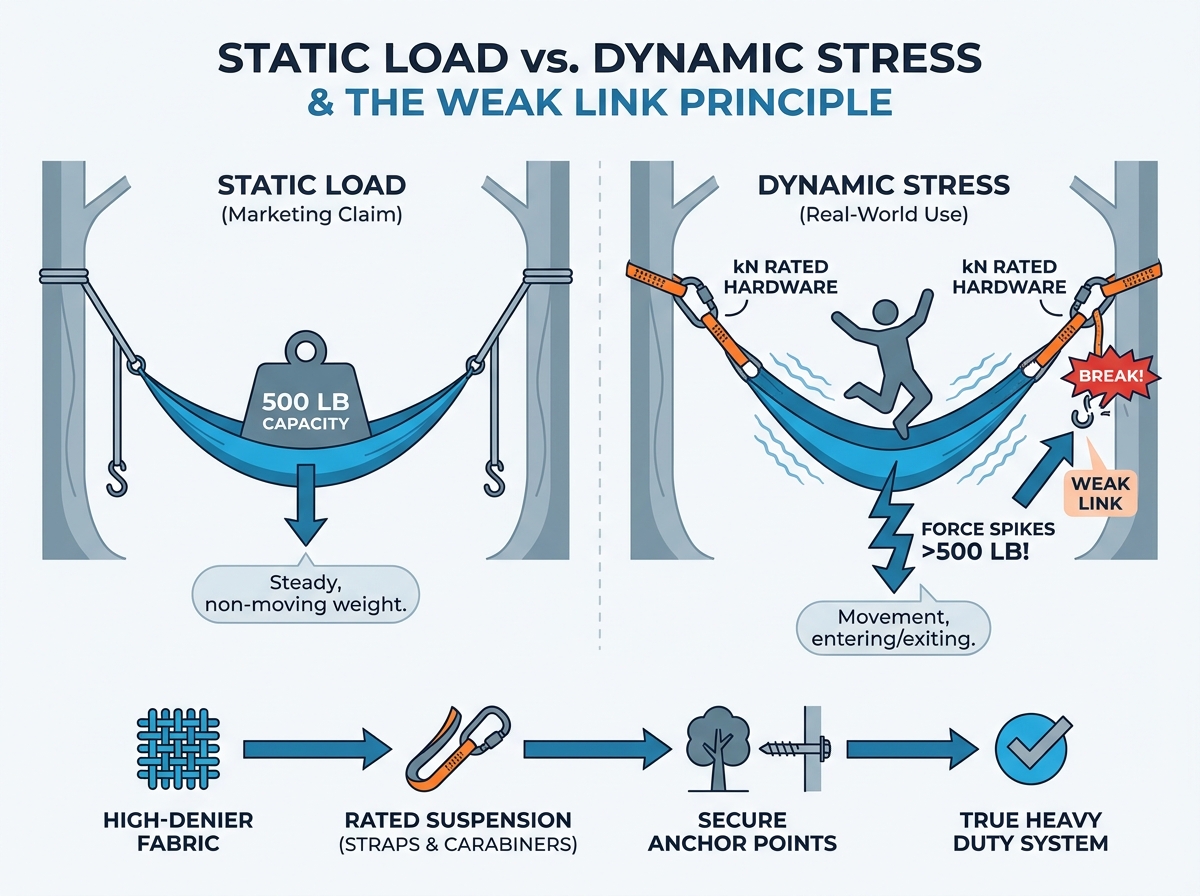
Finding a reliable outdoor retreat often turns into a frustrating guessing game. The market is flooded by products claiming immense strength. Yet, many fail under real-world pressure. The term "heavy duty" frequently acts as an empty marketing buzzword. This misleads buyers into poor purchases. These cheap setups often yield catastrophic fabric tears or hardware failures under dynamic stress. Such sudden failures severely compromise your physical safety and comfort.
We built this guide to offer a skeptical, evidence-based framework for evaluating durability. You will learn how to analyze material science, suspension integrity, and specific use cases. A secure setup requires aligning fabric specifications with your specific environment. It also means matching your weight requirements to proper anchor points. Understanding these core elements ensures you build a secure, long-lasting resting space.
Key Takeaways
- Dynamic vs. Static Load: A hammock's true durability is tested by the dynamic force of getting in and out, not just its static weight limit.
- The Weak Link Principle: A 500-lb rated hammock is unsafe if paired with unrated ropes or weak anchor points; suspension hardware matters as much as the fabric.
- Material Dictates Lifespan: High-denier ripstop nylon (for outdoors) and tightly woven canvas (for patios) offer the best price-to-lifespan ratios.
- Setup Geometry Impacts Tension: Hanging a hammock too tightly exponentially increases the sheer force on the fabric and suspension.
1. Defining "Heavy Duty": Moving Beyond Marketing Claims
Investing in a reliable Heavy Duty Hammock requires looking far past the packaging. Manufacturers love to advertise massive weight limits. However, evaluating actual strength demands a deeper understanding of stress mechanics, material density, and hardware grading.
Static Weight Limits vs. Dynamic Stress
Buyers often confuse static limits for practical safety markers. A static limit measures how much motionless weight a product holds before breaking. Real life involves movement. When you drop into a suspended bed, you generate dynamic force. A 300-pound person entering abruptly can generate over 400 pounds of instantaneous stress. You must always build a weight capacity buffer. Choosing a 500-lb capacity model for a 300-lb load absorbs shifts, bounces, and movement seamlessly.
Fabric Density and Weave (Denier Ratings)
Fabric strength relies entirely on its weave density. Manufacturers measure thread thickness using Denier (D). You will frequently see standard 210T parachute nylon on budget models. It feels soft but lacks structural rigidity. Higher-grade 70D or 100D ripstop nylon utilizes reinforced grid patterns. This specialized weave isolates small punctures. It stops them from turning into massive tears.
Stitching techniques also determine structural survival. Single stitching unravels quickly under tension. Look strictly for triple-stitched seams along every load-bearing panel. These seams lock fabrics together and prevent catastrophic blowouts.
Hardware Ratings
Never trust unrated metal. Cheap, unbranded "S-hooks" easily bend open under dynamic loads. You should introduce kilonewton (kN) ratings into your evaluation. High-quality carabiners display a kN rating stamped directly on the metal spine. One kN equals roughly 225 pounds of force. A standard 12kN climbing carabiner guarantees absolute safety for suspension systems.
Material Strength Comparison
| Material Type | Common Denier/Weight | Tear Resistance | Best Application |
| Parachute Nylon | 210T | Low to Moderate | Casual park lounging |
| Ripstop Nylon | 70D - 100D | Extremely High | Backcountry camping |
| Cotton Canvas | 10 oz - 14 oz | High | Permanent patio setups |
2. Core Evaluation Criteria: Features That Drive Long-Term Durability
A resilient system requires more than strong fabric. Long-term durability hinges on how well every component interacts. Evaluating suspension, weather resistance, and sizing ensures your setup survives daily wear and tear.
Suspension Systems
- Polyester Webbing Straps: These represent the gold standard for suspension. Polyester does not stretch under load. It handles massive capacities safely and protects tree bark.
- Traditional Nylon Ropes: Avoid these when possible. Nylon stretches significantly overnight. It also suffers from severe friction wear when rubbed against rough bark or masonry.
Breathability vs. Weather Resistance
Outdoor gear faces a constant battle against the elements. Tightly woven, weather-treated fabrics repel water beautifully. They endure harsh conditions but retain body heat. This makes them uncomfortable during humid summers. Conversely, porous materials breathe exceptionally well but absorb morning dew.
Ultraviolet (UV) degradation destroys synthetic fibers silently. Prolonged sun exposure makes nylon brittle and weak. You can mitigate this risk by packing your gear away after use. Alternatively, choose UV-treated polyester for permanent outdoor fixtures.
Ergonomics and Sizing
Width dictates comfort. Heavy individuals often struggle in narrow, single-sized models. A wider, double-sized bed provides superior weight distribution. The extra fabric allows you to lie diagonally across the center axis. This diagonal position creates a much flatter, ergonomically supportive lay. It eliminates the uncomfortable "banana shape" curve that strains lower backs.
![Heavy Duty Hammock Setup]()
3. Categorizing by Use Case: Which Heavy Duty Hammock Fits Your Needs?
Selecting the right Heavy Duty Hammock depends entirely on your environment. A heavy canvas bed proves useless on a backpacking trail. Similarly, ultralight nylon feels flimsy on a luxury patio.
Backpacking & Camping
Trail enthusiasts demand high tensile strength-to-weight ratios. Every ounce matters in a backpack. Key features include integrated bug nets to stop nocturnal pests. You should prioritize ripstop nylon construction. Ensure the suspension utilizes lightweight, aviation-grade aluminum carabiners. These components save energy on the trail while guaranteeing structural safety.
Backyard & Patio (Permanent Setups)
Backyard lounging prioritizes robust comfort over portability. Focus heavily on UV-resistant quilted fabrics or thick cotton canvas. These materials withstand backyard sprinklers, pets, and children.
You must choose between spreader bar and traditional designs. Spreader bars use wooden beams to keep the fabric flat and open. They look highly inviting. However, they create a severe tipping hazard. Shifting your weight off-center flips them instantly. Traditional gathered-end designs wrap around you securely. They create a stable cocoon effect, eliminating the risk of sudden falls.
Hammock Chairs
Vertical lounging requires different engineering. Hammock chairs rely on single-point suspension systems. This concentrated load demands incredibly strong swivel hardware to prevent metal fatigue. You must verify your mounting location thoroughly. Hanging these chairs indoors requires driving heavy lag bolts directly into load-bearing ceiling joists, never into drywall.
4. Implementation Risks: Setup, Safety, and Hardware Considerations
The strongest fabric on earth remains useless if rigged improperly. Installation failures cause the vast majority of outdoor accidents. Securing your anchor points and understanding suspension geometry prevents injuries.
Anchor Point Integrity
Your setup shares a direct strength correlation with your anchor points. Attaching high-capacity gear to dead trees invites disaster. Weak masonry or crumbling brick shatters under lateral sheer force. When hanging indoors, unverified wall studs split easily. You must confirm you are mounting into solid wood, robust concrete, or healthy tree trunks exceeding eight inches in diameter.
The 30-Degree Rule
Suspension physics dictate your safety margins. Hanging a bed too tightly drastically multiplies tension forces. A perfectly flat, zero-degree hang generates nearly infinite sheer force on the suspension lines and anchor points. Following the 30-degree rule solves this problem. Ensuring your suspension straps angle down at roughly 30 degrees cuts sheer force exponentially. This slack protects your fabric seams and prevents hardware from snapping under pressure.
Hardware Upgrades
Manufacturers often cut corners on included accessories to save costs. You should routinely audit factory-included hardware. Discard unmarked S-hooks or flimsy chains immediately. Upgrade your system using certified climbing-grade carabiners. If mounting to walls, discard cheap screws. Replace them utilizing heavy-duty steel lag screws driven deeply into structural framing.
5. Shortlisting Logic: How to Verify Quality Before Purchasing
Navigating crowded online marketplaces requires strict filtering criteria. Recognizing red flags prevents buyer's remorse and guarantees long-term satisfaction.
Identifying Red Flags
Transparency reflects manufacturing quality. Avoid brands hiding specific material data. If a product listing omits Denier ratings, move on. Lack of published hardware weight limits signals dangerous cost-cutting measures. Trustworthy companies proudly display their engineering metrics.
Warranty and Return Policies
Manufacturer warranties serve as an excellent proxy for actual durability. Companies utilizing premium materials back their products confidently. A lifetime warranty implies rigorous quality control and high manufacturing standards. Conversely, a brief 30-day return window suggests the brand expects rapid material fatigue. Prioritize brands standing firmly behind their craftsmanship.
Conclusion
Securing a resilient resting space requires discarding marketing hype and focusing on material science. The smartest purchasing decisions stem from evaluating fabric denier, verifying hardware kN ratings, and understanding proper suspension geometry. Aesthetic features matter little if the seams burst under dynamic load. Before finalizing your selection, audit your intended hanging space. Verify tree health, stud locations, and clearance. By aligning verified material strength with proper setup techniques, you guarantee years of secure, comfortable relaxation.
FAQ
Q: What is the best material for a heavy duty hammock?
A: The ideal material depends on your specific use case. High-denier ripstop nylon is best for portability, hiking, and camping. For stationary backyard setups, weather-treated cotton canvas or UV-resistant polyester excels in durability and comfort.
Q: Can a hammock really hold 500 lbs safely?
A: Yes, it can easily hold 500 lbs. However, this is only true provided the suspension straps, carabiners, and anchor points are all independently rated to handle that exact same weight capacity safely.
Q: How do I know if my suspension straps are strong enough?
A: You should look for non-stretch polyester webbing instead of nylon. Inspect the straps closely to ensure they feature heavy reinforced loop stitching rather than simple knots or thin threads.
Q: Are spreader bar hammocks less durable?
A: The fabric itself remains highly durable. However, the wooden spreader bars can rot or snap over time if left untreated in harsh weather. They also present a significantly higher tipping risk compared to gathered-end designs.