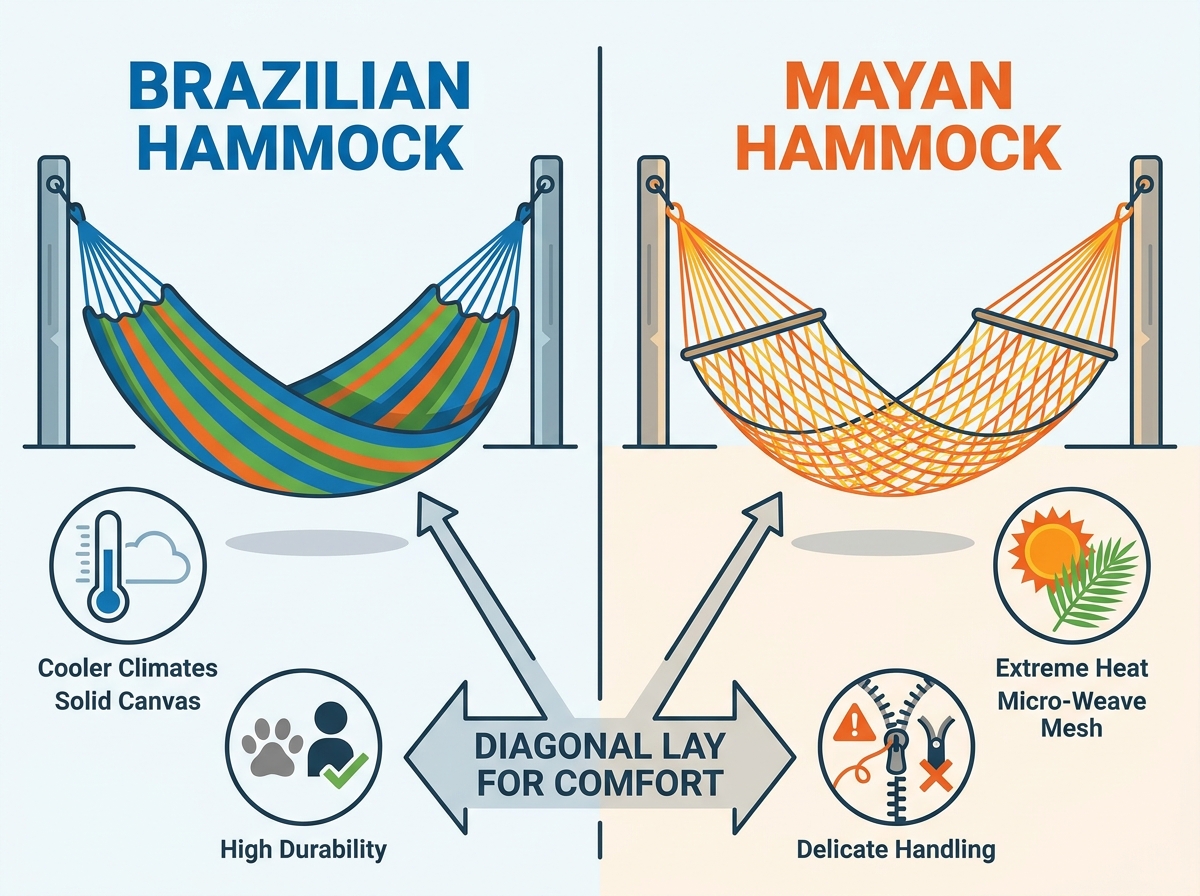
Investing in a premium hammock demands more than picking an appealing color. You must match the textile architecture to your specific environment. Your daily use case matters immensely. Many buyers face a difficult dilemma between two distinct styles. You have the tightly woven, fabric-based Brazilian design. Conversely, you find the open-net, string-woven Mayan style. Choosing the wrong material can ruin your comfort. It might also lead to rapid wear and tear. A poor choice quickly becomes a frustrating experience. The right choice ultimately depends on your local climate. User configuration, whether solo or family, plays a vital role. Long-term sleep requirements also dictate the best option. We will deeply explore structural differences and ergonomic support. We will also compare durability constraints and thermal properties. This comprehensive guide helps you confidently select the perfect resting solution. You will learn exactly how to match the hammock to your personal lifestyle.
Key Takeaways
- Brazilian hammocks excel in cooler to moderate climates, offer superior durability against pets/children, and provide a secure, opaque "cocoon" feel.
- Mayan hammocks are the industry standard for extreme heat and humidity due to maximum airflow, offering unparalleled dynamic stretch, but require careful handling to prevent snags.
- A Brazilian double hammock provides the most stable surface for long-term indoor sleeping or replacing a traditional mattress.
- Both require a diagonal sleeping position for proper spinal alignment; the decision hinges on thermal preference and durability risks.
Architectural Differences: Solid Canvas vs. Micro-Weave Mesh
Understanding hammock architecture helps you make an informed decision. The materials dictate how the surface behaves under human body weight. Manufacturers utilize distinctly different techniques to create Brazilian and Mayan styles. They serve completely different functional purposes.
Brazilian Construction
Artisans craft the Brazilian style using heavy-duty cotton. Many modern variations utilize a durable cotton-poly blend. Weavers create this fabric on traditional looms. The loom-woven technique results in a densely packed textile. This structural integrity guarantees minimal stretch over time. The material remains completely opaque. It acts as a solid, continuous piece of canvas. This dense construction makes the fabric highly resistant to tearing. You can trust it to support significant weight safely. A high-quality Brazilian double hammock feels robust and substantial. It mimics the reliability of heavy upholstery fabric.
Mayan Construction
Mayan designs utilize a completely different structural approach. They rely on a complex diamond-weave string pattern. Artisans typically use thin cotton or nylon threads for this process. This creates an intricate, open net. We call this a "micro-weave" dynamic. The open mesh expands infinitely. It conforms exactly to your body contours. The strings shift individually as you move. This eliminates pressure points entirely. The resulting sensation feels nearly weightless. However, the delicate strings require gentle handling. They do not possess the rigid structure of solid canvas.
Assumption Check
Many buyers misunderstand the term "double" in hammock sizing. The word refers purely to the width capacity. Both styles easily accommodate two people for casual lounging. However, they appear vastly different when empty. A solid fabric model always displays its full width. It looks broad and inviting. Meanwhile, the Mayan string mesh naturally contracts. It will visually appear much narrower until occupied. You must physically spread the mesh to see its true size. Do not let the contracted strings deceive you during setup.
![Brazilian double hammock vs Mayan hammock setup and structural comparison]()
Sleep Ergonomics: How a Brazilian Double Hammock Compares to a Mayan
Ergonomics play a crucial role in long-term hammock satisfaction. Lying down correctly requires specific techniques. Both styles handle physical support differently. You must understand these mechanics for a pain-free experience.
Spinal Support Mechanics
Proper sleep requires an asymmetric lay. You must position your body diagonally across the surface. This technique flattens the fabric beneath you. It prevents your spine from bending into a banana shape. A diagonal lay guarantees a completely flat back.
A sturdy Brazilian double hammock provides rigid, supportive tension. The dense fabric resists sagging under your hips. This sensation closely mimics a firm mattress. It offers excellent lumbar support for back sleepers. Conversely, the Mayan style provides targeted pressure relief. The independent strings adapt instantly to micro-movements. This dynamic feels closer to memory foam. It cradles joints gently but offers less structural firmness.
The "Bed Replacement" Scenario
Many people now evaluate hammocks for nightly indoor sleeping. Ditching a traditional mattress requires serious consideration. The dense fabric of the Brazilian style often feels psychologically secure. The opaque walls create a dark, soothing cocoon environment. This promotes deeper sleep for many adults. It provides a consistent, predictable resting surface.
Mayan designs also work for full-time sleep. However, they present a few unique challenges. The thin strings can occasionally leave temporary skin indentations. Some users find the infinite stretch slightly disorienting in the dark. The lack of solid fabric makes some sleepers feel exposed.
Steps for Optimal Nightly Sleep
- Measure your room to ensure a minimum 10-foot span.
- Install heavy-duty wall anchors securely into structural studs.
- Hang the ends with a 30-degree suspension angle.
- Lie directly in the center, then shift your feet left and head right.
- Adjust your angle until the surface beneath your spine flattens completely.
Multi-User Realities
Two people in a suspended sling face unique physics. Gravity inevitably pulls both users toward the lowest center point. We call this center-gravity pooling. It forces bodies together tightly. The solid fabric configuration minimizes this issue effectively. The sturdy canvas maintains better surface tension. It separates the users slightly better.
Mesh designs struggle significantly with multi-user pooling. The ultra-stretchy strings amplify the gravity effect. They wrap around both people intensely. This creates a deeply "tangled" feeling. Movement from one partner instantly disturbs the entire mesh. Therefore, solid canvas handles couples much better than string mesh.
Durability Constraints: Pets, Kids, and Maintenance
Your household environment dictates your ideal hammock material. Some textiles survive rough use effortlessly. Others require meticulous care and gentle handling. Let us explore the durability differences.
The Snag Factor (Mayan)
String mesh possesses one primary vulnerability. We refer to this as the snag factor. Buttons and zippers easily catch on the delicate threads. Dog claws present a massive hazard. Children's toys can quickly sever individual strings. Once a string breaks, the diamond weave unravels rapidly. A single broken thread compromises the entire structural integrity. You cannot easily repair a damaged micro-weave. Therefore, households with active pets should avoid this style.
The Heavy-Duty Advantage (Brazilian)
Solid canvas excels in chaotic environments. Highlight the tight weave's resistance to punctures. Pet claws glide harmlessly over the dense cotton. Children can roughhouse safely on the thick material. It acts much like a heavy denim or canvas tarp. You do not need to check your pockets for keys. The robust fabric withstands daily friction effortlessly. A quality Brazilian double hammock survives years of heavy family usage.
Washing & Upkeep
Maintenance procedures differ wildly between the two styles. Proper cleaning extends the lifespan significantly.
- Brazilian Upkeep: These are typically machine washable. You must tie the end strings together to prevent tangling. Wash on a gentle, cold cycle. This precaution avoids catastrophic shrinking. Never use a hot dryer. Always hang the heavy fabric up to air dry.
- Mayan Upkeep: Mesh requires delicate hand-washing. You must use mild detergent in a bathtub. Avoid wringing or twisting the strings. Meticulous line-drying is absolutely necessary. Improper handling during washing leads to catastrophic tangling. A tangled mesh is nearly impossible to fix.
Hammock Durability and Maintenance Comparison
| Feature | Brazilian Canvas | Mayan Mesh |
| Pet Friendly | High (Resists claws) | Low (Prone to snagging) |
| Child Friendly | High (Tear resistant) | Low (Toys can sever strings) |
| Washing Method | Machine wash (Cold/Gentle) | Hand wash only |
| Repairability | Easy (Can be patched) | Difficult (Unravels quickly) |
Climate and Environment: The Thermal Deciding Factor
Temperature regulation acts as the ultimate deciding factor. Hammocks expose your underside to the air. This completely changes how your body retains heat. You must match the material to your local climate.
Hot & Humid Environments
The Mayan style stands as the uncontested winner here. Tropical climates demand maximum ventilation. The open string design provides 80% open air flow. The breeze passes freely beneath your back. This prevents uncomfortable sweat accumulation. It keeps you cool during stifling summer afternoons. Solid fabric would trap body heat instantly in these conditions. If you live in high humidity, choose the open mesh.
Moderate to Cold Climates / Air-Conditioned Indoors
Cooler environments demand thermal protection. Convective heat loss cools your back rapidly. Campers call this "Cold Butt Syndrome" (CBS). The thick cotton of a Brazilian double hammock is optimal here. The dense fabric acts as a highly effective thermal insulator. It blocks the wind completely. It traps a layer of warm air against your skin. This makes it perfect for cool autumn nights. It also excels in heavily air-conditioned indoor spaces.
Outdoor Weathering
Leaving textiles outside introduces weathering risks. UV degradation destroys cotton fibers over time. Moisture invites mold and mildew. Both cotton-based styles will rot if left out in the rain constantly. However, drying times differ drastically. Mayan strings dry relatively quickly in a gentle breeze. Conversely, thick Brazilian fabrics take significantly longer to dry. A soaked canvas can stay damp for days. Always bring your cotton gear indoors during severe weather.
Thermal Performance Chart
| Climate Condition | Fabric Style Suitability | Mesh Style Suitability |
| Tropical / 85°F+ | Poor (Traps excessive heat) | Excellent (Maximum airflow) |
| Moderate / 65°F - 80°F | Excellent (Balanced warmth) | Good (May require a light blanket) |
| Cool / Below 65°F | Excellent (Prevents CBS) | Poor (Requires heavy underquilts) |
| Air-Conditioned Room | Excellent (Cozy insulation) | Fair (Might feel too drafty) |
Purchase Decision Matrix: Shortlisting Your Solution
You now understand the structural, ergonomic, and thermal differences. It is time to make a final decision. Use this matrix to shortlist your perfect match quickly.
Choose a Brazilian Double Hammock IF:
- You have children or pets who will use it frequently.
- You are installing it indoors as a permanent bed replacement.
- You live in a cooler climate and need thermal insulation.
- You prefer a firm, structured, and opaque resting surface.
- You dislike high-maintenance washing routines.
Choose a Mayan Hammock IF:
- You live in a tropical or consistently hot climate.
- You prioritize weightless, contouring pressure relief.
- You prefer a dynamic stretch over rough-and-tumble durability.
- You are an adult user who can commit to careful handling.
- You strictly avoid wearing clothing with zippers or metal buttons.
Next Steps
Measure your available hanging distance before buying. You typically require 10 to 12 feet of span for both styles. Verify the weight capacities of your chosen wall hardware. Heavy-duty lag screws inserted into wooden studs remain mandatory for safety. Never hang a bed from standard drywall anchors. Once you verify your measurements, you can select your preferred fabric color confidently.
Conclusion
Neither hammock style stands as objectively "better" than the other. The choice represents a strict trade-off between two excellent designs. You must weigh the breathable stretch of the Mayan against the robust thermal structure of the solid canvas. Assess your local climate honestly. Consider who will actually use the equipment daily.
Before checking out, double-check your metal stand size or wall-stud spacing. Ensure your hardware matches the required weight capacity. Take a moment to review specific collections online. Filter your search by double or XXL sizing to ensure maximum comfort. Your perfect resting environment awaits you.
FAQ
Q: Can two adults comfortably sleep in a Brazilian double hammock?
A: Yes, for lounging. For a full night's sleep, solo use on a double-sized hammock is recommended to achieve the proper diagonal angle without disturbing a partner.
Q: Which type of hammock is better for bad backs?
A: While not medical devices, both alleviate pressure points. Mayans offer more custom contouring, but Brazilians offer firmer support. The key is size—wider (double) allows a flatter lay.
Q: How long do Mayan vs. Brazilian hammocks last?
A: A well-maintained indoor Brazilian hammock can last a decade. A Mayan hammock's lifespan is highly dependent on avoiding physical snags and typically ranges from 3–5 years under regular use.